S - 60 | English English | S - 61
Repairing Punctures
Tyre punctures can happen to any cyclist. As long as you have the necessary
tools for changing tyres and tubes and a spare tube or a tyre repair kit, this need
not mean the end of your cycle tour, however. For bikes with quick-releases all you
need are two tyre levers made of plastic and a pump; if your wheels are secured
with nuts you also need a suitable wrench for removing the wheel.
Wheel Removal
If your bicycle has cantilever brakes and V-brakes you first have to unhook
the brake cable from the brake arm. To do this grip around the wheel with one
hand and press the brake pads and arms together. In this position it should be
easy to disengage the usually barrel-shaped nipple or, in the case of V-brakes,
the outer cable.
In the case of hydraulic rim brakes deflate the tyre completely or dismount
one brake unit, if you have a quick-release brake, before removing the wheel.
Be sure to read the instructions of the brake manufacturer on our website at
www.stevensbikes.de/manual. Make sure to fix the brake pad exactly in parallel to
the braking surface of the rim when mounting this brake unit!
If you have disc brakes and dismount the wheel for the first time, check the
exact position and condition of the brake pads and/or wear indicators (ear or nose-
shaped metal protrusions). This will help you to verify subsequently, whether the
brake pads are still in the proper position after dismounting. Open the quick-re-
lease of the wheel, as usually. Compared to all other brake systems the disc brake
does not interfere with the removal of the wheel; the wheel can immediately be
removed from the drop-outs.
Do not activate the brake lever as long as the wheel is dismounted; this would
change the position of the brake pads. This can make the brake drag along the
disc after the remounting.
Note:
Insert the transport
locks in the brake
callipers of the disc
brake when you have
dismounted the wheel.
Note:
Manufacturers of
thru-axle systems
usually deliver their
products with detailed
operating instructions.
Read them carefully
before removing the
wheel or doing any
maintenance work.
Wheel Removal
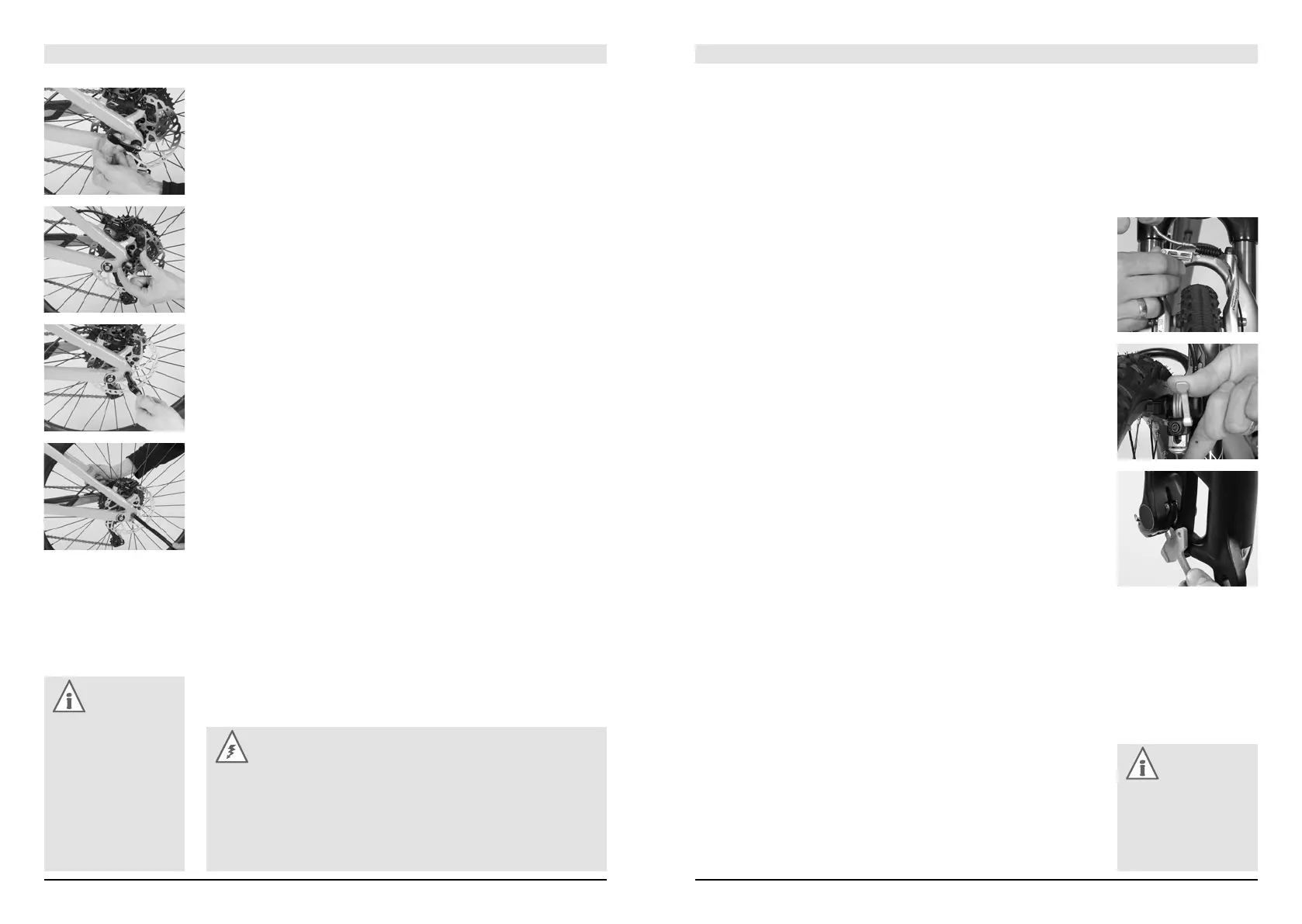
If you have a rigid thru-axle system, open the quick-release lever fully. If there
are levers, loosen the axle by turning.
Loosen all types of thru axles anticlockwise. After the thru-axle thread has fully
loosened from the nut thread, you can pull out the thru axle.
Hold the frame and the wheel tight while doing so, to ensure that parts do not
fall down or topple over.
Danger:
To mount the axle only use the tools recommended by the manufacturer.
Make it a rule to use a torque wrench. Tighten carefully by approaching
the prescribed maximum torque value in small steps (0.5 Nm increments)
and check in between the proper fit of the component. Never exceed the
maximum torque value indicated by the manufacturer! A too tight fixing of
the axle can impair the axle or the frame.



 To Next Page