S - 84 | English English | S - 85
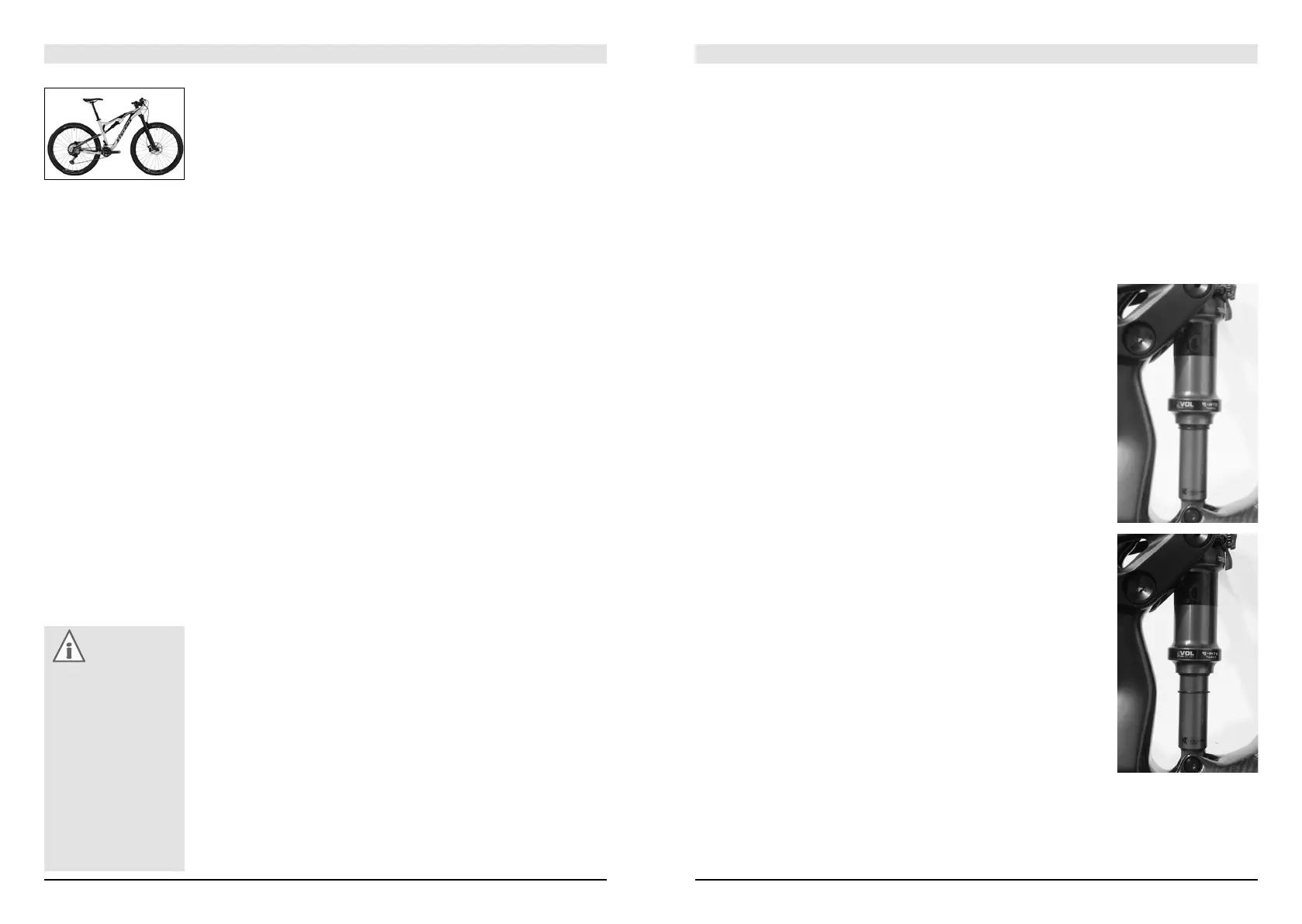
Full Suspension of the Mountain Bike Models
Full-suspension STEVENS bikes are not only equipped with a suspension fork
but also with a movable rear frame which is sprung and damped with a rear shock.
Depending on the system the rear shock has one or more suspension axes with
at least two bearings each.
Rear shocks work in general with a titanium coil, steel coil or air spring. Damp-
ing is usually controlled by the use of oil.
What to Bear in Mind When Adjusting the Saddle
Full-suspension mountain bikes yield a little when the rider sits on the saddle.
If you have trouble sitting, try lowering the saddle nose a little relative to the usual
position.
Adjusting to the Rider and the Riding Style
Rear shocks on STEVENS bicycles work with air as suspension medium. Air
suspension elements can be adjusted to the weight and the seating position of
the rider as well as to the desired spring characteristics. When your bicycle has
an air suspension element, the rear shock of your bicycle must be pumped up
before your first ride.
When doing so observe a few simple rules. The rear shock of the rear swing
arm must retract slightly to create a little sag as early as you sit on the bicycle.
When riding through a pothole the spring extends and the swing arm compensates
for the unevenness. If the spring rate or the air pressure is set too high, this effect
disappears as the bicycle is already fully sprung. This means that an essential
aspect of safety and comfort is not used.
The rear shock must be designed and set in a way that it doesn’t bottom out.
Insufficient air pressure can be felt and is usually also clearly audible in form of
hard impacts caused by the shock-like complete compression of the rear shock.
If the rear shock frequently bottoms out, it will sustain damage in the long run.
The rear shock damping regulates through valves inside the flow of oil and
thus the speed at which the rear shock rebounds and compresses. In this way it is
possible to optimise the reaction to obstacles.
In addition, it is possible to reduce the bobbing of the rear frame during pedal-
ling. For long uphill rides with hard pedalling while sitting in the saddle, it is there-
fore advisable to lock the damping almost completely. When riding downhill on
poor road surfaces it can be better to open the damping more or less completely.
Note:
Full-suspension bikes
have significantly great-
er ground clearance
than bikes without sus-
pension. With a properly
adjusted saddle height,
you will not be able to
reach the floor with your
feet. Set the saddle a
little lower to begin with
and practise getting on
and off the saddle.
Adjustment is a delicate job, as even a small change on the adjuster can
have a great effect. Try to approach the optimal setting gradually in steps or as a
maximum in quarter turn.
Adjusting the Spring Rate
Cross-country and marathon racers usually opt for a shorter sag than freerid-
ers or downhillers who often ride over rough terrain. In the case of cross-country
and marathon bikes, the rear shock should compress by about 10–25 % of its
maximum travel, in the case of enduro and freeride bikes by 20–40 %, when you
sit on the saddle.
For measurement you can use the rubber ring which is mainly positioned on
the thinner, plunging tube of the rear shock or attach a cable tie around the thinner
tube of the tube of the rear shock in a way that it can still be moved, but does not
slip on its own.
Get on the bicycle with the clothes you wear usually (if necessary with a packed
rucksack), adopt your usual riding position and lean against a sturdy object (rail,
wall etc.) so that you don’t topple over. Slide the rubber ring/cable tie against the
dust wiper on the rear shock and get off the bicycle so that the rear frame does
not compress any further.
The distance between the rubber ring/cable tie and the dust wiper is the sag.
Compare it with the total travel of the rear shock (manufacturer’s specification) to
determine whether the suspension has to be adjusted harder or softer.
The preload on most rear shocks with steel coil can be set within narrow limits
via an adjusting ring. If this is impossible and you cannot adjust the designed sag,
the steel coil must be replaced by a harder or softer model. When replacing any
parts, be sure to only use parts that bear the appropriate mark and, to be on the
safe side, original spare parts. Your STEVENS dealer will be pleased to help you.
In the case of air spring rear shocks the spring rate is set through the air pres-
sure in the rear shock. The pressure must be adjusted with a special high pressure
pump with pressure indicator before your first ride and adapted later, if necessary,
to changes of the rider's weight and/or additional load. Note the suitable setting
values and check them in the following at regular intervals. Always observe the
recommendations of the manufacturers and do not exceed the maximum air pres-
sure in the rear shock.



 To Next Page