S - 64 | English English | S - 65
Danger:
Before you set off again connect the brake cable and check whether the
brake pads hit the braking surfaces. Make sure that the wheel is properly
seated and firmly fixed in the drop-outs. After mounting the wheel make
sure that the brake pads or the rim are free of grease or other lubricants.
Be sure to do a brake test! In the case of disc brakes, make sure that the
rotor does not drag on the brake calliper or the brake pads! Inappropriate
wheel mounting can make you loose control of your bicycle and result in an
accident!
Tyre Mounting
When mounting a tyre make sure that no foreign matter such as dirt or sand
gets inside the tyre and you do not damage the inner tube.
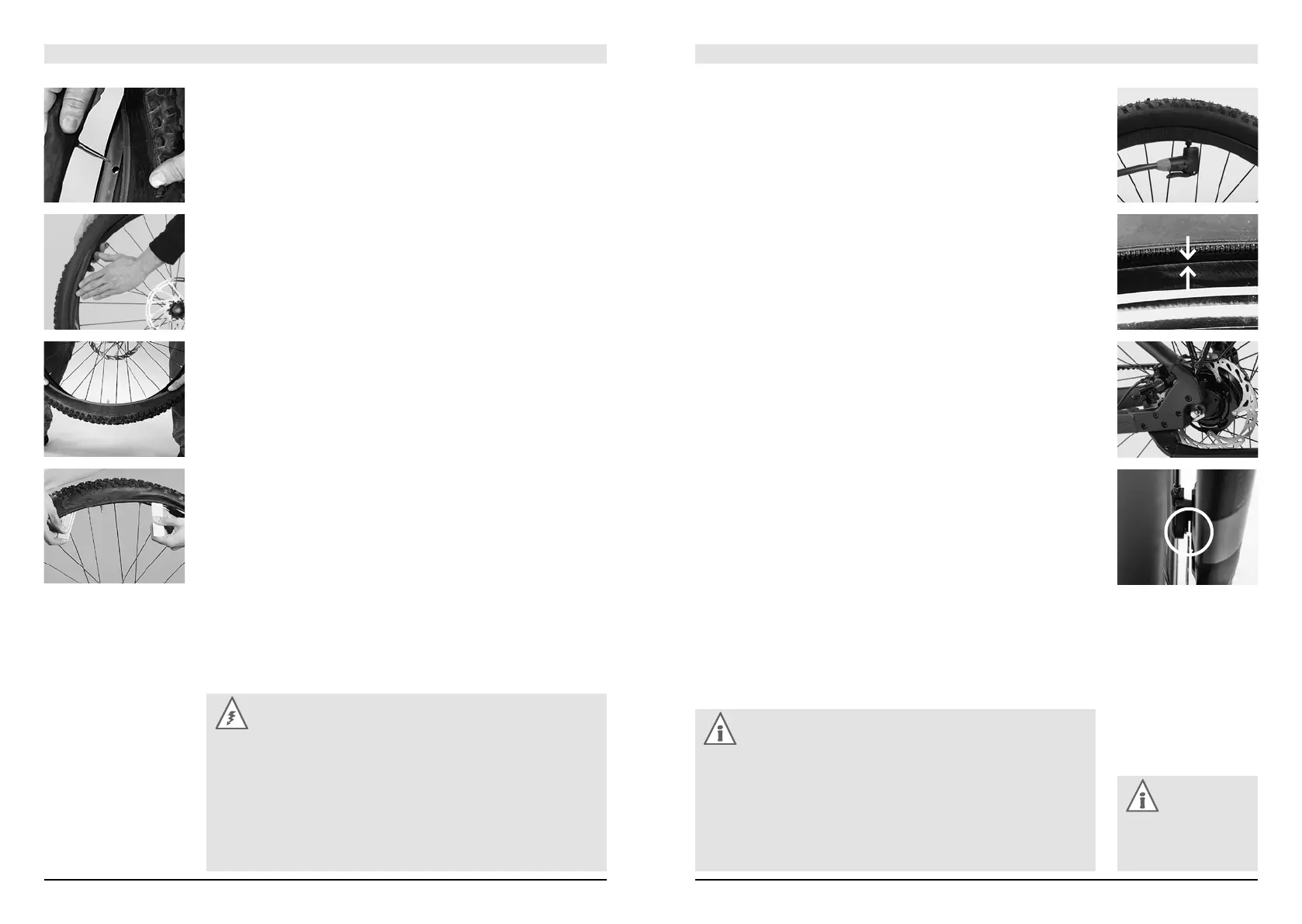
• Slip one bead of the tyre onto the rim. Using your thumbs, press the bead over
the edge of the rim over the entire circumference. You should be able to do
this without any tools, regardless of the type of tyre. Stick the valve of the tube
through the hole in the rim.
• Inflate the inner tube slightly so that it becomes round and push it into the tyre
all the way round. Make sure not to leave any folds in the tube.
• To finish mounting the tyre start at the point opposite the valve. Using your
thumbs, press the second bead of the tyre over the edge of the rim as far as
you can. Make sure that the inner tube does not get pinched and squashed
between tyre and rim. This is prevented by pushing the inner tube into the tyre
hollow with a finger as you work along.
• Work the tyre into the rim by approaching the valve symmetrically from both
sides. Towards the end you will have to pull the tyre vigorously downwards to
make the already mounted portion of the tyre slip towards the deepest part of
the rim base. This will ease mounting noticeably on the last centimetres.
• Check again the proper seat of the inner tube inside the tyre and press the last
stretch of tyre over the edge of the rim by using the balls of your thumb. It will
help you to bring the wheel to rest on your hip.
• If this does not work, you will have to use tyre levers. Make sure that the blunt
ends point towards the inner tube and the inner tube does not get damaged.
• Press the valve deep into the tyre so that the inner tube does not get caught
between rim and tyre beads. Does the valve stand upright? If not, dismount
one bead again and reposition the inner tube. To make sure that the inner tube
does not get pinched between rim and bead, inflate the tyre a little and then
move it sideways back and forth between the sides of the rim. While doing so
you can check whether the rim tape has shifted.
• Inflate the inner tube to the desired pressure. The maximum pressure is indi-
cated on the side of the tyre.
• Check the proper seat of the tyre by means of the “witness line” on the side of
the tyre just above the edge of the rim. Make sure that the witness line is even
with the rim edge all the way around the tyre.
Mounting Wheels
Mounting the wheel is generally done in reverse order to the removal. Make
sure the wheel is properly seated in the dropouts and accurately centred between
the fork legs or the seat and chainstays. Make sure the quick-release and the
possibly available safety tabs are properly seated. For more information see the
chapter “How to Use Quick-Releases and Thru Axles”.
If you have disc brakes, check before mounting the wheel whether the brake
pads rest snugly in their seats in the brake calliper body. The gap between the
brake pads and the wheel should be parallel and the wear indicators in their cor-
rect position. Make sure that you slide the rotor carefully between the brake pads.
After mounting the wheel and tightening the axle nut or the quick-release and
a thru axle, if available, pull the brake lever (several times, if you have disc brakes).
To do so lift the bicycle off the ground and spin the wheel with your hand. With the
wheel spinning the rotor should not drag along the brake calliper or the brake pads
and the rim should keep off the (rim) brake pads.
Note:
If you have any
questions, contact your
STEVENS dealer.
Note:
In addition, observe the information and the operating instructions of the
gear manufacturers. They are available on their websites:
https://support.enviolo.com/hc/en-us
www.pinion.eu/downloads
www.rohloff.de/en/service
https://si.shimano.com
https://sunrace.com



 To Next Page