S - 46 | English English | S - 47
Normally, the shifters are mounted as follows:
Right-hand shifter – rear sprockets
Left-hand shifter – front chainrings
Modern mountain bikes can have up to 30 gears. As there are, however, over-
lapping ranges, actually 15 to 18 gears are usable.
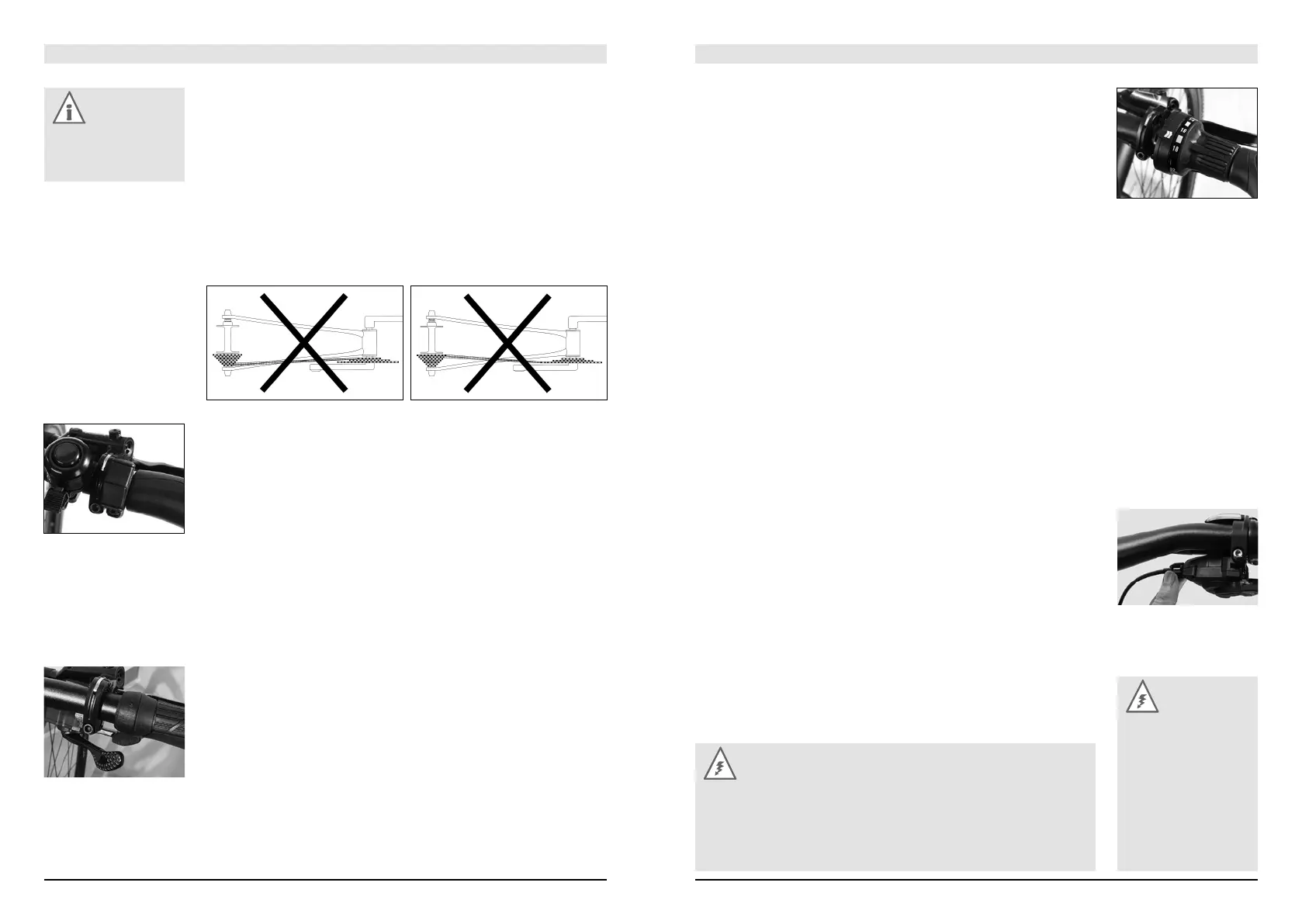
The chain should not run at an extreme angle, otherwise it wears down quickly
and efficiency decreases. An unfavourable run of the chain is when the smallest
chainring is used with one of the two or three outermost (smallest) sprockets or
when the largest chainring is used with one of the inmost (largest) sprockets.
Push-Button Shifters
Shifters in form of push-button shifters work in different ways. With most of
them pressing the large shifter moves the chain to the larger chainrings. The small
shifter located in front of the handlebars, from the rider’s viewpoint, moves the
chain towards the smaller chainrings.
This means that any gear shift made by pushing the large thumb shifter on
the right produces a lower gear, while pressing the large thumb shifter on the left
moves the chain to the larger chainring, thus producing a higher gear.
With the Shimano inverse technology this gear shift pattern for the rear derail-
leur of the Rapidfire finger shifter can be reversed and actuating the right thumb
push-button shifts on a small sprocket with a heavier gear ratio.
The Shimano Rapidfire Plus shifters work according to the usual Rapidfire
principle (see above), they offer however the possibility to operate the front “index
finger lever” with the thumb initiating the same gear shifting action as with the
index finger operation. The chain moves to the small chainring or small sprockets.
You can therefore shift either with the thumb and the index finger or only with the
thumb.
In addition, you can shift through several gears with one lever movement, i.e. a
short lever movement shifts from one gear to the next gear, whereas a longer lever
travel shifts over the next two gears.
Twist Grip Shifters
The principle of twist grips is different. Twisting the right-hand grip towards
you moves the chain to a larger sprocket giving you a lower gear, while the same
movement on the left produces a higher gear by moving the chain to the larger
chainrings.
The shifter transmits the shifting command to the rear derailleur via Bowden
cable. Then the rear derailleur swivels, causing the chain to climb onto the next
sprocket. It is therefore important when changing gears to continue pedalling
smoothly without force as long as the chain is moving between sprockets or chain
-
rings! On today’s bicycles there are, however, special guides in the chainrings which
allow for changing gears under force. Shifting gears under load shortens, however,
the service life of your chain considerably.
Furthermore, this can lead to a chain-suck, i.e. the chain can get jammed
between chainstay and chainrings. Therefore, avoid shifting gears while pedalling
with force, in particular when changing gears with the front derailleur.
Checking and Readjusting the Gears
The derailleur gears of your the STEVENS bicycle were carefully adjusted by
your STEVENS dealer before delivery. The Bowden cables may, however, give way
or compress the cable housings on the first kilometres making gear changing
imprecise. This will result in the chain not wanting to climb onto the next smaller
sprocket.
Rear Derailleur
In the case of imprecise shifting increase the tension of the Bowden cable by
turning the adjusting bolt through which it passes at the entry to the shift lever or
rear derailleur. To do so, shift to the smallest sprocket and turn the clicking bolts
anticlockwise in half turns until the cable is slightly tensioned.
After tensioning the Bowden cable check whether the chain readily climbs onto
the next larger sprocket. To find out you either have to turn the cranks by hand or
ride the STEVENS bicycle.
If the chain readily climbs onto the next larger sprocket, check whether it also
readily shifts to the small sprockets when you change to a higher gear. You may
need several tries to get the derailleur system properly adjusted.
Danger:
Practise shifting gears in
a place free of traffic un-
til you are familiar with
the functioning of the
different levers or twist
grips. If you do so in road
traffic, your attention
might be drawn off from
possible risks.
Note:
Avoid gears which
involve an extremely
oblique run of the chain.
Danger:
Shifting gears under load, i.e. while pedalling hard, can make the chain slip.
At the front derailleur the chain may even slip off the chainrings when shift-
ing under load. Furthermore, this can lead to a chain-suck, i.e. the chain can
get jammed between chainstay and chainrings. This can result in a fall. This
will at least shorten the service life of the chain and damage the frame.



 To Next Page