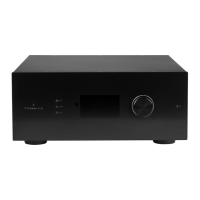
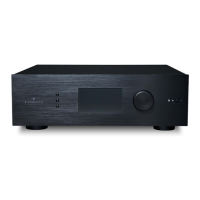
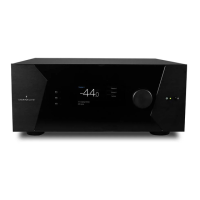
ISP Immersive Sound Processor
7
digital inputs 1-6. Stereo or surround analog
sources can be connected to the Analog Inputs
section. Analog input conguration is dened at
“4. Main Audio In” on page 12. HDMI sources can
be connected as well.
Connect to Display
Connect your displays using HDMI outputs. Note
that outputs are mirrored (same content):
• 7+2 eARC: eARC/ARC is only supported in
HDMI OUT 1, so the recommended output
to interface with a TV receiver. HDMI OUT 2
is recommended for Projector interface.
• 7+2: HDMI OUT 1 supports up to HDCP 1.4
while HDMI OUT 2 supports HDCP 2.2. Use
HDMI OUT 2 as your primary output port.
Should no picture appear on HDMI OUT 1,
troubleshoot EDID conicts.
Connect Audio Outputs
If you choose to connect your outputs at this step,
take note of which output number is routed to each
channel so that you can map them appropriately in
a later step. Otherwise, when you setup the theater
using the web UI, the default outputs will be
noted for you. At that point, you can connect your
ampliers based on the default output channel
mapping.
First Run
Upon rst run, you must congure the ISP according
to your specications using the web based user
interface. There is no on-screen display or provision
to congure the unit using the front panel.
Power On
Turn the main switch on the rear panel to the ON
position.
The front panel display will show the StormAudio
logo for a few seconds, then will go blank as the
ISP enters sleep mode. The power LED will show
steady red.
Once in sleep mode, press the front panel POWER
button. The ISP will begin the startup sequence.
During the Initialization process (about 30s) the LED
will blink green until the unit is ready with a steady
green LED. Initialization process can be shorten at
the cost of more standby power consumption. See
“Settings” on p28 to adjust this.
Get Network Access
Press and hold the EDIT button for about 3 seconds.
The display will show a list of information including
the IP address at the top which was assigned by
DHCP. Note this address.
Note: In case the unit is not in DHCP mode, and you need to
restore DHCP mode from the front panel, follow the above
steps, then press and hold EDIT for a few seconds more until
a message appears asking for conrmation of this action.
Conrm by pressing the ENTER button
Using a web browser on a device (laptop preferred)
on the same network, enter this IP address in the
address bar of your web browser.
Note: Only one instance of control via web UI can be opened
at a time. If a window is already accessing the I.ISP web UI, a
message will ask you to close one. Browsers supported: Edge
(Windows), Safari (macOS) and FireFox, Chrome (Windows,
macOS et Ubuntu). Others might show issues.
The ISP home page will be shown.
Selecting Remote Control will give access to the
end user remote control functions. No setup
parameters can be changed here.
Select Expert Setup to gain access to the setup
portion of the web UI.
Default Passwords
Note: In case you have forgotten the Expert User or Installer
password, it is possible to reset them to the default values
by rst accessing the Info screen (see “Get Network Access”
on page 7). Then press and hold EDIT and EXIT buttons
together. Press ENTER to conrm when prompted.
The Expert Setup area has two levels of access:
Expert User and Installer. Expert user gets access
to portions of the menu dened by the installer.
Installer gets full access to setup. Use this level to
perform the conguration.
The default password for full access to the setup
menu is ‘installer’. Enter the password and press
connection to enter the setup menu. Default
password for Expert User is ‘expert’.


 To Next Page