rev. 08.15.2006.
3-34
parameter change screen, hit the “ESC” button to go to the next screen. When you modified all the required values,
you have to hit the ESC button until you get back to the operational mode screen.
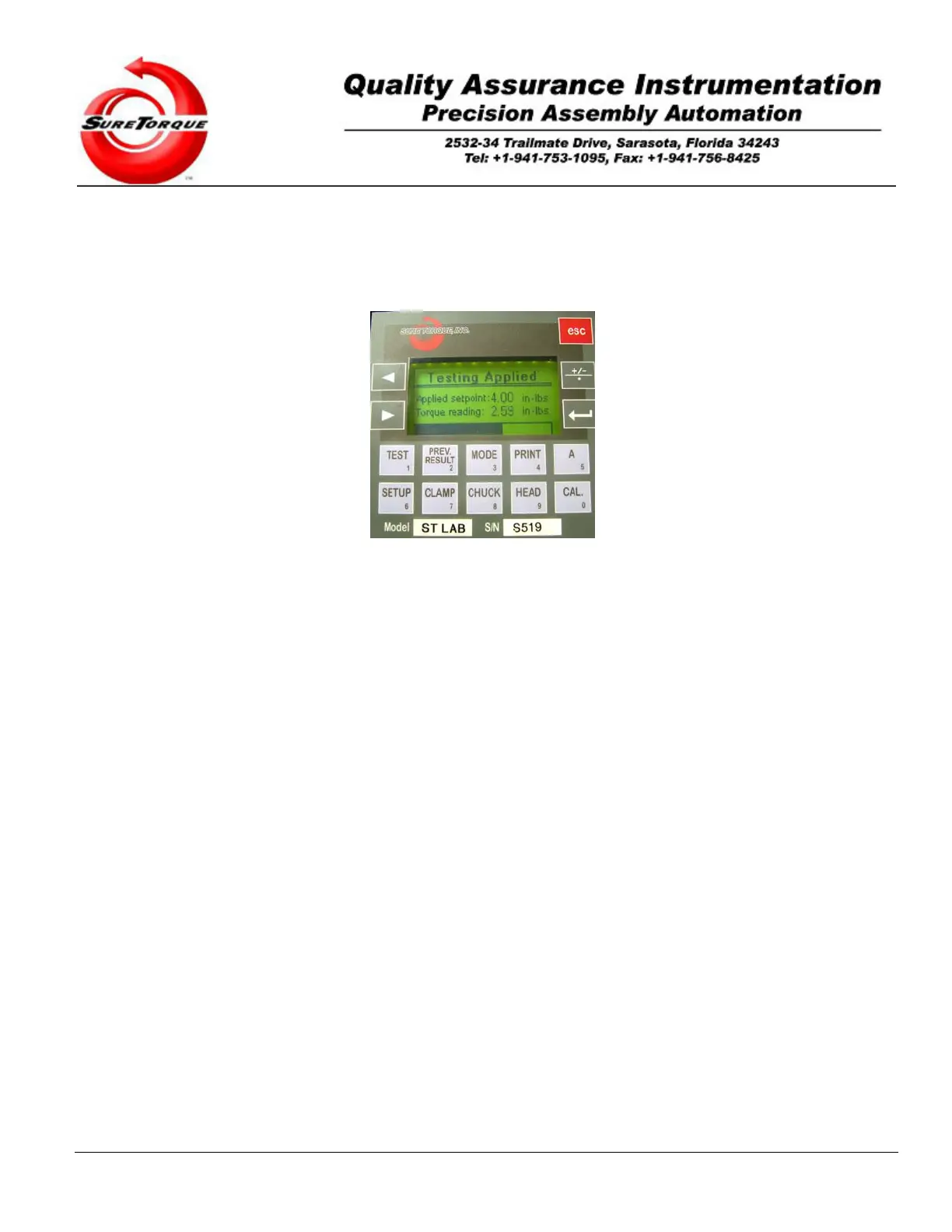
On the mode screen just press and hold down the start button(s) until the chuck closes, and it will initiate the test
cycle. It is not necessary to hold down the start button when the safety feature is not enabled, or the tester is not
equipped with the dual activation safety start button(s) option. When the test is running there are a real-time digital
torque readout and a progress bar showing the applied torque throughout the test.
At the end of the test cycle, the “completed” screen will appear holding the applied torque until you press “ESC”,
which takes you back to the operation mode screen, where the test was initiated. Pushing the start button(s) on either
the completed screen or the mode screen will run the same test again.
3.3.3.3. Release Mode
This test method is used to determine the initial release torque of a closure. The sensitivity of the release torque
measurement depends on the release fallback value. The release fallback value is used to determine the end of the
measurement cycle after reaching a peak torque. If the torque decreases by the fallback value from the peak torque,
the torque tester will finish the actual test and show the torque value where the fallback was sensed on the completed
screen. As it was stated previously the fallback value directly affects the sensitivity of the measurement. The release
fallback value is used in all the off-torque modes to determine the initial, the highest or the local release torque values.
In the standard release torque mode upon reaching the immediate release torque, the chuck stops rotating, then
opens, then the container is unclamped for operator removal.
In the optional special release torque mode - where the torque tester measures the initial opening torque on
special CR closures, upon reaching the first drop in the release torque, the tester will continue the rotation and look for
a next drop in the torque to validate the previously measured release torque as the real initial release torque. If there is
another drop in the release torque, the previous drop was generated by the engagement of the CR cap outer and inner
caps, and determined to be a false readout. When there is no other drop throughout the release cycle, the first drop is
validated as the real initial release torque and at the end of the rotation the chuck opens, then the container is
unclamped for operator removal.
Optional Modes
The base ST-Lab comes with the standard application and release modes. All other measurement methods are
optional, some of them may be unlocked after purchasing the unlock code, others need hardware modifications as
well. Optional hardware modules may be required for example the 8000 cpr rotation encoder or the topload
transducer for topload measurement and torque-angle monitoring/controlling.
3.3.3.4. Multiple Applied Mode
The only difference compared to the “Applied Mode” is that the torque tester applies the set point torque as many
times as it is set in the “number of cycles” variable. This method may be used to test how does the multiple
reapplication affect the removal torque.


 To Next Page