rev. 08.15.2006.
3-36
3.3.3.13. Sealed closure torque testing methods
After analyzing your closure we can write the best torque testing algorithm for you to test special sealed closures.
3.3.3.14. Precision Applied and Release tests
Special tests have been developed by Sure Torque to test or precisely apply torque on syringes, vials and these
tests may be used in other low torque range applications, as well. The precision release test may be also used on CR
caps, too. In the optional special release torque mode – it mainly used to test the initial opening torque on special CR
closures, upon reaching the first drop in the release torque, the tester will continue the rotation and look for a next drop
in the torque to validate the previously measured release torque as the real initial release torque. If there is another
drop in the release torque, the previous drop was generated by the engagement of the CR cap’s outer and inner caps,
and determined to be a false readout. When there is no other drop throughout the release cycle, the first drop is
validated as the initial release torque and at the end of the rotation the chuck opens, then the container is unclamped
for operator removal.
3.3.3.15. Topload measurements
One of the most forgotten questions regarding to torque testing is the effect of the topload force on the cap. There
are thread/closure designs where the removal/applied torque is highly affected by the force pushing down on the cap.
We can upgrade the ST-Lab with the topload option, and let you run torque measurements where the topload force is
kept on the same level, providing accurate topload independent readouts. We can also sell you measurement
methods, checking the thread friction torque at different topload force levels. Although these tests are mainly useful
for closure designers, it is also a good idea to check a cap design with a topload equipped torque tester before buying
thousands/millions of them. The topload option is also a must to properly test child resistant caps, for example the
Reverse Ratchet torque, and the shelling force. It is also useful to determine the “pull-apart” force, or the maximal
topload force of a container.
3.3.4. Historical Data Screens
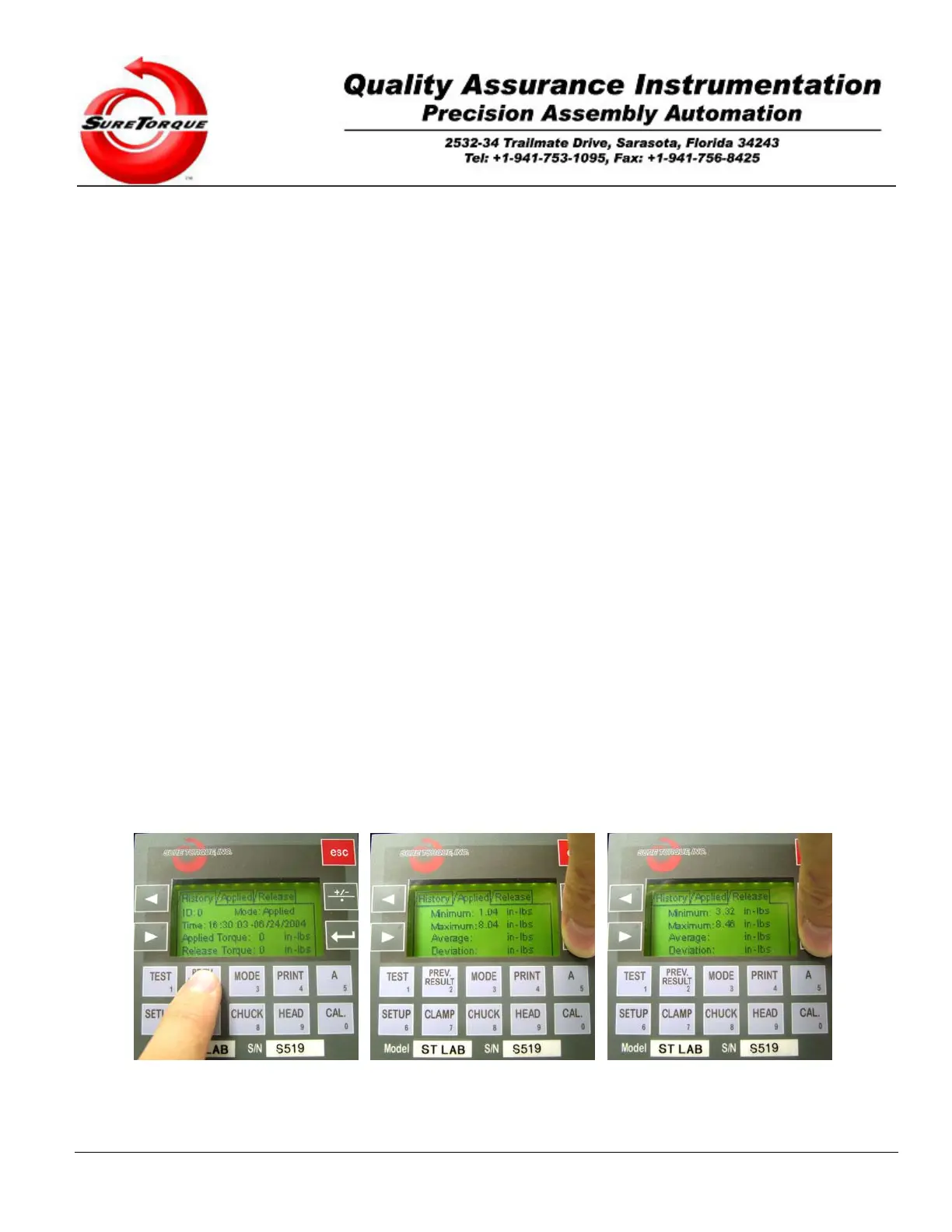
Press the PREV. RESULT button on any of the operational mode screens. It will forward you to the statistical
screens when the historical feature is enabled. On these screens you may navigate between historical measurement
records. In release modes the tested and found to be loose caps are registered with 000.0 lbfin torque value, while
the caps where the release fallback was not sensed below the pre-defined torque limit will be registered with 999.9
lbfin. On the first historical screen, the ARROWS may be used to navigate between records, but on the second
screen the same button is used to see the statistics of the different measurement modes. It calculates the Minimum,
Maximum, Average and Standard Deviation values of the captured measurement data. ESC is used to jump forward
to the next screen. The third screen is reserved for customer specific statistics.


 To Next Page