rev. 08.15.2006.
1-12
1.1.2.1. Stand Assembly
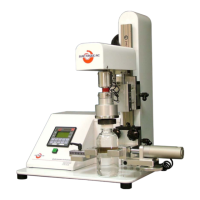
The Base is an aluminum fixture which supports the Container Platform, Clamp, Chuck, and ST-LAB Control
Head Assembly. The stand has a wide stable base to minimize motion during the test cycle, and a rugged main
support post on which the neck clamps and the chuck platform is attached. The neck clamps manually raised or
lowered to accommodate the different container / bottle heights and locked into position by a “quick-release” half-turn
locking handle.
On top of the stand’s Main Column (slide or support post) is the ST-LAB’s Main Head Assembly, which contains
all of the main pneumatic and force-sensing components required for the actual torque testing function operations.
The base of the control head assembly is a solid aluminum plate, which acts as a sturdy mounting surface for all
these components. The cover of the control head is removable for component cleaning, servicing and calibrating.
1.1.2.2. Chuck Assembly
The Chuck is the mechanical component, which holds the Collet that “grasps” the various closure devices, and
transmits the force to actually remove the closures. Both the “grasping” and the “turning” forces of the Chuck are
applied pneumatically, via electronic control. The Chuck rotates on a shaft, actuated by the pneumatic Test Cylinder
located in the Main Head Assembly. This Test Cylinder applies the required force to perform all torque-test functions.
1.1.2.3. Change-Parts
Each different container and closure “combination” requires a different set of change-parts, (please refer to the
Machine Tuning Sheet for the required change-parts for the particular container/closure combination being tested).
The change-parts, (or tooling package), for the basic ST-LAB consists of:
a. Container Base Clamp (when applicable) holds the container’s base.
b. Container Neck Clamps which hold the container’s neck as close to the closure as possible.
c. Closure Collet, which actually “grasps” the closure during the test cycle.
1.1.2.4. Pneumatic Assembly
Understanding the Pneumatic Assembly and its components is the key to understanding your ST-LAB Sure
Torque system and receiving optimum production and maintenance free operation from your unit. Please refer to
Figure 1-3, ST-LAB Pneumatic Diagram.
The pneumatic components control these 4 major Sure Torque functions:
1. Holding the container, (the Clamp function).
2. “Grasping” the closure, (the Chuck function).
3. Raising and lowering the Platform.
4. Activating the Test Cylinder to apply or remove the closure.
The Pneumatics Operational Philosophy is as follows:
Air pressure is applied to the ST-LAB through a panel-mounted regulator. ST offers an optional filter package for
those locations, which do not have a clean air supply.
The central air supply is then distributed via an inlet manifold to four regulators, which individually control the air
supply to the four main operation functions listed above. The manifold air supply is also monitored by a pressure
switch that will warn the Sure Torque operator if incoming air supply falls below a preset value. The air pressure is
sent directly to the Platform, Clamp, and Chuck air valves, which control the air cylinders that activate these
components.
The air pressure to the Test Cylinder, however, is first routed to a special electronic regulator, and a small
cylindrical storage reservoir. The electrical regulator is an electrically operated, pneumatic control device that utilizes
a variable electronic input signal to control a pneumatic output pressure. The input voltage to the electronic regulator
is steadily increased, producing an increase in the output pressure to the Test Cylinder, thus increasing the Chuck
torque for both the applying and releasing of closures. This output pressure is not affected by changes in input
pressures that may occur from normal plant air variations.


 To Next Page