UNIMASTER
3
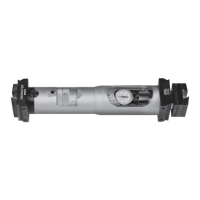
The UNIMASTER is a direct measuring, mecha-
nical instrument, for checking the dimensions of
large workpieces. Internal and external sizes up to
several metres can be measured. The UNIMASTER
consists of two principal components:
– The measuring head and the extensions.
– The measuring head comprises a micrometer
system coupled to a plunger, the displacement
of which is shown by a dial indicator.
– Each extension piece houses a built-in gauge
rod, and the extensions are joined firmly to each
other and to the measuring head by snap rings.
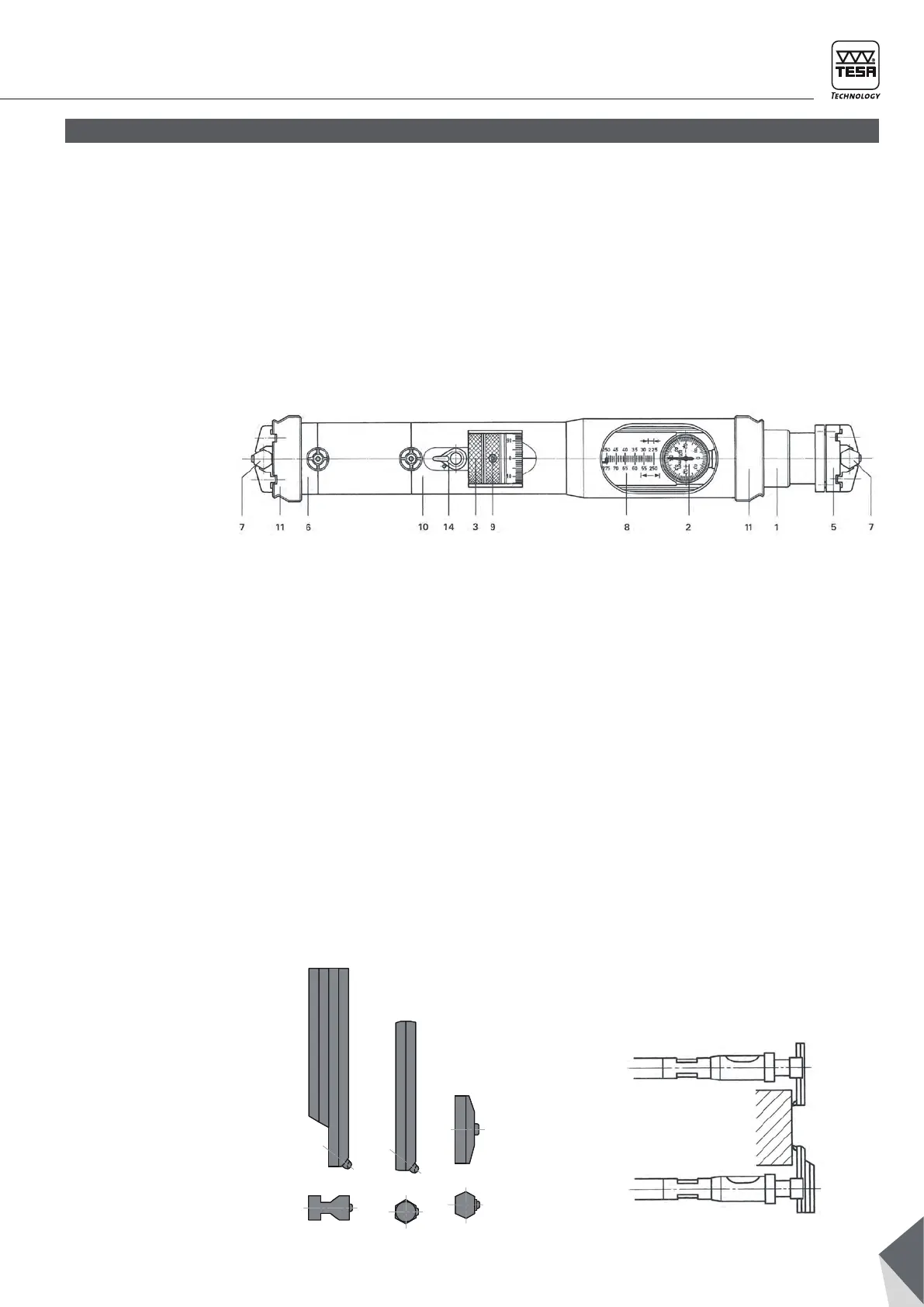
The plunger (1) of the measuring head is guided in
ball bushings. The plunger displacement is trans-
mitted to the dial indicator (2) through a shock-ab-
sorbing mechanism. When measuring, the contact
surfaces are applied to the workpieces (8) by move-
ment of the 1 mm pitch micrometer screw, and the
actual size is read off on the graduated barrel (3).
The measuring range of the micrometer screw is
25 mm. The mobile stop (5) and the fixed stop (6),
which carry the measuring arms (7), are situated at
The UNIMASTER can be used for measuring inter-
nal dimensions from 250 mm upwards, and for ex-
ternal dimensions from 225 mm. To adapt, simply
turn the screw in the gauge head, so that the spring
which applies the measuring force acts in the op-
posite direction. The hexagon section measuring
arms are gripped in clamps, and can be adjusted to
a convenient height.
1 GENERAL DESCRIPTION
Before using, the measuring head is calibrated se-
parately with the setting gauge supplied, then the
instrument is completed by fitting the number of
extension pieces required. In use, the measuring
head is swung in a small arc back and forth across
the contact point on the workpiece, until the needle
on the dial gauge shows the correct positioning of
the instrument. To determine the exact dimension,
the graduated barrel is then rotated to bring the
needle to the zero mark, and the size is read off on
the barrel.
either end of the measuring head. The instrument
is made up to the required length by adding exten-
sions; these are joined to each other and to the mea-
suring head by snap rings, and form a rigid, robust
assembly. Each of these tubular extensions houses
a gauge rod, mounted un supports. The faces of
the outer tubes are parallel, and those of the gauge
rods – one flat, the other spherical – are tipped with
tungsten carbide. Adequate contact between rods
and micrometer system is ensured by springs.
The standard UNIMASTER set includes three
pairs of measuring arms, all with tungsten carbide
contact faces:
– For internal measurement, with spherical contact
faces, coaxial to the instrument axis.
– For internal/external measurement, offset for
measuring up to 60 mm from the instrument
centreline.
– For external measurement, specially reinforced
and offset, for measuring up to 85 mm from the
instrument axis. Other measuring arms can be
supplied on request.
Fig. 1.
Fig. 2. Fig. 3.




 To Next Page