REVUE THOMMEN AG
CH-4437 Waldenburg
AD20 Standby Altimeter
Page 33 of 72
07-Sep-2009 Document No: AD-INSOP-800 Revision: 1.6
2.4.3 Failure Modes
2.4.3.1 Fault Code Handling Overview
There are three types Failure Modes:
Critical Failures Mode (ref. also to 2.4.3.3 on page 35):
It requires an immediate shutdown of the instrument in any case.
Non Critical Failures Mode (ref. also to 2.4.3.2 on page 34 )
It degrades the operation of the instrument but allows a safe operation of the instrument functionality.
When failure is detected detection during startup BIT a shutdown of the instrument is required.
Tolerable Failures Mode (ref. also to 2.4.3.2 on page 34)
It is not critical for the normal operation of the instrument so there is no requirement of shutting down
of the instrument, in any case.
The detected failures modes are stored / saved in the instrument’s BIT history for retrieval during
maintenance and repair. Critical Failures require depot level maintenance in any case. The initiated
BIT (TEST button pushed) function can be performed by flight crew or maintenance personnel if any
failure occurs, to perform the self test function of the instrument.
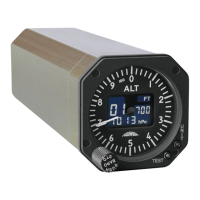
If AD20 Standby Altimeter has a failure detected, the failure will be displayed by the indication of
word “Err” on the display which can stop its operation. Even the warning flag valid output discrete
(WFVOUTD) can indicate an error.
The display of failures at the LCD and the reaction of the pointer and the operation mode of the
instrument in case of fault indication shall be according to the following definition:
Failure Class BIT Action Display
critical
Startup
Initiated
Continuous
- Warning Flag Valid discrete output is set to
invalid
- ARINC 429 communication shall mark all labels
as “failure warning”
- Pointer is stopped at its current position
- Failure Code is stored and displayed (Fxx)
- instrument is set to idle mode
(ref. to 2.4.3.3 on
page 35)
non critical
or tolerable
Startup
Initiated
Continuous
- Warning Flag Valid discrete output is set to
invalid as long as the Fault exists
- ARINC 429 communication shall continue
operation, invalid labels shall be marked as
“failure warning”
- Failure Code is stored
- ‘Err’ indication shall be intermittent
(ref. to 2.4.3.2 on
page 34 )
Table 2-11 Fault Code Handling


 To Next Page