3.7 Backfeeding
3.7.1 Introduction
Backfeeding is sometimes also called backflow. Backfeeding is an unintentional and irregular flow
of current mainly over the signal path. It can happen if interfaces are crossing different power
domains. Backfeeding can happen between circuit blocks powered by or switched by different
power rails (power domains) and thus transitioning through different power states over time. A
domain that is still powered can feed another power domain. This can lead to residual voltages on
a power rail that is supposed to be turned off.
The most obvious consequences of backfeeding are increased power consumption, unexpected
behaviors, failing power-on resets, and in the worst-case, damages of interfaces. This section
discusses why backfeeding occurs, how it can be identified, and potential preventions of
backfeeding in a Colibri carrier board design.
Interfaces that are prone to backfeed are UART, RS232, VGA, HDMI, and I2C. Therefore, special
attention is required to these interfaces when designing a carrier board for the Colibri module.
3.7.2 What is Backfeeding
Backfeeding is sometimes also called backflow. To understand what backfeeding is, we need to
look at the internal circuit of an input pin. Most Colibri module pins (and also peripheral device
input pins) feature ESD protection diodes. These protection diodes provide basic protection for
electrostatic discharge. Depending on the SoC and peripheral devices, the pins are typically only
protected up to 1kV (Human Body Model) or 250V (Charged-Device Model). This means additional
ESD protection is still needed for signals that are exposed to the real world. The basic ESD
protection is usually accomplished with two (Schottky) diodes. One diode is between the pin and
the ground, and a second between the pin and the power rail of the I/O block (IO rail). These
diodes are the reason why for a lot of IO pins, the absolute maximum voltage is specified as
VDD+0.3V.
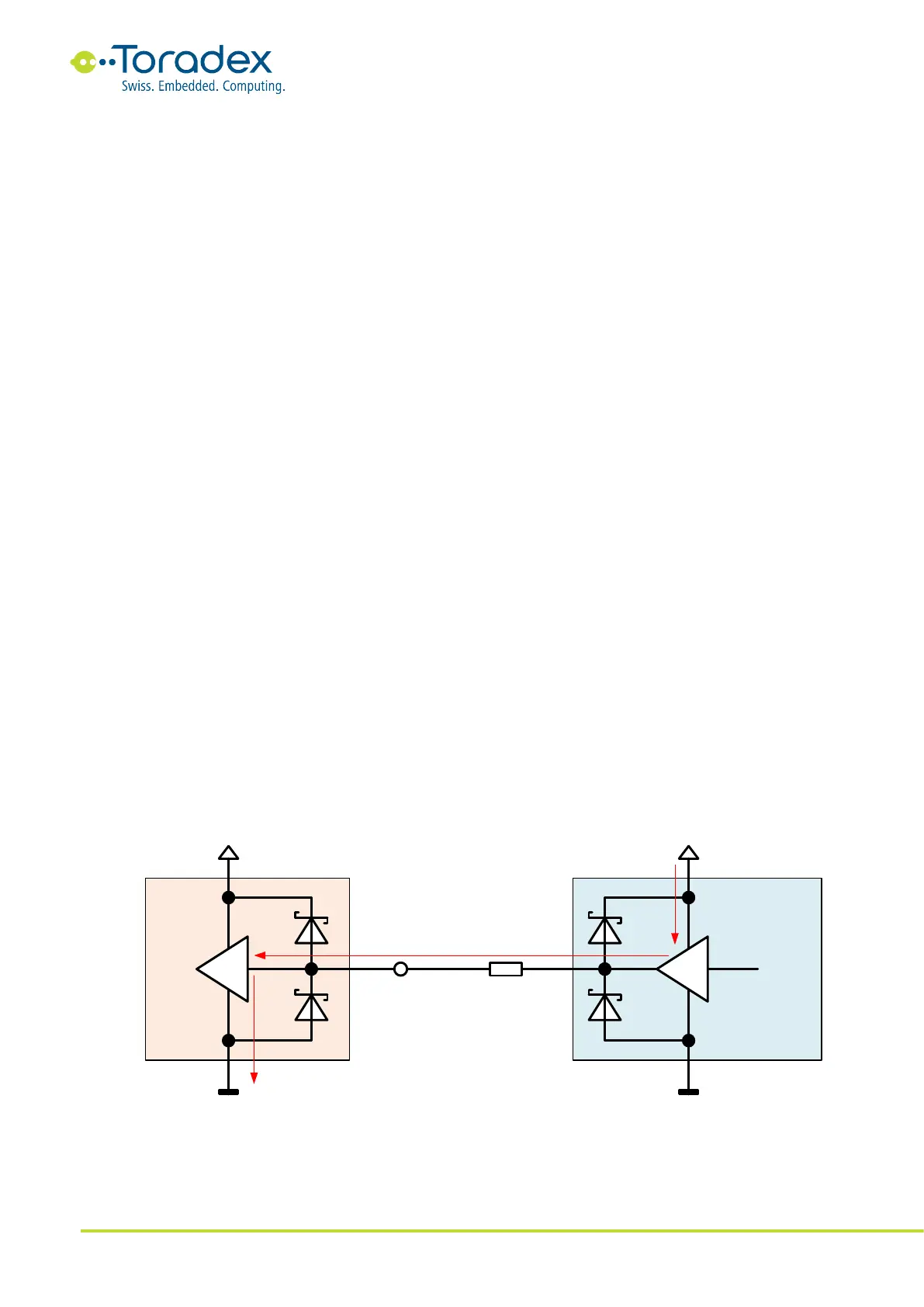
Figure 32 shows a typical low-speed SoC input pin with ESD protection diodes. If the IO rail and
the peripheral rail are turned on, these ESD diodes are not conducting. The diodes can basically be
ignored. There is a small current flowing from the peripheral output to the input buffer of the SoC.
This is not backfeeding. This is a regular signal current.
Figure 32: SoC input pin with ESD protection, both power rails on
But what happens if the on-module IO rail is turned off while the peripheral rail is still on and the
peripheral signal is set to high? In this situation, there is a non-marginal current from the output
buffer of the peripheral interface into the SoC input pin. Since the IO rail is turned off, the upper
ESD protection diode of the input pin becomes forward-biased. The current flows through the



 To Next Page