3.7.5.9 Non-Backfeeding Buffer
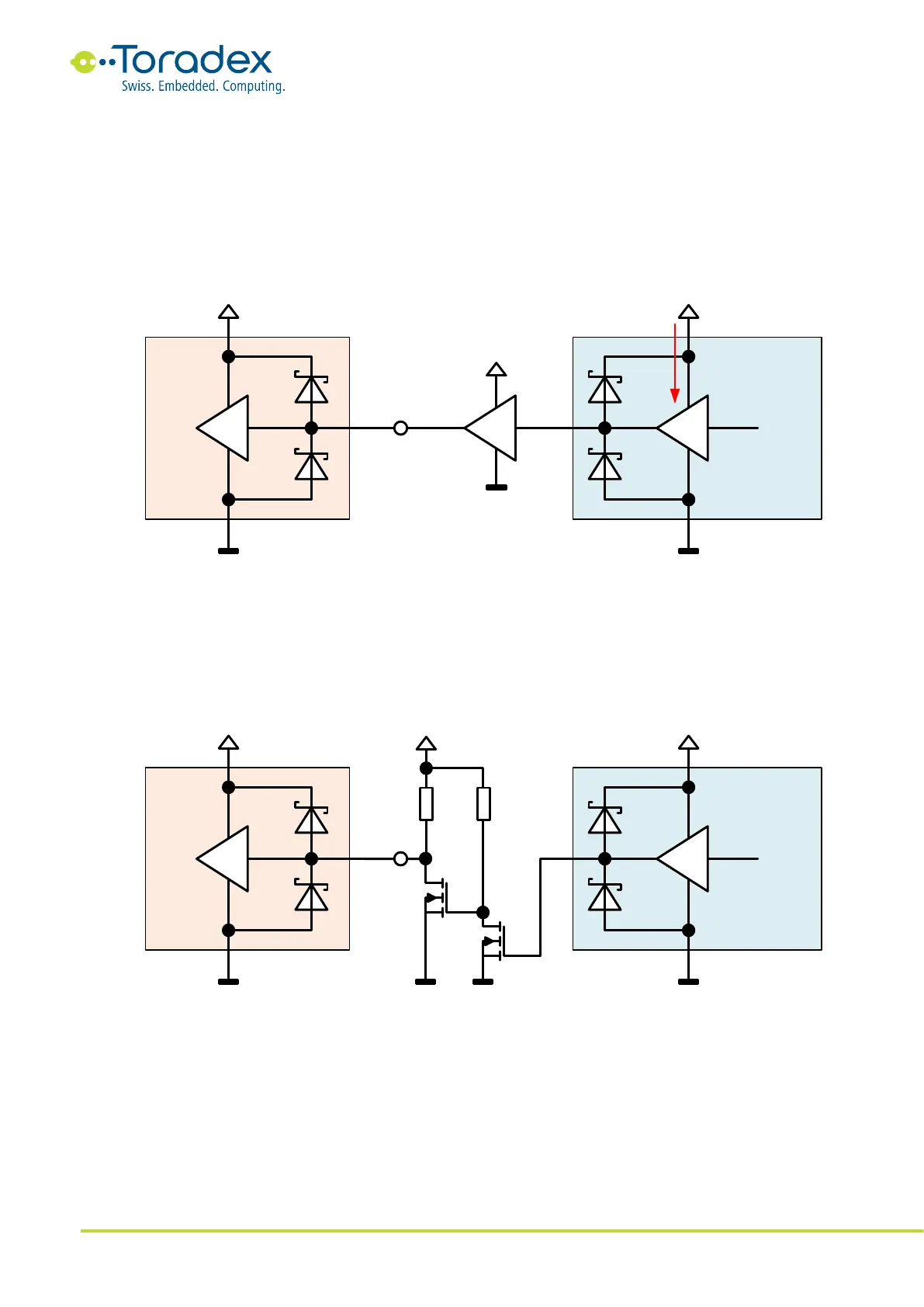
Placing an additional buffer in the signal path can prevent backfeeding. The buffer needs to be
powered from the same domain as the rail of the input. If the Colibri module is the signal input,
using a power rail that is switched by a module GPIO as the buffer's power supply is advised.
Noteworthy, the buffer should not have an ESD protection circuit at its input that allows for
backfeeding. Otherwise, the signal would back feed to the module domain, and the whole circuit
would lose its purpose.
Figure 50: Non-backfeeding buffer
3.7.5.10 Dual-FET circuit
For low-speed signals, two transistors and two resistors can be used for blocking backfeeding. The
first transistor is inverting the signal, while the second one makes it an open-drain type. Make sure
the pull-up resistors are on the input IO rail. Instead of using two transistors, it might be possible
to invert the signal in software and use only a single FET.
Figure 51: Dual-FET circuit



 To Next Page