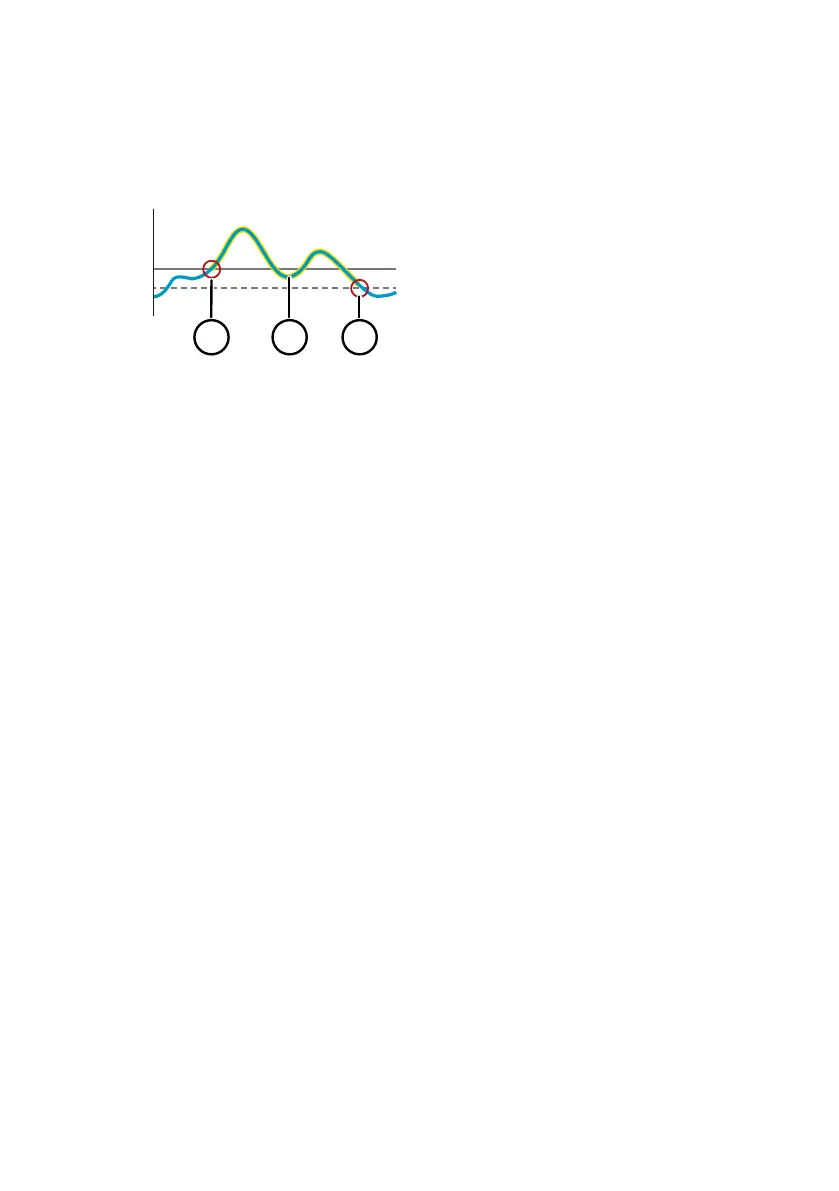
When hysteresis is used, the relay activates at the defined limit, but does not switch o
immediately when the measurement moves back to the other side of the activation limit.
Instead, with hysteresis, the relay remains active until the measurement crosses the relay
activation/deactivation limit and the additional buer value.
Figure 19 Behavior of relay that activates
above limit, with hysteresis
1 Measurement goes above the relay
activation limit (solid line —) and the
relay activates.
2 Measurement falls below the activation
limit, but stays above the hysteresis
limit (dashed line - - -). The relay
remains active.
3 Measurement falls below the hysteresis
limit and the relay switches o.
6.1.3 Relay activation and hysteresis examples
Figure 20 (page 36) shows examples of dierent relay setpoint options, ranging from only
one setpoint to dierent combinations of "above" and "below" setpoints. The eect of
hysteresis is also described in the examples.
Chapter 6 – Configuring relays
35




 To Next Page