Recipes
The recipe function may be needed in special applica-
tions where the measuring conditions vary so much
that they cannot be covered with just one calibration.
These changes may be for example
– large changes in total solids content that go outside
the measuring range of the device (±9…±15%, de-
pending on sensor type),
– a change in the measured material, when the total
solids content sensitivity of the materials is very dif-
ferent, or
– a large chemical change (e.g. different chemical
type) that cannot be covered by chemical compens-
ation.
In such cases the device is calibrated and configured
separately for each different set of process conditions,
and these are then saved as separate recipes.
Each recipe can have its own total solids content
calibration, chemical compensation, temperature com-
pensation correction, sensitivity correction, and current
output scaling. Up to four recipes can be stored in the
device.
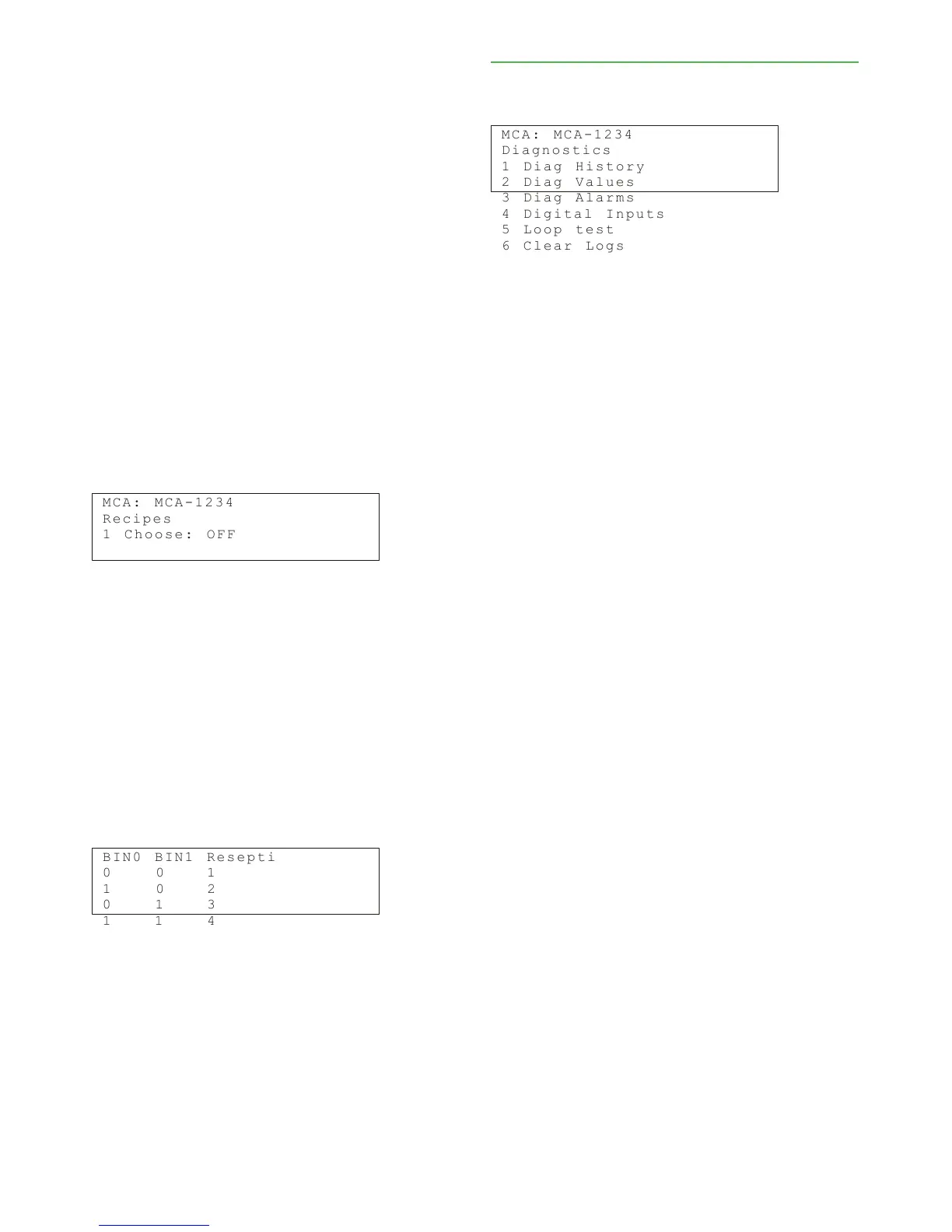
The "Recipes" menu looks like this:
M C A : M C A - 12 3 4
R e c i p e s
1 C h o o s e : O F F
In field "Choose", set the required recipe. Alternat-
ives:
– OFF: recipe function is not in use (default),
– 1, 2, 3, 4: choose the recipe number,
– BIN: recipe selection with binary inputs.
Choose a recipe, then calibrate the device and scale
the current output for the recipe. Take the other recipes
into use in the same way.
When the setting "BIN" is used, connect for example
digital control lines from the mill system to TCU's binary
inputs BIN0 and BIN1, their ground to input BINGND.
Choose the recipe with the binary inputs as indicated
in the following table.
B I N 0 B I N 1 R e s e p t i
0 0 1
1 0 2
0 1 3
1 1 4
12.5. Diagnostics
The "Diagnostics" menu contains the following func-
tions:
M C A : M C A - 12 3 4
D i a g n o s ti c s
1 D i a g H i s to r y
2 D i a g V a l ue s
3 D i a g A l a rm s
4 D i g i t a l I n p u t s
5 L o o p t e s t
6 C l e a r L o gs
Diag History: The ten most recent self-diagnostics
alarms, with beginning and ending times.
Diag values: Measured values of the diagnostics
variables (see section 8.2).
Diag Alarms: Alarm limits of the diagnostics variables,
and setting alarms on and off (see section 8.3).
Digital Inputs: Status of TCU binary inputs BIN0 and
BIN1.
Loop test: Forcing the output signal to a certain value.
Master Reset: TCU reset. Similar to powering off, does
not erase calibration.
Status, Status nxt: Status of diagnostics variables
(alarm on / off).
Installation & Owner's manual, OUL00489 V2.3 EN
46
Valmet Total Solids Transmitter


 To Next Page