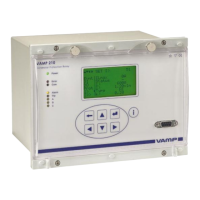
VAMP Ltd
Motor protection relay
Technical Description
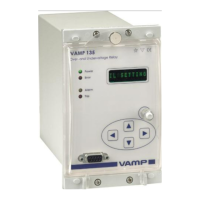
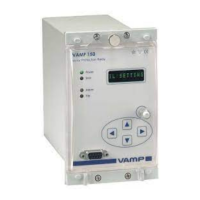
VAMP 150
VM150.EN005 Vamp 24h support phone : +358 (0)20 753 3264
3
1. Introduction
This part of the manual describes the protection functions,
provides a few application examples and contains technical
data. This part of the manual also includes the operating
instructions.
Mounting and Commissioning Instructions are provided in a
separate mounting and commissioning manual
(VMMC.EN0xx).
1.1. Application
The versatile basic protection functions, the wide variety of
additional functions and several available communication
protocols render the motor protection relay VAMP 150 an ideal
protection relay for circuit breaker controlled three phase
asynchronous motors.
The modern technology in association with an extensive self-
supervision system and a reliable construction ensures an
extremely high availability for the VAMP 150 protection relay.
The relay is used for internal short circuits faults, internal
earth faults, unbalance single phasing, incorrect phase
sequence, overload protection and too frequent starting. The
relay includes also an undercurrent function to protect the load
driven by the motor e.g. a pump.
The relay is further provided with a mA output for measuring
the load current. As an option the relay can be provided with
an arc detection system, which in combination with the
extremely fast overcurrent stage forms a fast arc protection
function.
1.2. Main features
•
Fully digital signal handling with a powerful 16 bit micro
processor and high measuring accuracy on all setting
ranges due to an accurate 12 bit A/D conversion technique.
•
Easy enabling and disabling of protection functions
according to the needs of the intended application.
•
Wide setting ranges for the protection functions.
•
Flexible external control and blocking possibilities due to
the digital signal control input (DI).


 To Next Page