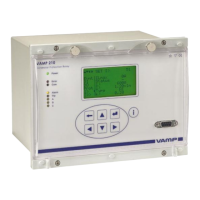
VAMP 150 Motor protection relay
Technical Description
VAMP Ltd
30
Vamp 24h support phone : +358 (0)20 753 3264
VM150.EN005
3. Application examples
3.1. Using the alarm of T> stage for restart
inhibition
It is useful to inhibit the starting of a motor in case the start
would lead to an immediate trip by the thermal protection
stage. By setting the Θ
ALARM
properly the signal given by the
temperature alarm can be used to inhibit this kind of starts.
See Figure 3.1-1 and curves 4 and 5 in Figure 3.1-2.
Figure 3.1-2 shows an example of how the temperature is
calculated from the measured current. The events in this figure
are:
•
10 minutes
The motor is started for the first time after a long off time. The
simulated temperature starts to rise from 0% proportionally to
the square of the current and to the given time constant τ.
After some tens of seconds the current stabilizes to value I
load
and temperature starts to approach Θ
load
(curve 1). The given
time constant τ is used because the current exceeds I
STOP
.
•
15 minutes
The motor is switched off and temperature starts to approach
0% now using the prolonged time constant k
τ
x τ (curve 2).
•
20 minutes
The motor is started again. The temperature starts to rise
using the time constant τ. After some tens of seconds the
current stabilizes to value I
load
and temperature starts to
approach Θ
load
(curve 3).
•
25 minutes
The motor is switched off and temperature starts to approach
0% now using the prolonged time constant k
τ
x τ (curve 4).
•
30 minutes
Starting of the motor is inhibited, because the temperature is
at the moment above the setting Θ
ALARM
. Starting now would
raise the temperature well above the trip level Θ
TRIP
= 100%
(curve 5).
•
38 minutes
Starting of the motor is possible again because the temperature
is now below the setting Θ
ALARM
. A start at this moment would
rise the temperature near the trip level
Θ
TRIP
= 100% but not
over it.


 To Next Page