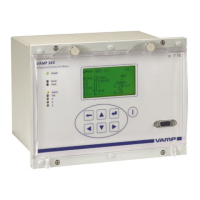
VAMP 150 Motor protection relay
Technical Description
VAMP Ltd
20
Vamp 24h support phone : +358 (0)20 753 3264
VM150.EN005
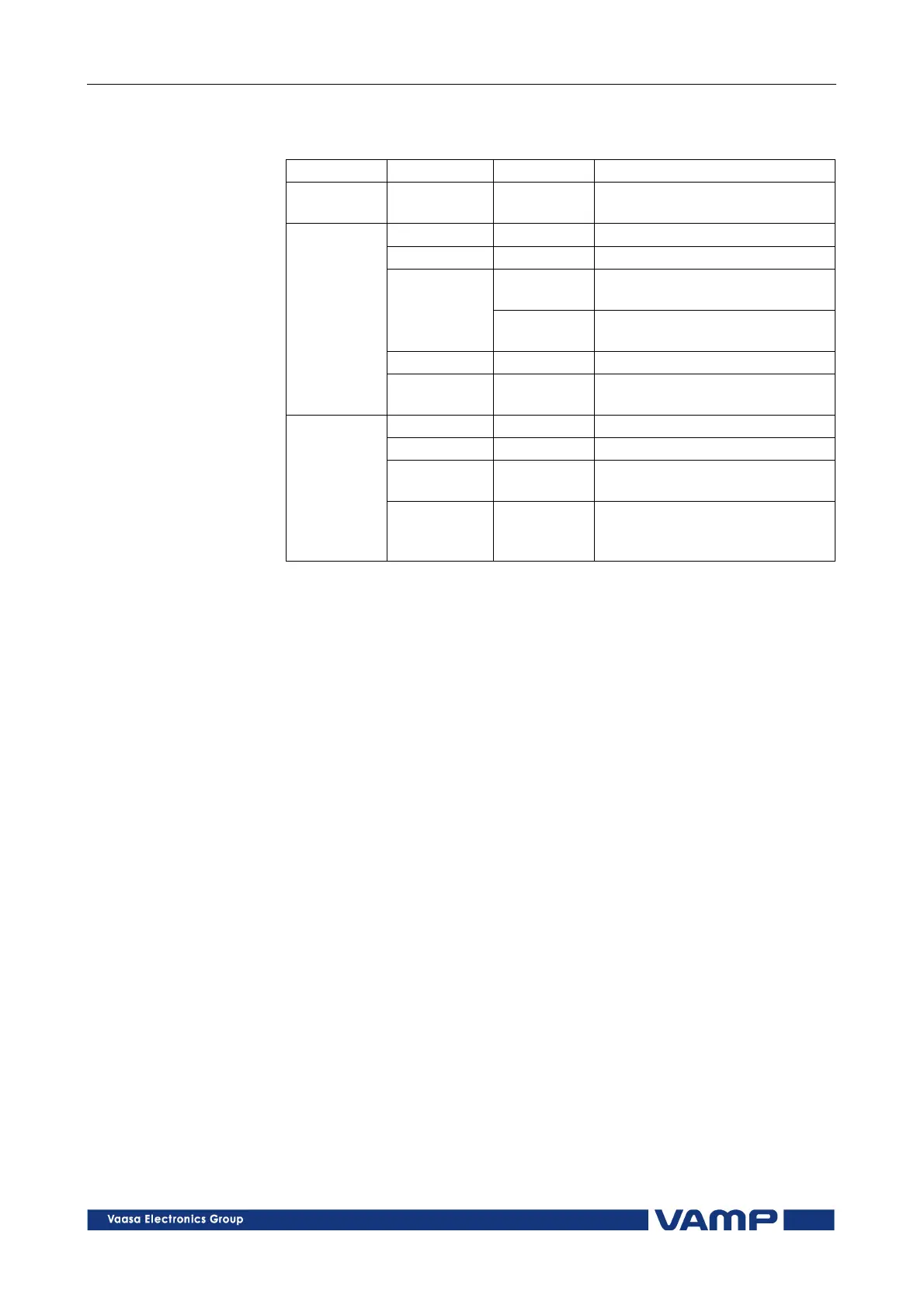
Parameters of the earth-fault stage:
I
II
I
0
00
0
>> (50/51N)
>> (50/51N)>> (50/51N)
>> (50/51N)
Parameter:
Parameter:Parameter:
Parameter:
Value/unit:
Value/unit:Value/unit:
Value/unit:
Measured
value
I
0
A Earth-fault current in primary
value
I
0
>> A Setting value in primary value
I
0
>> pu Setting value as per unit value
DT Operation charact./ definite
time
Type
INV Operation charact./ inverse
time
t>> s Operation time [s]
Setting
values
k>> Time multiplier at inverse
time
SCntr Start counter (Start) reading
TCntr Trip counter (Trip) reading
Flt pu Max. fault current in primary
value
Recorded
values
EDly % Elapsed time as compared to
the set operate time, 100% =
tripping
2.2.8. Frequent start protection N> (66)
The simplest way to start an asynchronous motor is just to
switch the stator windings to the supply voltages. However
every such start will heat up the motor considerably because
the initial currents are significantly above the rated current.
If the motor manufacturer has defined the maximum number of
starts within on hour or/and the minimum time between two
consecutive starts this stage is easy to apply to prevent too
frequent starts.
When current has been less that I
STOP
and then exceeds I
StartMin
the situation is recognized as a start. The maximum current for
a stopped motor I
STOP
is 10 % x I
MOT
. The minimum current for
a just started motor I
StartMin
is 150 % x I
MOT
.
The stage will give a start signal when the second last start has
been done. The trip signal is normally activated and released
when there are no starts left. Figure 2.2.8-1 shows an
application.


 To Next Page