7.1.1 Room Preparation
The room should be well insulated and must have a sealed vapor barrier. The vapor barrier in the ceiling
and walls can be a polyethylene film. Paint on concrete walls and floors should contain either rubber or
plastic.
NOTE: The single most important requirement for maintaining environmental control in the
conditioned room is the vapor barrier.
Outside or fresh air should be kept to a minimum when tight temperature and humidity control is
required. Outside air adds to the cooling, heating, dehumidifying and humidifying loads of the site. Doors
should be properly sealed to minimize leaks and should not contain ventilation grilles.
7.1.2 Location Considerations
CAUTION: Risk of leaking water/glycol. Can cause equipment, furniture and building damage.
Do not mount units over equipment or furniture that can be damaged by leaking water /glycol.
Install a watertight drain pan with a drain connection under the cooling unit and ceiling
mounted water-cooled condensing unit. Route the drain line to a frequently used maintenance
sink so that running water can be observed and reported in a timely manner. Post a sign to alert
people to report water flowing from the secondary drain pan.
NOTE: Do NOT mount units in areas where normal unit operating sound may disturb the working
environment.
Locate the evaporator unit over an unobstructed floor space if possible. This will allow easy access for
routine maintenance or service. Do not attach additional devices (such as smoke detectors, etc.) to the
housing, as they could interfere with the maintenance or service.
NOTE: Temperature and humidity sensors are located in the wall box. Carefully select a position for the
box where discharge air DOES NOT blow directly on the sensors.
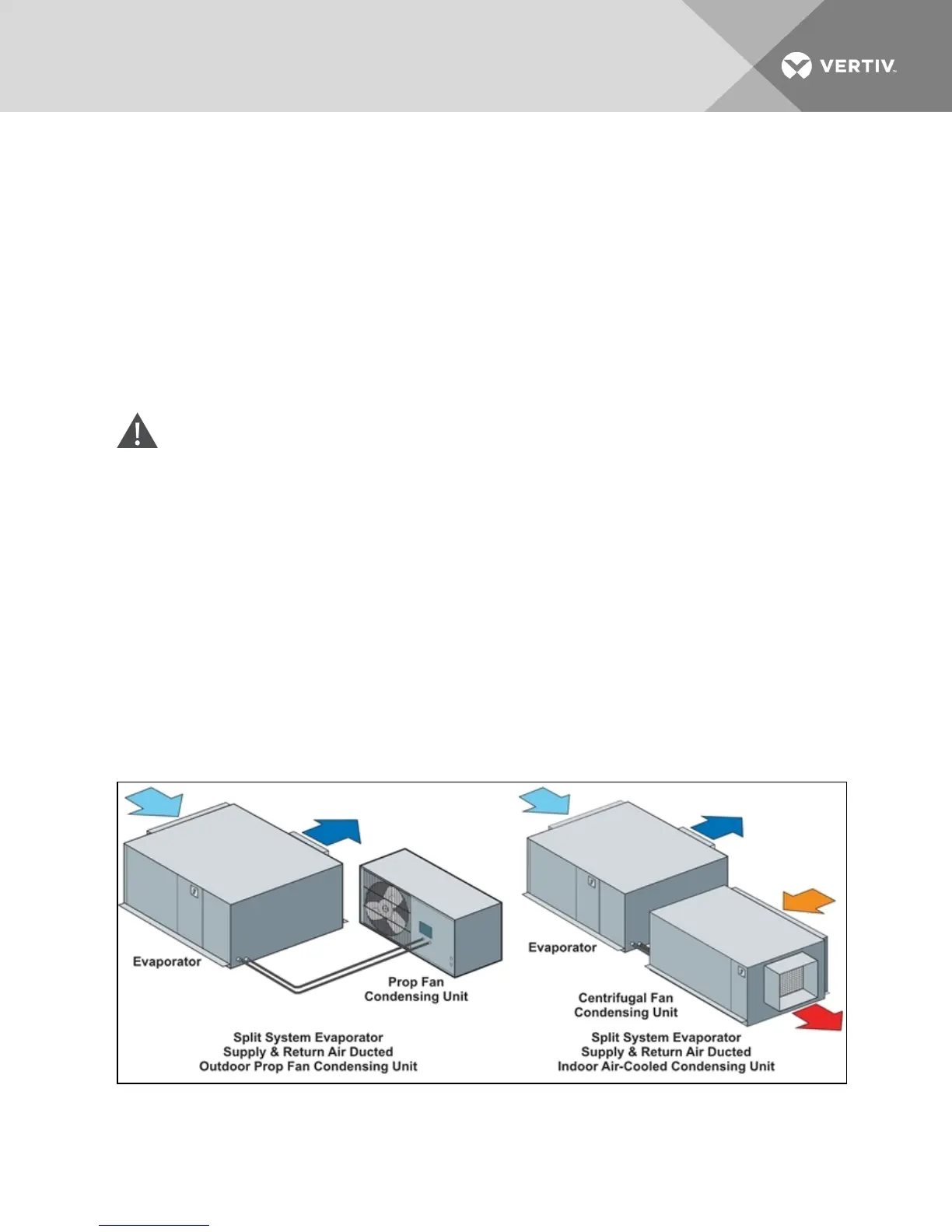
Figure 7.1 Air-cooled systems
Vertiv | Liebert Mini-Mate2—5 ton User Manual| 26



 To Next Page