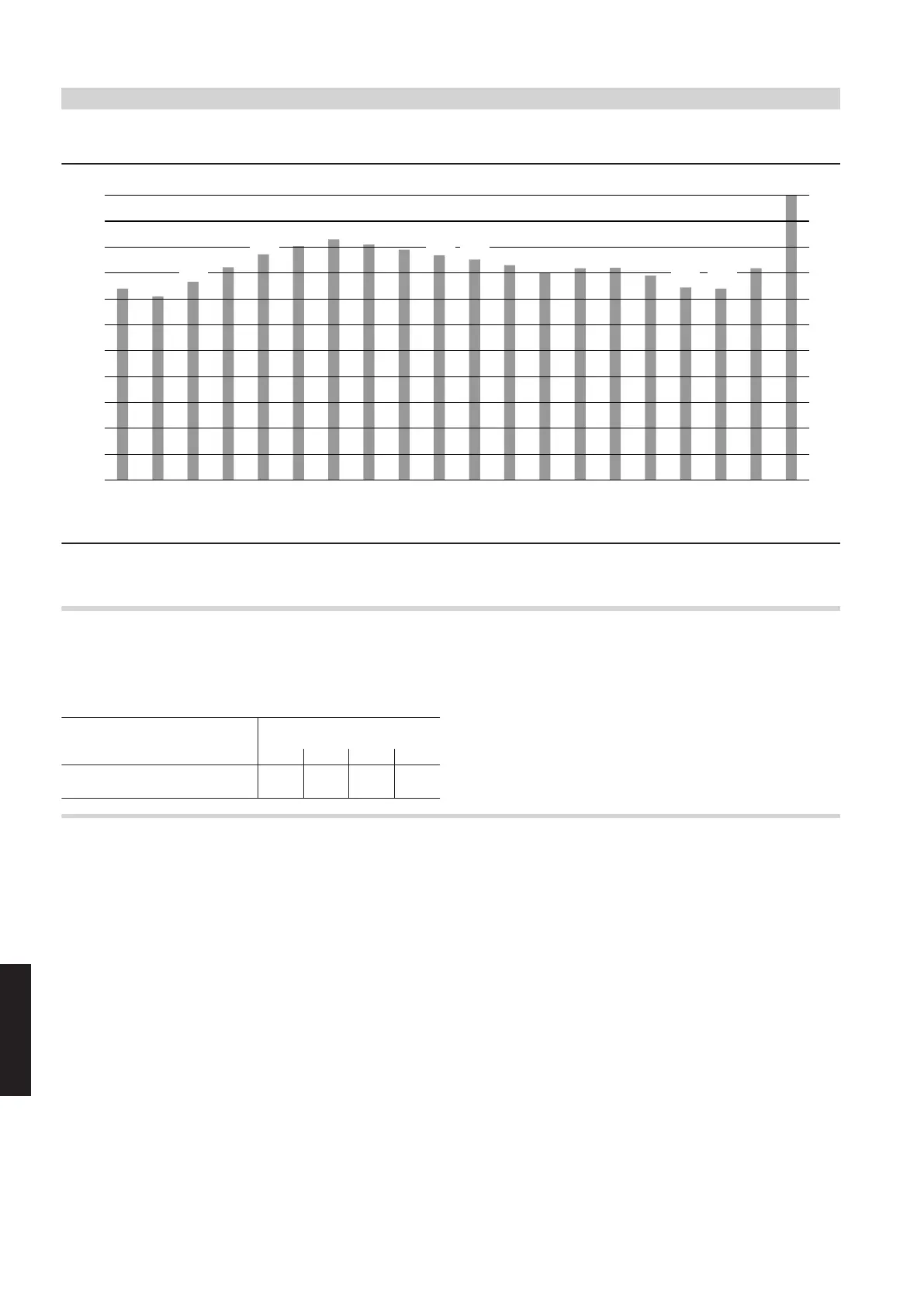
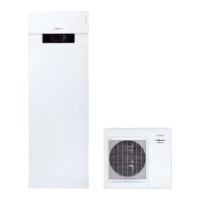
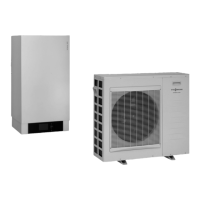
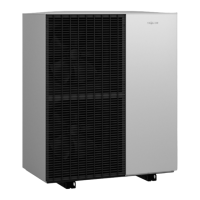
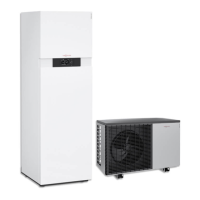
Outdoor unit types 201.A10 to A16 and 221.A10 to A16, 400 V~
100
125
160
200
250
315
400
500
630
800
1000
1250
1600
2000
2500
3150
4000
5000
6300
Σ
0
5
10
15
20
25
30
35
40
45
50
55
Frequency in Hz
Sound power in dB(A)
37
35.5
38.3
41.1
43.6
45.2
46.5
45.5
44.5
43.4
42.6
41.5
40
40.9
41
39.5
37.2
37
40.9
55
Σ Total sound power level
Increase of sound power level for heat pump cascades
In heat pump cascades, the sound power level L
W
increases in rela-
tion to the number of individual units. If outdoor units with equal out-
put are used, the following increases in sound power level may be
assumed:
Number of outdoor units
with equal output
2 3 4 5
Increase of sound power level L
W
in dB(A)
3 5 6 7
Example:
Cascade of 4 outdoor units Vitocal 200-A, type AWO 201.A10:
■ Max. sound power level L
W
of individual unit: 61 dB(A)
■ Increase for 4 outdoor units: 6 dB(A)
■ Max. sound power level L
W
of cascade: 67 dB(A)
Information on reducing noise emissions
■ Never site the heat pump directly next to living rooms, bedrooms
or their windows.
■ When routing pipes through ceilings and walls, prevent the trans-
mission of structure-borne noise through suitable insulation materi-
als. See information on siting the indoor unit from page 105.
■ Never position the heat pump immediately next to neighbouring
buildings or properties. See information on siting the outdoor unit
from page 99.
■ The sound pressure level may be increased if the heat pump is
installed in unfavourable physical positions.
In this context, please observe the following:
– Avoid surroundings with hard reflecting floors (e.g. concrete or
paving), as the sound pressure level can be increased through
reflection. Surroundings that are covered with vegetation (e.g. a
lawn) can noticeably reduce the perceived sound pressure level.
– The heat pump should preferably be freestanding: See the "Heat
pump principles" technical guide.
■ If the requirements of TA Lärm [Germany] are not observed, suita-
ble building measures (e.g. additional planting) must be employed
to reduce the sound pressure level to acceptable levels: See the
"Heat pump principles" technical guide.
Design information
(cont.)
116
VIESMANN
VITOCAL
7
5831388





 To Next Page