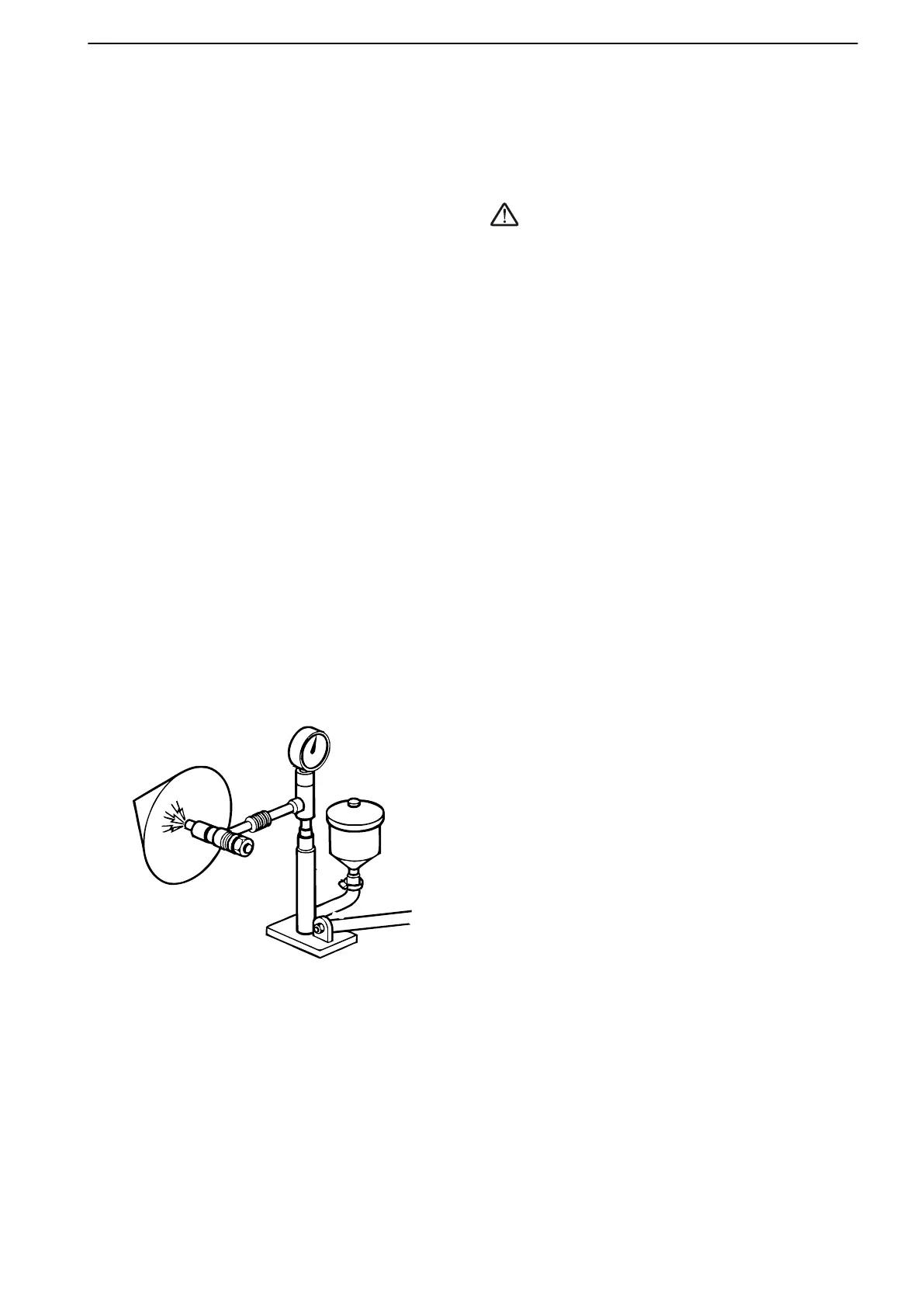
Testing injectors
Testing is done in an injector tester. During the test,
opening
pressure
and sealing are most important. The
spray pattern is more difficult to evaluate and does not
fully indicate the condition of the nozzle.
WARNING!
Be careful
when testing injectors, avoid getting the fuel
jet from an injector on un-protected parts of your body.
The jet has such powerful penetration ability that it can
force its way in under your skin and cause blood poi-
soning (septicemia).
Opening pressure
With the pressure gauge connected, press the injector
tester lever down slowly until the injector opens and
releases fuel. Read off the opening pressure at the
opening instant.
If the value noted does not coincide with the prescribed
value, the setting must be changed. This is done with
washers.
NOTICE! The opening pressure increases or
decreases by about 1 MPa (145 psi)with a change of
shim thickness of 0.1 mm (0.0039").
Checking injectors
Spray pattern
Tools:
9999772 Pressure testing kit
1 Pump the injector tester, special tool
9999772 Pressure testing kit, and check the
injector spray pattern. The fuel spray should be
cone shaped and aligned with the injector center
line. Fuel drops must not occur in the spray.
2 Check that the fuel jet has a circular cross section.
Sealing
When sealing is checked, investigate any fuel leakage
that may occur between the injector nozzle seat and
the tapered sealing surface in the injector sleeve.
1 Wipe the injector nozzle tip dry.
2 Pump the pressure up to about 2 MPa (290 psi)
below the injector opening pressure (refer to
Group 23: Fuel System page 21). Keep the pres-
sure constant for about 10 sec. and check that no
fuel drips out from the tip of the injector. Damp
injectors may be approved.
Fit protective plugs to the injector pipe connections and
over the injector nozzles if the injectors are not to be
installed immediately.
23-7 Injectors and Delivery Pipes
47701798 05-2013 © AB VOLVO PENTA 107




 To Next Page