June 28, 2016, 715003956 Rev. C
Page 17
1 Instrument Features and Operating
Modes
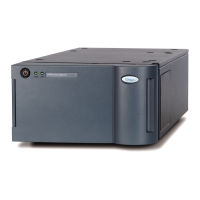
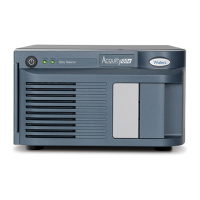
To effectively use the ACQUITY
®
QDa
®
Detector, you must familiarize yourself with its features
and operating modes.
1.1 Operating modes
You can acquire data using any of these operating modes:
• Scanning, where the instrument scans across a user-defined span of mass-to-charge (m/z)
ratios to produce a mass spectrum.
• Selected ion recording (SIR), where the instrument records the signal intensity at a static
m/z ratio for the purpose of quantitation. Multiple m/z ratios can be recorded simultaneously.
• RADAR, where the instrument performs Scanning and SIR acquisitions simultaneously.
Important: Do not open the instrument’s front door during data acquisition. Doing so cancels the
acquisition.
1.2 Ion optics
Ions flow through the instrument in the following sequence:
1. Samples from the LC are introduced into the ionization source.
2. The ions pass through the sample cone into the vacuum system.
3. The ions pass through the transfer optics (the ion guides) to the quadrupole, where they are
filtered according to their m/z ratios.
4. The transmitted ions are detected by the photomultiplier detection system.
5. The signal is amplified, digitized, and sent to the software for analysis.
1.3 Auto setup
The instrument can perform auto setup checks when it powers on. If auto setup is enabled, the
instrument performs a startup check of mass scale calibration and quadrupole (spectrum)
resolution, using an internal calibrant during startup. If the instrument reports no problems, the


 To Next Page