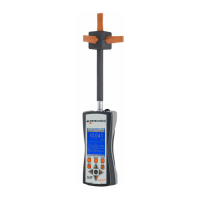
Special functions of the Selective probes
These probes have certain specific functions, given their spectral analysis capacity.
• RANGE: Select how the probe will adapt to field levels. With changes in
levels, the electronics processing the signal must adapt to high or low levels
in order to give accurate results under both conditions. That adaptation takes
time, which needs to be taken into account in special cases.
• Automatic: the measurement range of the probe adapts automatically to the
signal, with either increase or decrease in the level. Suitable in most cases.
• Auto-increase: the range will only increase, adapting to higher levels
detected and maintaining those conditions for accurate immediate reading
of high levels. This is very important in the case of signals with non-
repeating high levels, e.g. signals with sporadic peaks (at intervals of more
than one second). If they are very fast and short with high levels, the device
might not have time to adapt to the first pulses and could measure a level
lower than the actual level. If this function is activated, the device will already
be adapted to measure the following pulses correctly. This function could be
useful, for example, to measure pulses generated by welding equipment.
• FILTER: Select the high pass filter
• 1 Hz. No filter is applied. Using this option requires special care. In this
mode all operations are slower due to the integration time required for
having the RMS value at 1 Hz. The device will take longer to adapt to
changes in the field, so any movements must be slower or the device
should remain still for several moments at those positions where you want
to take a reading. Another effect is that if a static field is present and you
take measurements moving the device, that movement will make the
probe detect the field as dynamic and it will contribute to the end result. In
both cases, we recommend using a tripod and keeping anyone at a
distance when taking measurements.
• 10 Hz (-3dB at 10 Hz). Recommended if you know there are no
signals under 10 Hz (true in most cases).
• 25 Hz (-3dB at 25 Hz). To attenuate readings below 25 Hz.



 To Next Page