EasyManua.ls Logo

Williams Electronics WHIRLWIND - Auto Burn-in Mode; System-11 B Memory Chip Test; CPU LED Indicator Codes Table

Williams Electronics WHIRLWIND
106 pages
Print Icon
To Next Page IconTo Next Page
To Previous Page IconTo Previous Page
Loading...
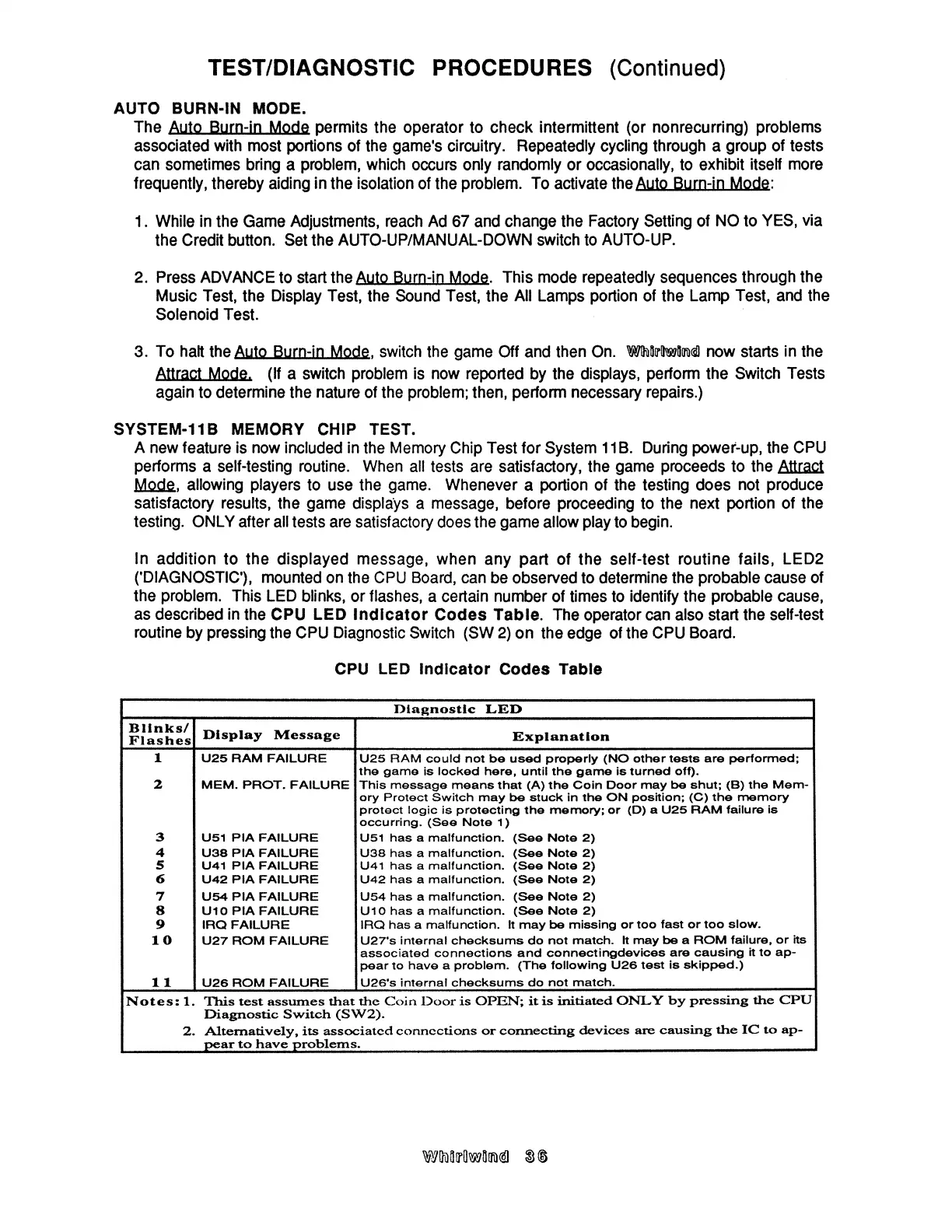
TEST/DIAGNOSTIC
PROCEDURES
(Continued)
AUTO
BURN-IN
MODE.
The
Auto__Bu_m_-_in_Mgd_e
permits
the
operator
to
check
intermittent
(or
nonrecurring)
problems
associated
with
most
portions
of
the
game's
circuitry.
Repeatedly
cycling
through
a
group
of
tests
can
sometimes
bring
a
problem,
which
occurs
only
randomly
or
occasionally,
to
exhibit
itself
more
frequently,
thereby
aiding
in
the
isolation
of
the
problem.
To
activate
the
:
1.
While
in
the
Game
Adjustments,
reach
Ad
67
and
change
the
Factory
Setting
of
NO
to
YES,
via
the
Credit
button.
Set
the
AUTO-UP/MANUAL-DOWN
switch
to
AUTO-UP.
2.
Press
ADVANCE
to
start
the
Music
Test,
the
Display
Test,
the
Sound
Test,
the
All
Lamps
portion
of
the
Lamp
Test,
and
the
Solenoid
Test.
A
'
3.
To
halt
the
AttLat;t_Mt2t1e,
(If
a
switch
problem
is
now
reported
by
the
displays,
perform
the
Switch
Tests
again
to
determine
the
nature
of
the
problem;
then,
perfonn
necessary
repairs.)
SYSTEM-11B
MEMORY
CHIP
TEST.
A
new
feature
is
now
included
in
the
Memory
Chip
Test
for
System
118.
During
power‘-up,
the
CPU
performs
a
self-testing
routine.
When
all
tests
are
satisfactory,
the
game
proceeds
to
the
Atttact
Mt2_d_e_,
allowing
players
to
use
the
game.
Whenever
a
portion
of
the
testing
does
not
produce
satisfactory
results,
the
game
displays
a
message,
before
proceeding
to
the
next
portion
of the
testing.
ONLY
after
all
tests
are
satisfactory
does
the
game
allow
play
to
begin.
In
addition
to
the
displayed
message,
when
any
part
of
the
self-test
routine
fails,
LED2
(‘DIAGNOSTIC’),
mounted
on
the
CPU
Board,
can
be
observed
to
determine
the
probable
cause
of
the
problem.
This
LED
blinks,
or
flashes,
a
certain
number
of
times
to
identify
the
probable
cause,
as
described
in
the
CPU
LED
Indicator
Codes
Table.
The
operator
can
also
start
the
self-test
routine
by
pressing
the
CPU
Diagnostic
Switch
(SW
2)
on
the
edge
of
the
CPU
Board.
CPU
LED
Indicator
Codes
Table
Diagnostic
LED
B11
k
/
Flaghzs
Display
Message
Explanation
1
U25
RAM
FAILURE
U25
RAM
could
not
be
used
properly
(NO
other
tests
are
performed;
the
game
is
locked
here,
until
the
game
is
turned
off).
2
MEM.
PROT.
FAILURE
This
message
means
that
(A)
the
Coin
Door
may
be
shut;
(B)
the
Mem-
ory
Protect
Switch
may
be
stuck
in
the
ON
position;
(C)
the
memory
protect
logic
is
protecting
the
memory;
or
(D)
a
U25
RAM
failure
is
occurring.
(See
Note
1)
3
U51
PIA
FAILURE
U51
has
a
malfunction.
(See
Note
2)
4
U38
PIA
FAILURE
U38
has
a
malfunction.
(See
Note
2)
5
U41
PIA
FAILURE
U41
has
a
malfunction.
(See
Note
2)
6
U42
PIA
FAILURE
U42
has
a
malfunction.
(See
Note
2)
7
U54
PIA
FAILURE
U54
has
a
malfunction.
(See
Note
2)
8
U10
PIA
FAILURE
U10
has
a
malfunction.
(See Note
2)
9
IRO
FAILURE
IRQ
has
a
malfunction.
It
may
be
missing
or
too
fast
or
too
slow.
1
0
U27
ROM
FAILURE
U27‘s
internal
checksums
do
not
match.
It
may
be
a
ROM
failure,
or
its
associated
connections
and
connectingdevices
are
causing
it
to
ap-
pear
to
have
a
problem.
(The
following
U26
test
is
skipped.)
1
1
U26
ROM
FAILURE
U26's
internal
checksums
do
not
match.
Notes:
1.
This
test
assuxnes
that
the
Coin
Door
is
OPEN;
it
is
initiated
ONLY
by
pressing
the
CPU
Diagnostic
Switch
(SW2).
2.
Alternatively,
its
associated
connections
or
connecting
devices
are
causing
the
IC
to
ap-
pear
to
have
problems.
Wlhillrllvryiltmcvil
SS

Table of Contents