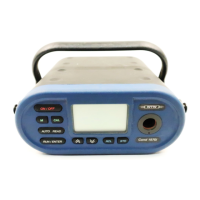
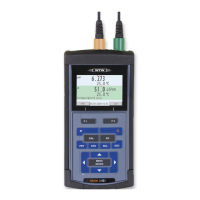
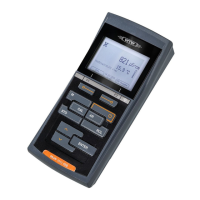
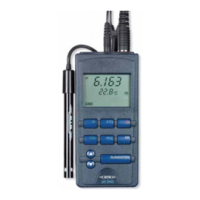
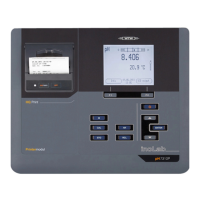
Multi 9420 Dissolved oxygen (D.O.)
ba75964e04 04/2015 73
The measurement error is within the specified validity scope.
No cleaning or user calibration is required.
7.3 Calibration
7.3.1 Why calibrate?
D.O. sensors age. This changes the slope of the D.O. sensor. Calibration deter-
mines the current slope of the sensor and stores this value in the instrument.
7.3.2 When to calibrate?
If your evaluation of the FDO
®
Check procedure suggests the necessity of
a calibration
When the calibration interval has expired
When your accuracy requirements are especially high
Routinely within the framework of the company quality assurance
7.3.3 Calibration procedures
The Multi 9420 provides 2 calibration procedures:
Calibration in water vapor-saturated air.
Use an OxiCal
®
air calibration vessel for calibration.
Calibration via a comparison measurement (e.g. Winkler titration according
to DIN EN 25813 or ISO 5813). At the same time, the relative slope is
adapted to the comparison measurement by a correction factor. When the
correction factor is active, the [Factor] indicator appears in the measuring
window.
7.3.4 Calibration in water vapor-saturated air
Use the check and storage beaker (FDO
®
Check) to calibrate the FDO
®
925
sensor.
Proceed as follows to calibrate the D.O. sensor:
The FDO
®
925 D.O. sensor ages so little it does not have to be reg-
ularly calibrated.
To detect changes of the sensor as early as possible, the
FDO
®
Check procedure can be useful (see section 7.2
FDO
®
CHECK PROCEDURE, page 71).
1. Connect the D.O. sensor to the meter.


 To Next Page