Need help?
Do you have a question about the XTS DVR72XX-V and is the answer not in the manual?
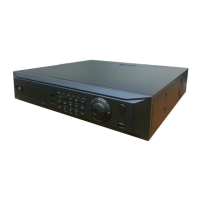
Provides a general description of the DVR, its OS, and network capabilities.
Details the key features of the DVR, including monitor, storage, and backup functions.
Lists the technical specifications for different DVR models, covering hardware and compression.
Describes the components and buttons on the front panel of the DVR.
Details the various ports and connectors located on the rear panel of the DVR.
Illustrates a typical connection setup for cameras and network devices.
Explains the functionality and layout of the remote control for the DVR.
Details how to use the mouse for navigating menus and controlling the DVR functions.
Covers the use of the virtual keyboard and front panel for input and control.
Instructions for verifying the DVR and its accessories upon unboxing.
Information about critical labels and ports on the front and rear panels.
Step-by-step guide for installing Hard Disk Drives (HDDs) into the DVR.
Guidance on mounting the DVR unit into a standard server rack.
Details on connecting the power supply and recommendations for UPS usage.
Instructions for connecting video input sources and output displays.
Guidance on connecting audio input/output devices and enabling two-way audio.
Details on connecting alarm input sensors and output devices.
Information on using the RS232 port for POS systems or keyboard control.
Instructions for connecting PTZ devices using the RS485 interface.
Brief mention of other available interfaces like USB ports.
Details on system login, logout procedures, and the main menu interface.
Instructions for initiating and managing manual recording operations.
Guide to searching recorded video files and performing playback operations.
Configuration settings for scheduling recording, motion detection, and alarms.
Setup for motion detection, video loss detection, and camera masking.
Configuration for alarm inputs, outputs, and activation triggers.
Procedures for backing up recorded data via USB or eSATA.
Operations for controlling PTZ cameras and adjusting video color settings.
Configuration and activation of preset camera positions, patrols, and scan patterns.
Functionality to flip or mirror the video display.
Visual representation of the DVR's menu structure and hierarchy.
Overview of the primary icons and navigation within the main menu.
Detailed configuration options for system parameters like time, network, and display.
Functionality for searching recorded video files based on various criteria.
Access to advanced features such as HDD management, account settings, and auto-maintenance.
View system status, HDD information, data stream statistics, logs, and version.
Procedures for logging out, restarting, or properly shutting down the DVR.
Accessing the menu for controlling camera PTZ functions like zoom, focus, and iris.
Configuration and activation of preset camera positions, patrols, patterns, and borders.
Steps to establish a network connection for web client access.
Procedure for logging into the DVR via the web browser interface.
Detailed configuration settings accessible through the web client interface.
Web client interface for searching and downloading recorded video files.
Web client interface for setting and managing alarm types and sound.
Displays information about the current web client version and SDKs.
Process for logging out of the web client session.
Instructions for uninstalling the web client control software.


 To Next Page
 General