If you exceed the welding machine duty cycle, the thermal protection system will engage, shutting off all welding current output.
After cooling, the thermal protector will automatically reset, and the welding functions can resume. The user needs to know it is the
expected behavior of this machine. However, it would be best if you waited at least ten minutes after the thermal protector engages
before resuming welding. You must do this even if the thermal protector resets itself before the ten minutes is up, or you may
experience less than specified duty cycle performance.
CAUTION: DO NOT REGULARLY EXCEED THE DUTY CYCLE OR DAMAGE TO THE WELDER CAN RESULT.
3.2 Internal Thermal Protection
- 13 -
3.1 Performance Data Plate And Duty Cycle
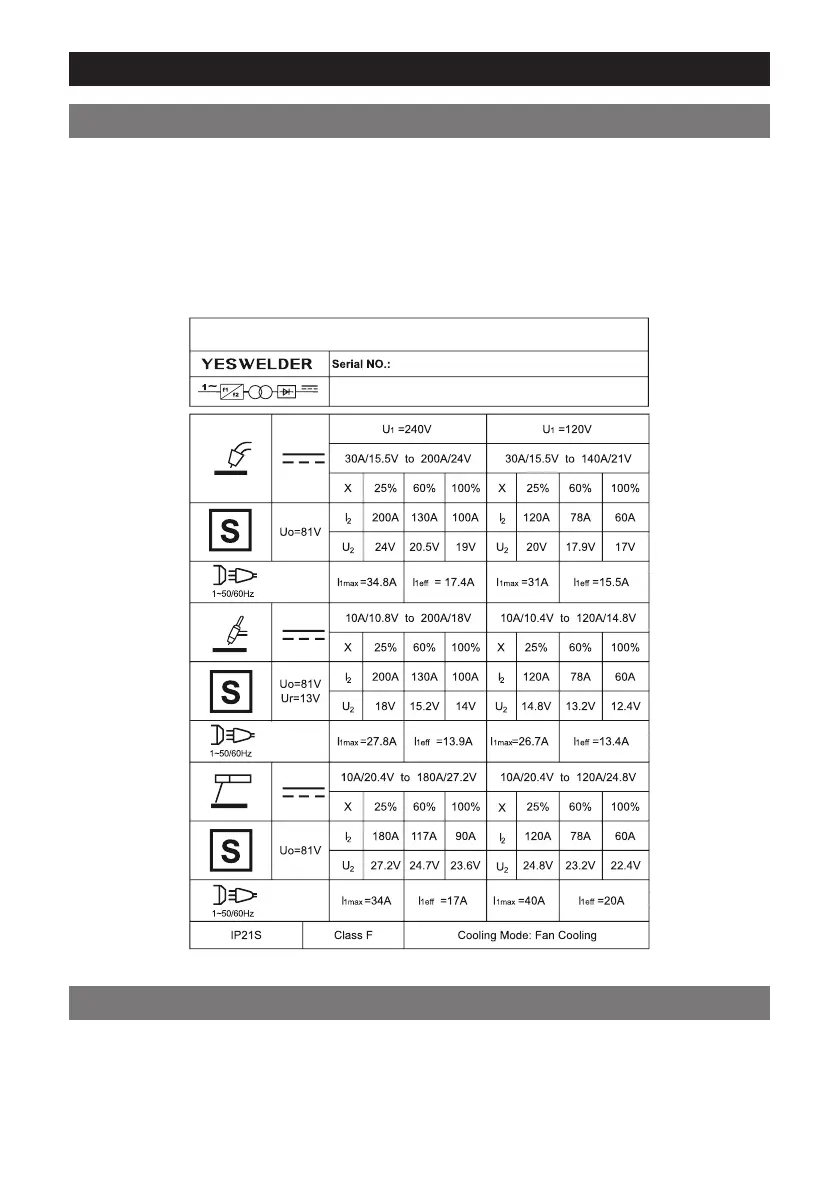
On the machine, there is a plate that includes all the operating specifications for your new unit. The duty cycle rating of a welding
machine defines how long the operator can weld and how long the welding machine must rest and be cooled. Duty cycle is
expressed as a percentage of 10 minutes and represents the maximum welding time allowed. The balance of the 10-minute cycle is
required for cooling.
For example, a welding machine has a duty cycle rating of 30% at the rated output of 90A. With that welding machine, you can weld
at 90 A output for three (3) minutes out of every 10 min with the remaining seven (7) minutes required for cooling.
The duty cycle of your new welding machine can be found on the data plate affixed to the machine. The picture below shows that
the “X” row lists duty cycle percentages while the “I2” row lists the amp draw corresponding to the duty cycle. Various duty cycles at
other amperages are listed on your data plate.
3. OPERATION



 To Next Page