Safety instructions 8
3.3 RESIDUAL RISKS
Despite all precautionary measures taken, residual risks, or potential hazards, may occur
during the use of the vehicle, including:
o Possibility of catching clothing, hands, arms or hair by lifter or large waste
o Possibility of hitting the user with flying parts or waste
o Allergies, mucosal irritations and dust formation during waste collection
o Road hazards caused by other road users
o Thermal hazards, e.g. by touching hot surfaces
o Biological hazards, e.g. through contact with waste
3.4 GENERAL SAFETY
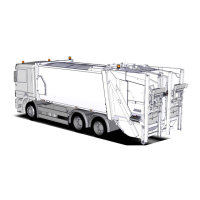
The RCV body (hereinafter referred to as the vehicle) is constructed in accordance with the
current state of technology and safe in operation. Due to the need to perform various
operations, the vehicle has, however, such places and parts that cannot be secured, without
limiting the functionality and serviceability. Therefore, to protect personnel and the vehicle, it
is necessary to comply with the safety rules.
o For the vehicle to be completely safe, the driver/operator cannot be colour blind,
because the operating elements are marked with different colours. The driver/operator
must also not have hearing impairment, as he must hear alarm and signal sounds.
o All safety devices installed on the body must be used for their intended purpose and
their correct operation must be checked before each start-up.
o Vehicle operating personnel must be trained to operate the vehicle in accordance with
the operating instructions.
o The vehicle may only be operated and maintained by authorized, trained and qualified
personnel.
o Communication devices should be used to ensure safety (space control system behind
the vehicle, signalling buttons, buzzer, signal lamps) and check their operation before
starting the vehicle.
o In case of weighted footboards, the following limitations are activated:
▪ Max 30km/h when driving forward
▪ Reverse driving is blocked


 To Next Page