Accsense VersaLog Data Loggers User’s Manual Page 21
What is a Strain Gauge
A strain gauge (also strain gage) is a device used to measure the strain of an object.
The gauge is attached to the object by a suitable adhesive. As the object is deformed, the foil is
deformed, causing its electrical resistance to change. This resistance change, usually measured
using a Wheatstone bridge, is related to the strain by the quantity known as the gauge factor.
The gauge factor GF is defined as:
where
is the change in resistance caused by strain,
is the resistance of the undeformed gauge, and
is strain.
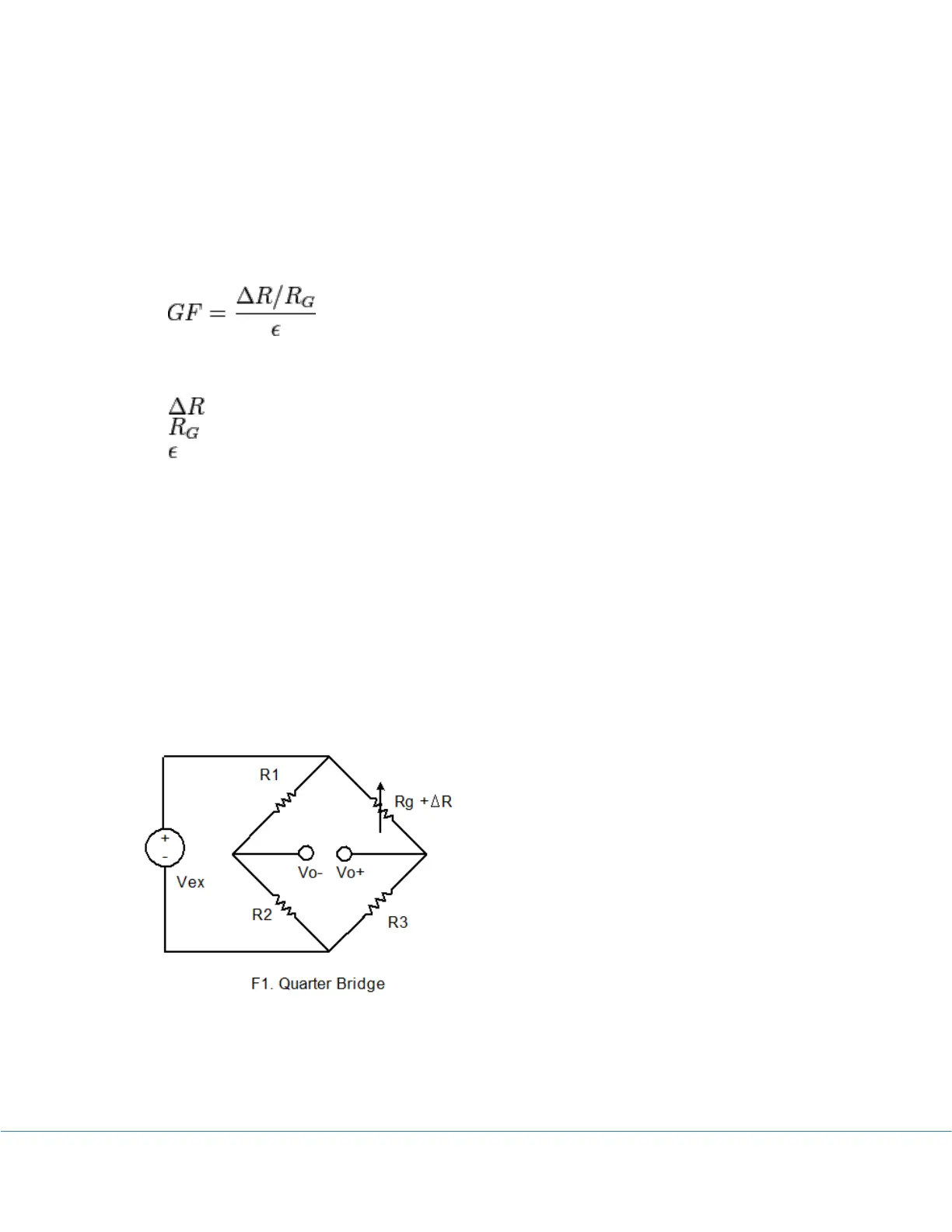
A Wheatstone bridge is an electrical circuit used to measure an unknown electrical resistance by
balancing two legs of a bridge circuit. The Wheatstone bridge consists of four resistances (R1,
R2, R3 and R4), an excitation voltage and an output voltage. Generally, one or more of the
resistances are variable and change in accordance with some physical phenomenon, such as
strain in this case. The Wheatstone bridge then converts this change in resistance to a change in
voltage.
There are 3 configurations are used - quarter bridge, half bridge or full bridge.
Quarter Bridge Circuit:
Only one active strain gauge (Rg) is used as shown below. R3 is the inactive gauge, which is
identical to the active gauge but does not encounter any mechanical strains and is used for
compensating the temperature effect. The other two arms contain fixed resistors.
Half Bridge Circuit:
If the dummy gauge in the above figure is replaced by an active gauge, as shown below, the
resulting arrangement is called a half bridge. The half bridge has advantages for temperature



 To Next Page