Spa
27
3.4 DRIVING THE MIXER FEEDER
Before starting the engine, check to make sure that:
the machine does not have any loose parts.
the cutter arm is about 500mm from the ground and with the
protective guard lowered.
the gear shift is in neutral.
the parking brake is engaged.
Driving the MAXI mixer feeder is very much like driving a car!
The left lever on the steering wheel has two positions:
CENTRAL IS IN “NEUTRAL”
FORWARD 1st GEAR
FORWARD 2nd GEAR
REVERSE 1st GEAR
REVERSE 2nd GEAR
3.4.1 FARM MODE
When the diesel motor is started and warmed up, release the parking brake, and select the
forward or reverse gear with the gear lever. To start moving, press the forward pedal, which
will automatically regulate the engine RPMs and the machine speed (20Km/h). When
releasing the pedal the hydrostatic transmission acts as a brake. If emergency braking is
necessary, press the brake pedal which is located on the opposite side of the forward pedal.
The number of RPMs of the MAXI mixer feeder’s diesel engine can be regulated either with
the forward pedal (automotive mode) or with the hand lever located on the cab side console.
Naturally, the priority command is given by the lever, i.e. if the lever is regulated for the
maximum number of RPMs, when pushing on the pedal there will be no change in the diesel
engine RPMs.
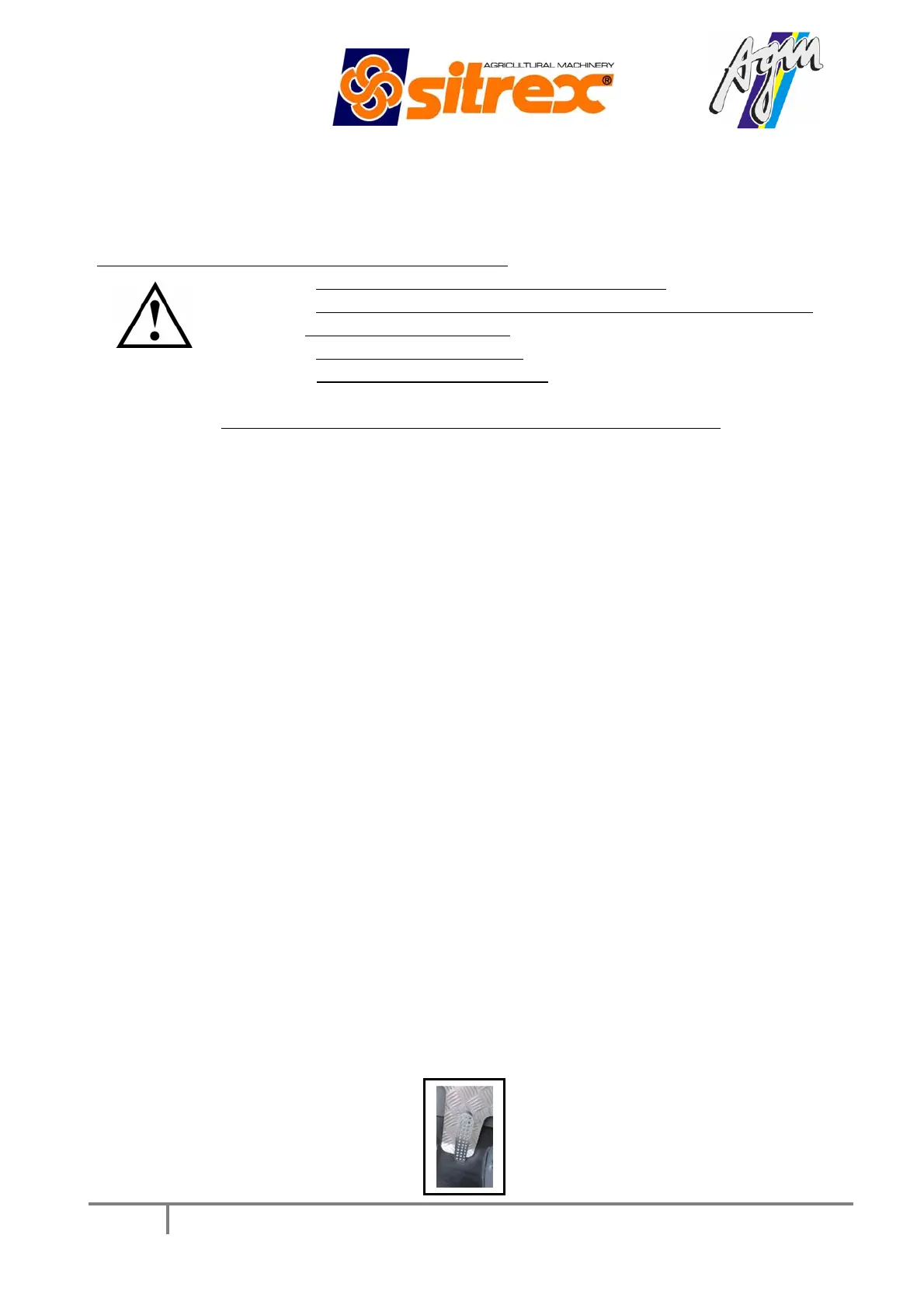
For small and repetitive movements, especially during cutting, it is possible to use an
additional foot button (Fig.1) located on the left side of the cab that reverses the direction of
travel even if the gear lever on the steering column is in the forward position. When the foot
button is released, the machine will return to the gear selected on the steering column.
Regardless of the gear it is in, when the predetermined weight threshold is reached, the
machine will be limited to a speed of 8 km/h. During unloading, as soon as the weight goes
under this threshold, the machine will of course return to a speed of 20 km/h with the
forward pedal fully depressed.
FIG.1 FIG.1



 To Next Page