6.2. Carrying
In order to carry the machine to the various working sites, follow the instructions given below. Considering the large
dimensions of some models, before carrying, it is recommended to inquire about the overall dimension limits for road
transport in force in your country.
Before carrying the machine, turn it off and remove the keys from the control panels. No people are
allowed in proximity to or on the machine to avoid any risks deriving from sudden movements.
For safety reasons never lift or tow the machine by means of its booms or platform.
Loading operations are to be carried out on a flat surface with a suitable capacity, after setting the
platform to rest position.
To carry the machine the operator shall load it onto a vehicle either:
▪ By means of loading ramps and translation controls located on the platform to load it directly onto the machine
(if ramp slope is within the gradeability described in paragraph “TECHNICAL FEATURES” and ramp capacity is
adequate to weight) according to the instructions given in paragraph “USE INSTRUCTION” under paragraph “Drive
and steering” for correct operation of drive controls. During the loading operation following this system, it is best to
raise the Jib (not over +10° with respect to the horizontal to prevent engaging the safety speed) to prevent the
platform knocking against the ground. Pay attention not to load other booms during this operation to prevent the
emergency microswitches from being activated, which in case of inclined machine disable all the manoeuvres
except the lowering ones. If the slope exceeds the gradeability, the machine is to be towed by means of a windlass
only if the operator on the platform simultaneously activates the drive control to release the parking brakes. The
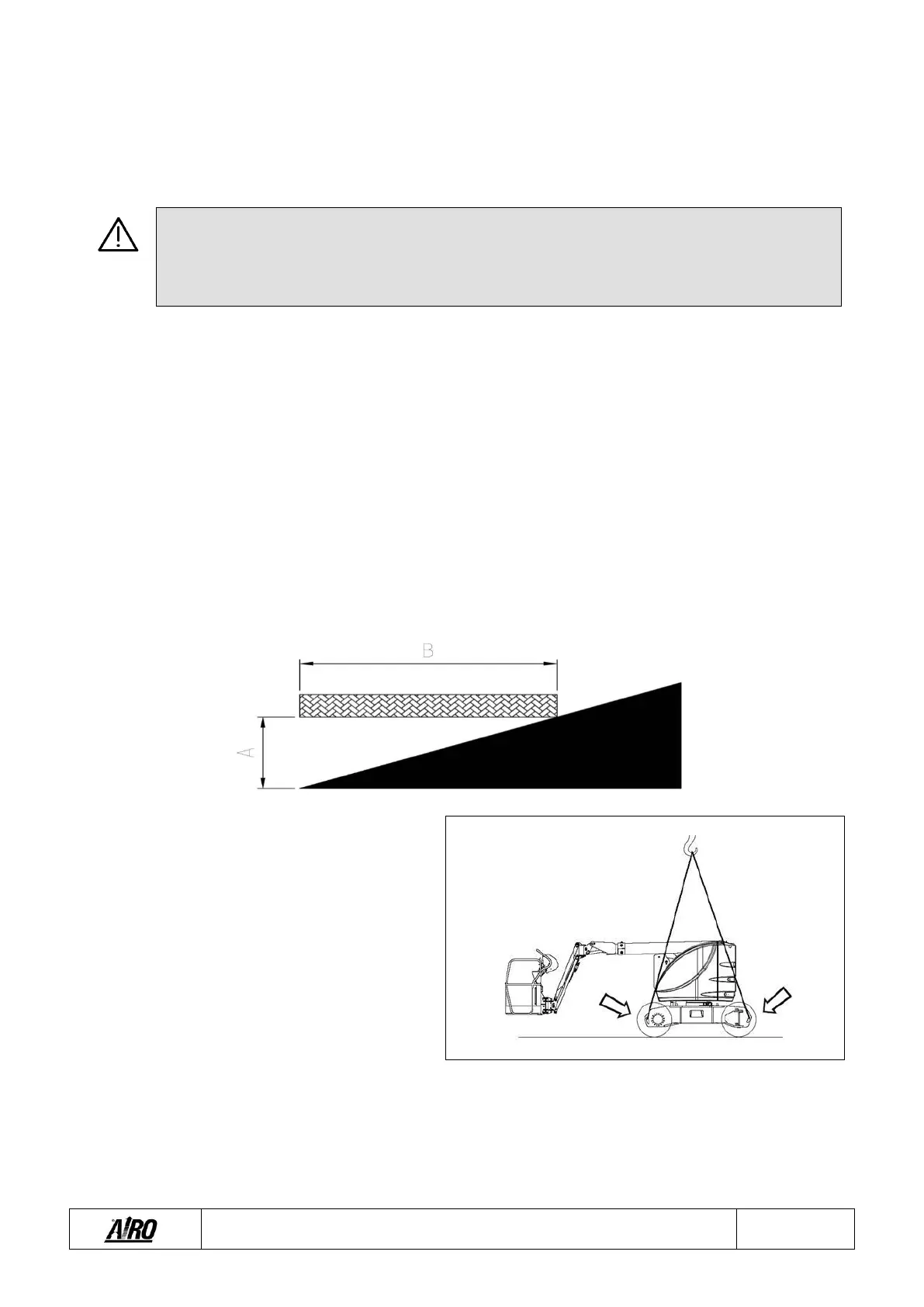
gradient can be determined using an electronic level or empirically as described below: position a wood board of
known length on the gradient to be measured. Position a spirit level on the wood board and lift the downstream
extremity of the latter until it is level. Now measure the distance between the board and the ground (A), divide this
by the length of the board (B) and multiply by 100. The following image sums up the method.
▪ By means of hooks and steel ropes (with safety
factor = 5, see machine weight in Technical
features) connected to the provided holes as
indicated in the picture aside;


 To Next Page