1.1.2.2. Further periodical checks
Yearly checks are compulsory. In Italy the Aerial Platform owner must apply for a periodical check - by registered letter - to the local
competent inspection board (ASL/USL or other qualified public or private services) at least twenty days before the expiry of the
year from the last check.
NB: If a machine without a valid control document should be moved in an area outside the competence of the usual inspection
board, the owner of the machine must ask the inspection board, competent for the new territory where the machine is to be used,
for the annual check.
1.1.2.3. Transfers of ownership
In case of transfer of ownership (in Italy) the Aerial Platform new owner must notify the ownership of the machine to the local
competent inspection board (ASL/USL or ARPA or other qualified public or private services) by enclosing a copy of:
▪ Declaration of conformity issued by the manufacturer.
▪ Declaration of commissioning carried out by the first owner.
1.1.3. Operator training and information
The employer must ensure that the workers appointed to use the equipment are adequately and specifically trained so they are
able to use the Mobile Elevating Work Platform in a proper and safe way and also avoid the risks caused by other people.
1.2. Tests performed before delivery
Before being placed on the market, each MEWP undergoes the following tests:
▪ Braking test
▪ Overload test
▪ Operating test
1.3. Intended use
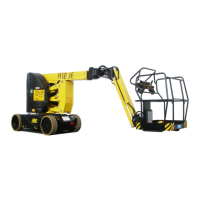
The machine described in this use and maintenance manual is a self-propelled aerial platform intended for lifting persons and
materials (equipment and work materials) in order to carry out maintenance, installation, cleaning, painting, de-painting, sand-
blasting, welding operations, etc.
The max. capacity allowed (which varies according to the model – see paragraph “Technical features”) is divided as follows:
▪ 80 Kg for each person on board.
▪ 40 Kg for equipment.
▪ The remaining load is represented by the material being worked.
In any case NEVER exceed the maximum capacity allowed as indicated in paragraph "Technical features”. Persons, tools and work
materials can be loaded on the platform only from the access position (platform lowered). It is absolutely forbidden to load persons,
tools and work materials on the platform when it is not in access position.
All loads must be positioned inside the cage; do not lift loads (even if complying with the maximum capacity allowed) hanging from
the platform or from the lifting structure.
Do not carry large-sized panels since they increase the resistance to wind force thus causing the machine to overturn.
While the machine is being displaced with lifted platform, no horizontal loads can be loaded onto the platform (operators on board
are not allowed to pull wires or ropes, etc.).
An overload controller stops the operation of the machine if the load on the platform exceeds by 20% approx. the nominal load (see
chapter "General use rules”) and platform is lifted.
The machine cannot be used in areas where road vehicles operate. Always surround the working area by means of suitable signs
when the machine is used in public areas.
Do not use the machine to tow trucks or other vehicles.
All types of machine use other than those for which it was designed must be approved in writing by the machine manufacturer
following a specific request on the part of the user.


 To Next Page