GT3000 Maintenance
50 IMGT30017EN
4A.3 Preventative maintenance
VFD maintenance requirements fall into three basic categories:
1. · keep it clean
2. · keep it dry
3. · keep the connections tight.
♦ Dust on VFD hardware can cause a lack of airflow, resulting in diminished performance from heat sinks
and circulating fans.
♦ Dust on an electronic device can cause malfunction or even failure.
Dust absorbs moisture, which also contributes to failure.
♦ The air used for cleaning the dusty surface must be oil-free and dry.
♦ Heat cycles and mechanical vibration can lead to sub-standard connections.
♦ A screw has maximum clamping power at a torque value specific to its size, shape, and composition,
exceeding that torque value permanently reduces the clamping power of that screw by reducing its
elasticity and deforming it.
Periodically check:
Wires are not damaged
Terminals are tight
Drive and motor ambient temperature does not exceed recommended specifications
Boards are free of dust and condensation
Insulation is not damaged or discolored
Vents or the areas next to the drive fans are not obstructed.
ELECTRONIC BOARDS: Boards do not require particular maintenance operations. Periodically remove the dust without using
compressed air. Components sensitive to electrostatic charges are mounted on the boards.
HEATSINK: Periodically remove the dust.
FANS: Assuming an average temperature of 35°C and 20 operating hours a day, the average life of the fan is about
3-4 years. The increase in fan noise produced by the bearings and the gradual temperature increase of the
Heat sink are symptoms of possible failure.
CAPACITORS: Assuming an average temperature of 35°C and 20 operating hours a day, the average life of the electrolytic
capacitors is about 5-6 years.
Capacitor Reforming of Spare and Stored Converters
Electrolytic capacitors keep their original characteristics only if they are energized within 1 year from the supply date.
Without reforming, capacitors may be damaged when the converter starts to operate.
The reforming methods and guidelines detailed here assume that a drive has been stocked and/or used in clean and dry conditions.
It is recommended, as a general rule, that the users reform the capacitors once a year.
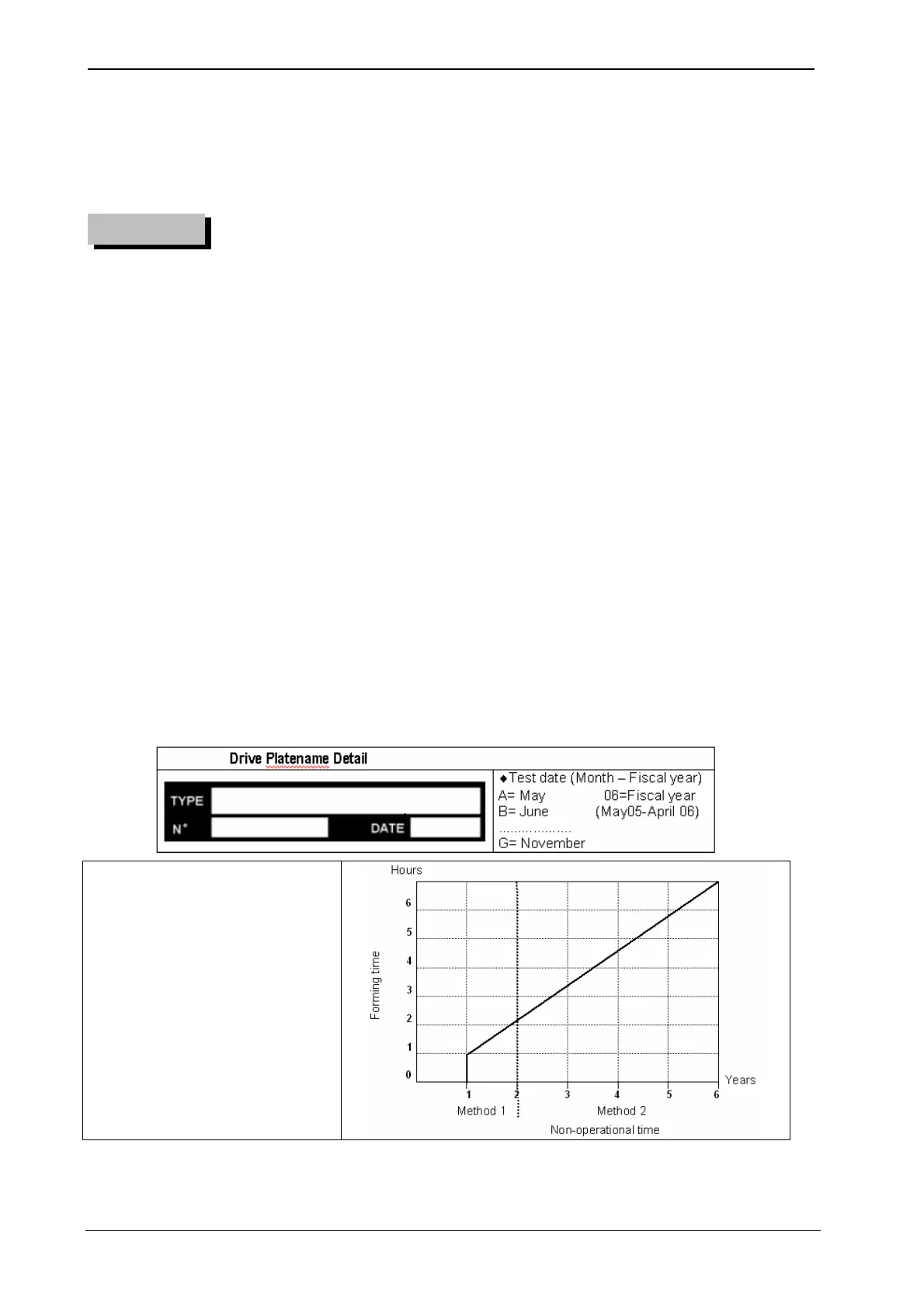
To determine the age of a drive, check the test date on the drive plate name.
Reforming time
The converter is kept at a safe voltage during
the reforming time required to “wake up” the
capacitors. The reforming time required depends
on how long the converter has been stocked
(non-operational):
Figure 4A.2.1
Drives stocked (non-operational) less than two (2) years: Switch the power on to the converter for a time given in Figure 1 (Method 1).
The converter “wakes up” its capacitors by itself.
CAUTION !


 To Next Page