CAUTION
Check that you have properly understood the interdependency and relationships between
the various application parameters and application techniques, including the principles of
laser safety.
In case of any doubt, you should consult a colleague with practical experience and/or an
application specialist of Asclepion Laser Technologies GmbH before you begin with laser
treatment.
CAUTION
To be able to assess the success of a therapy, you should perform an initial trial treat-
ment on a carefully selected test area before you proceed with the treatment of extended
skin areas.
This will enable you to gauge the risk of scarring, the likeliness of a healing effect and a potential
tendency towards post-inflammatory mal-pigmentation. It also enables you to tell the patient what
to expect in advance.
Energy density
= energy per area = fluence
Energy density is the crucial parameter for achieving a desired therapeutic effect. Since the
spot diameter represents a power-of-2 constituent of the area (area = × radius²), a change in
spot size will have a much stronger influence than a change in energy.
This is based on the following mathematical relationships:
Energy density = energy [J] = 127 x energy [J]
[J/cm²] area [cm²] (spot diameter in mm)
2
The energy density is displayed as FLUENCE.
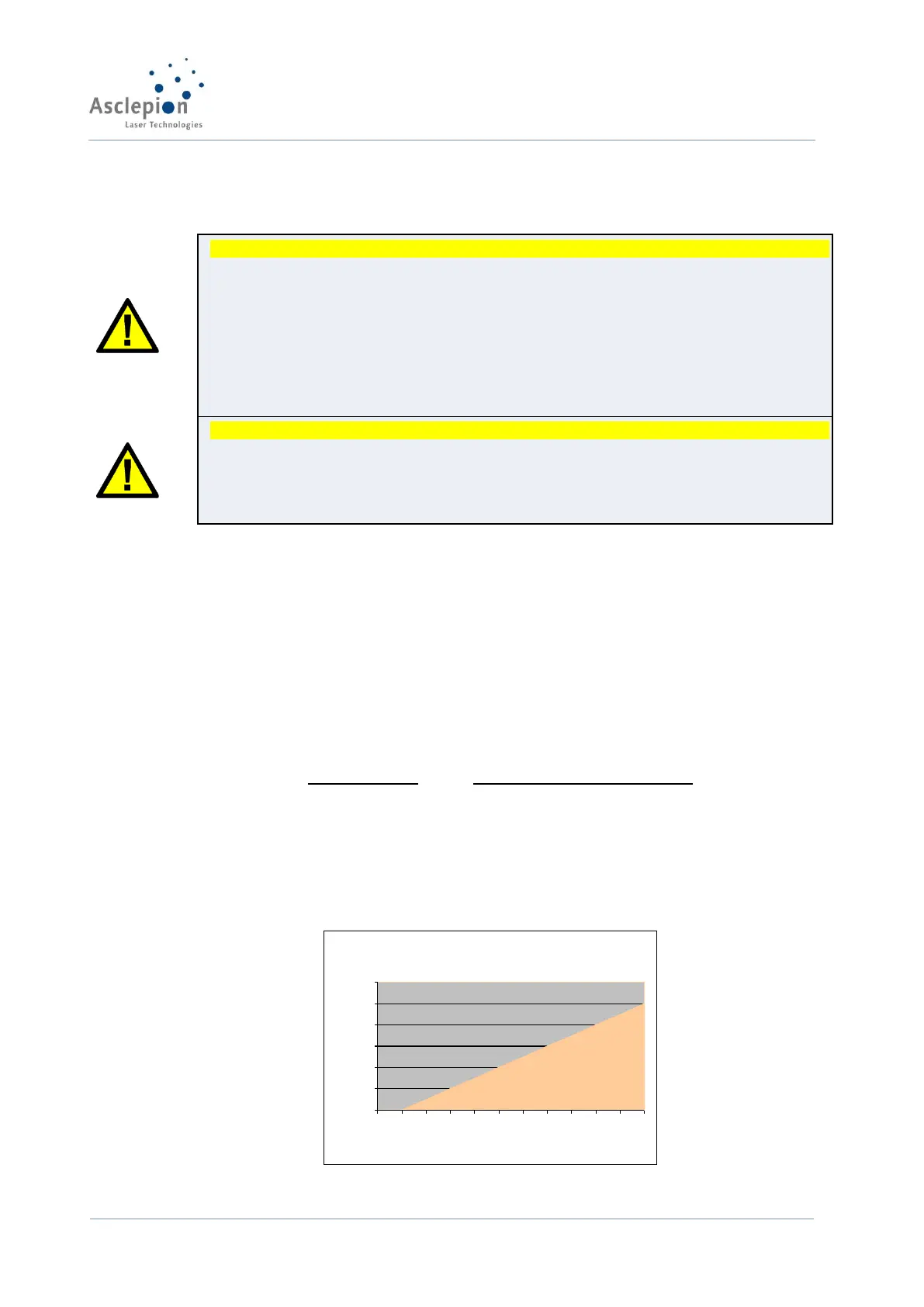
The energy density determines the depth of ablation. Er:YAG lasers perform with a directly pro-
portional relationship, i.e. ablation depth will increase in a linear relationship with increasing ener-
gy density. This is true of a single laser pulse and of a several laser pulses that are applied to the
same location. Figure 21 illustrates this relationship.
Figure 29: Ablation depth as a function of energy density


 To Next Page