" This appliance uses refrigerant R410A.
Comply with the legislation on handling of refrigerants.
3.1 Rules and precautions
" Connections must be made on the same day the
installation is lled with gas (see para. page 24).
• Minimum tools required
- Set of pressure gauges (Manifold) with hoses
exclusively designed for HFCs (Hydrouorocarbons).
- Vacuum gauge with isolation valves.
- Vacuum pump specically for HFCs (using a standard
vacuum pump is allowed if, and only if, it is tted with
a non-return valve on the suction side).
- Flaring tool, Pipe-cutter, Deburring tool, Spanners.
- Certied refrigerant gas leak detector (sensitivity 5g/year).
" Using tools that have been in contact with
HCFCs (R22 for example) or CFCs is prohibited.
" The manufacturer declines any liability with
regard to the warranty if the above instructions
are not observed.
• Flared connections
" Lubricating with mineral oil (for R12, R22) is prohibited.
- Lubricate only with polyolester oil (POE). If POE is not
available, t without lubrication.
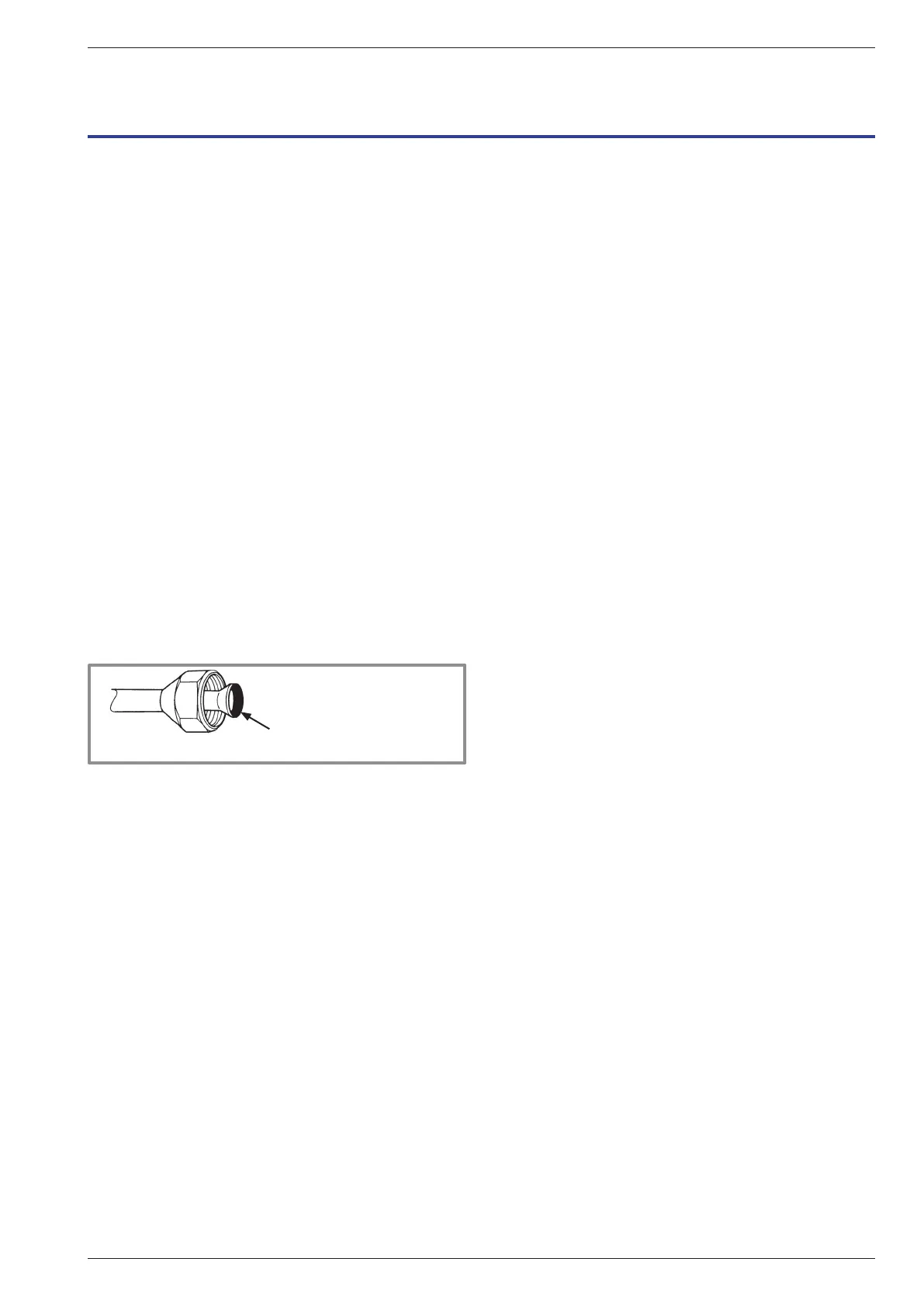
Coat the ared surface with POE
refrigeration oil.
Do not use mineral oil.
• Brazing the refrigeration circuit (if necessary)
- Silver brazing (40% minimum recommended).
- Brazing only with dry nitrogen internal ux.
• Other remarks
- After each maintenance operation on the refrigeration
circuit and before nal connection, take care to put
the caps back in position to avoid any pollution of the
refrigeration circuit.
- To eliminate any lings getting into the pipes, use dry
nitrogen to avoid introducing any humidity that may
adversely aect the appliance's operation. In general,
take every precaution to avoid humidity penetrating
into the appliance.
- Proceed with thermal insulation of the gas and liquid
pipes to avoid any condensation. Use pipe insulators
resistant to temperatures over 90°C. In addition, if the
humidity level in areas where the refrigerant pipes are
installed is expected to exceed 70%, protect the pipes
with pipe insulators. Use an insulating material thicker
than 15mm if the humidity level reaches 80%, and an
insulating material thicker than 20mm if the humidity
exceeds 80%. If the recommended thicknesses are
not observed under the conditions described above,
condensation will form on the surface of the insulation
material. Lastly, use insulating sleeves whose thermal
conductivity will be less than or equal to 0.045 W/mK if
the temperature is equal to 20°C. The insulation must
be impermeable in order to withstand the passage
of vapour during the defrosting cycles (glass wool is
prohibited).
3.2 Shaping the refrigeration pipes
3.2.1 Bending
The refrigeration pipes must be shaped only on a
bending machine or with a bending spring in order to
avoid any risk of crushing or breaking them.
" Warning!
• Remove the insulation material from the section of
pipe to be bent.
• Do not bend copper to an angle greater than 90°.
• Never bend pipes more than 3 times in the same place
otherwise traces of fracturing may appear (hardening
of the metal).
3 Refrigeration connections
and lling the installation with gas
Installation and Operating Manual "1821- EN" - 21 -
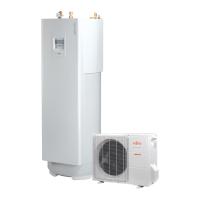
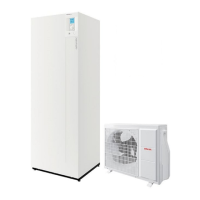
Alféa Extensa Duo A.I. Heat Pump




 To Next Page