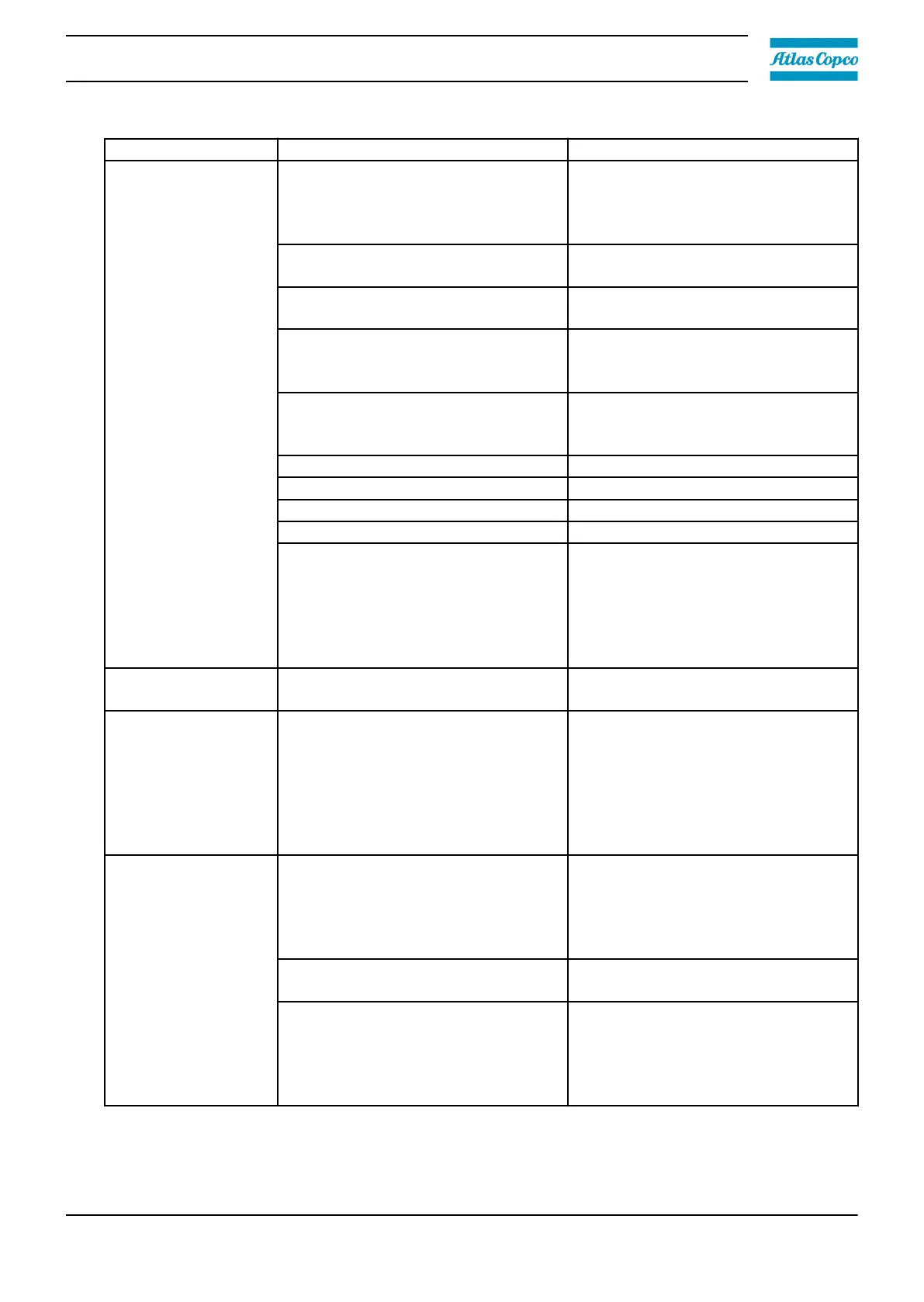
Condition Fault Remedy
High dew point.
The dryer has not had the time to
regenerate completely.
Close the valve installed between
the dryer and the application (if
permitted) and have the desiccant
regenerated.
Liquid water at dryer inlet.
Check PD filter and the drains. Fit an
extra water separator if required.
Excessive flow.
Check actual flow against maximum
specified.
Low inlet pressure.
Check pressure against
specification, and use inlet flow
correction factors where required.
High inlet temperature.
Check temperature against
specification, and use inlet flow
correction factors where required.
Silencer blocked or damaged. Replace silencer.
Air leaks. Tighten joints or fit new seals.
Dirty purge plug. Clean purge plug.
Wrong size purge plug. Contact your supplier.
Shuttle valve stuck in one position.
Check if the exhaust valves closes
off: no air must leave the silencer of
the tower that is drying. If air
escapes from the silencer, check the
connections for air leaks. If no
solution: check the membranes.
The dryer produces a
lot of noise.
Check the silencer and its fixation to
the unit.
Replace the silencer or correct its
fixation.
Insufficient air leaves
the dryer.
Too much purge air escapes.
Check the condition of the solenoid
valve and replace if necessary.
Check the fitting of the solenoid
valve and tube to the bonnet for air
leaks.
Check if the correct purge nozzle is
installed.
Excessive purge air
flow.
Shuttle valve stuck in one position.
Check if the exhaust valves closes
off: no air must leave the silencer of
the tower that is drying. If air
escapes from the silencer, check the
connections for air leaks.
Membrane damaged.
Check the membrane of the tower
that is having the high purge air flow.
Shuttle O-ring damaged.
If the shuttle does not seal, there will
be a leak path between inlet air and
exhaust. Open the valve block and
inspect the shuttle O-ring. Replace
O-ring if needed.
Instruction book
2920 7219 10 75



 To Next Page