I N S T A L L A T I O N a nd P OWER
page 1 – 7
D-75 / Sep 2004
CONNECTORS - All AES/EBU connections are made with the
supplied DB-25 connectors. These crimp style connectors will accept wire
gauge 24 - 28AWG.
SPDIF INPUTS - The SPDIF (Sony/Phillips Digital Interface) or
“consumer” digital audio interface is a two wire unbalanced signal
typically on a single RCA style connector. We recommend using shielded
twisted pair cables for these connections. Wire the SPDIF center conduc-
tor (HOT) to the SRC-75 “HI” input pin using one wire of the pair and wire
the SPDIF shell (ground) to the SRC-75 “LO” input pin. Connect the
cable’s shield to the SRC-75 “SH” pin, leaving the shield floating (that is,
not connected) at the SPDIF end.
The SRC-75 digital input audio card is provided with 110Ω/75Ω
switches on the A and B inputs to allow impedance matching with 75Ω
sources.
Unbalanced Connections (analog audio)
ANALOG INPUTS — Wire to the console with typical shielded two
conductor cable (like Belden 9451), just as if you were connecting a
balanced source. At the unbalanced source machine’s output, connect the
black wire (LOW) to the shield. If the machine has a -10 dBu output, don’t
hesitate to turn module input gain as high as is needed.
ANALOG OUTPUTS — D-75 consoles use a balanced output circuit
which behaves exactly like the secondary of a high-quality transformer,
with no center tap—this output is both balanced and floating. Either the
HIGH or LOW side of the output should be strapped to ground, with the
output taken from the other side. (Normally you’d strap LOW to ground,
and take HIGH to feed your unbalanced equipment.)
Modules Layout
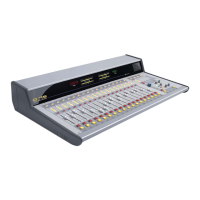
The D-75 console’s mainframe comes supplied with 20 (for 26 pos.
frame) or 12 (for 18 pos. frame) input modules along with an output
module, a control room module, and a studio control module. Each module
type has its assigned slot (see drawings on pages 1-10 and 1-11). To handle
mic level inputs, a quad mic preamp is included. Also there can be optional
modules: a superphone, a second quad mic preamp, a line preselect, and
a tape remote. Modules must be placed in the slots indicated on the module
layout drawings that follow.


 To Next Page