page 7 – 2
D-75 / Sep 2004
SUPERPHONE INPUT
Superphone Input
(SP-75; optional)
Module Overview
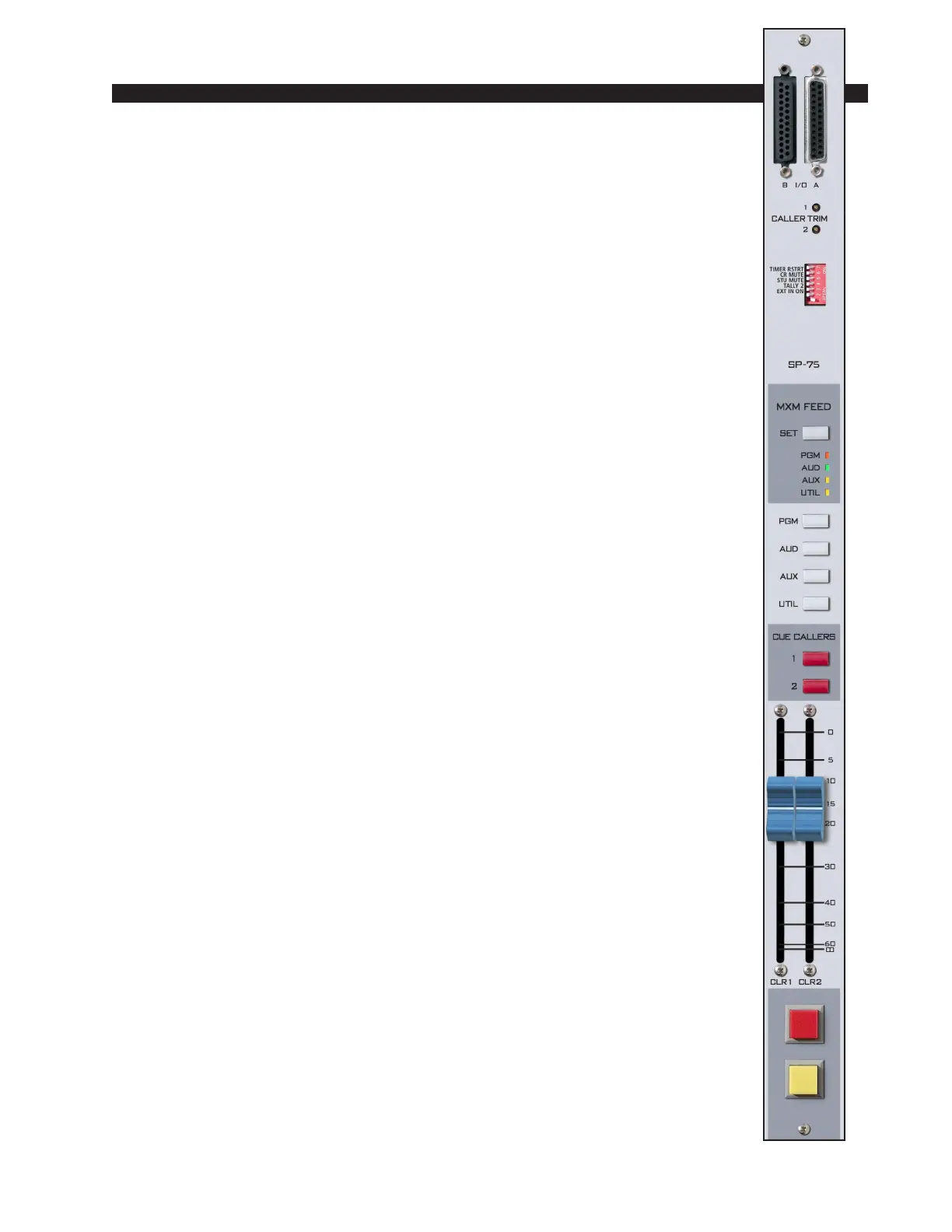
The SP-75 input module is used for telephone call-ins, and can handle two
callers. Caller signals enter the module from your station hybrid. Each caller
has its own fader.
Output switches assign callers to any combination of the console’s
four outputs: PGM (program), AUD (audition), AUX (auxiliary), and/or
UTIL (utility).
Two recessed front panel trimpots at the top of the module adjust the input
gain of the two CALLER signals.
Caller Set-Ups
Pre-air segment communication between the console operator (DJ) and
callers is via CUE buttons (2) which place the callers’ voices on the console’s
cue speakers (or control room speakers/operator’s headphone if the CR-75
module’s cue interrupt function has been so programmed). These cue signals
can be programmed pre or post fader.
The DJ can assign his microphone input module to an unused output
bus—say UTIL—and the DJ then selects the UTIL input with the MXM FEED
SET switch. This sends a dedicated (digitally generated) version of the UTIL
bus signal to the SP-75 module’s hybrid output, where it is ultimately heard
by the caller through his telephone. This mix minus source select method can
also be used to preplay a musical segment (or any other program content) for
the caller off-air. Take the IN-75 input module handling the desired music cut
and assign it to an unused output bus; select the same bus as the caller’s mix
minus source input and he will hear it off-air.
For convenient handling of call-ins, the console ships with the UTIL bus
assignments from IN-75 input modules made pre-fade and pre-on. That way,
when you use UTIL as the caller MXM FEED source, the DJ mic, and any
other inputs you want the caller to hear, do not need to be turned on or faded
up for the callers to hear them, as long as those inputs are assigned to UTIL.
If desired, the input pre-fade, pre-on feed to UTIL can be defeated (see
page 10-4), resulting in UTIL being fed post-fade, post-on for all inputs.
Regardless of this setting, the caller audio to the UTIL bus is always post-fade,
post-on.
The DJ microphone input module can also be assigned via dipswitch to the
console’s talkback (TB) bus. Any audio on the TB bus is heard by a caller when
that caller’s cue button is pressed, if the Hybrid 1 Out and Hybrid 2 Out
connections are used.
The SP-75 also has an external mono audio input that can be selected via
dipswitch to feed both caller outputs. One possible application is to feed the
output of the DJ microphone QMP-4 channel both to the IN-75 input and the
SP-75 external input. If the SP-75 dipswitch is set to enable the external input
the DJ’s voice is always sent to the callers.
D-75 / Mar 2009


 To Next Page