The cameras can be operated non-overlapped
*)
or overlapped. Depending on the mode
used, and the combination of exposure and readout time:
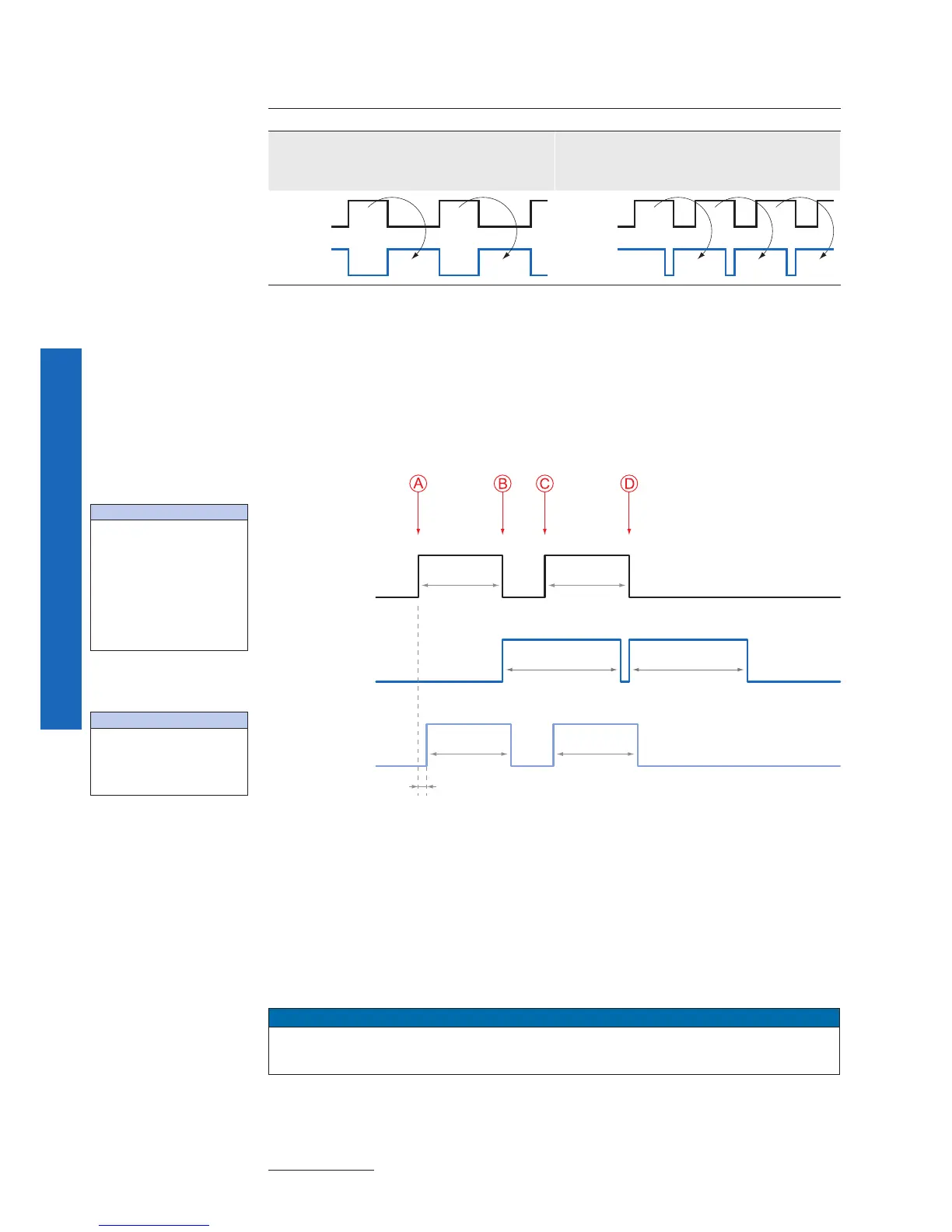
Non-overlappedOperation OverlappedOperation
Here the time intervals are long enough
to process exposure and readout succes-
sively.
In this operation the exposure of a frame
(n+1) takes place during the readout of
frame (n).
2.4.1 FreeRunningMode
In the "Free Running" mode the camera records images permanently and sends them to
the PC. In order to achieve an optimal (with regard to the adjusted exposure time t
exposure
and image format) the camera is operated overlapped.
In case of exposure times equal to / less than the readout time (t
exposure
≤ t
readout
), the maxi-
mum frame rate is provided for the image format used. For longer exposure times the
frame rate of the camera is reduced.
Exposure
Readout
Flash
t
exposure(n)
t
flash(n)
t
flashdelay
t
flash(n+1)
t
readout(n+1)
t
readout(n)
t
exposure(n+1)
t
ash
= t
exposure
Fixed-Frame-RateMode2.4.2
With this feature Baumer introduces a clever technique to the TXG camera series, that
enables the user to predene a desired frame rate in continous mode.
For the employment of this mode the cameras are equipped with an internal clock genera-
tor that creates trigger pulses.
Notice
From a certain frame rate, skipping internal triggers is unavoidable. In general, this de-
pends on the combination of adjusted frame rate, exposure and readout times.
*) Non-overlapped means the same as sequential.
Imageparameters:
Offset
Gain
Mode
Partial Scan
Timings:
A - exposure time
frame (n) effective
B - image parameters
frame (n) effective
C - exposure time
frame (n+1) effective
D - image parameters
frame (n+1) effective


 To Next Page