5.4 TransmissionDelay
Another approach for packet sorting in multi-camera operation is the so-called Trans-
mission Delay, which was introduced to Baumer Gigabit Ethernet cameras in hardware
release 2.1.
Due to the fact, that the currently recorded image is stored within the camera and its
transmission starts with a predened delay, complete images can be transmitted to the
PC at once.
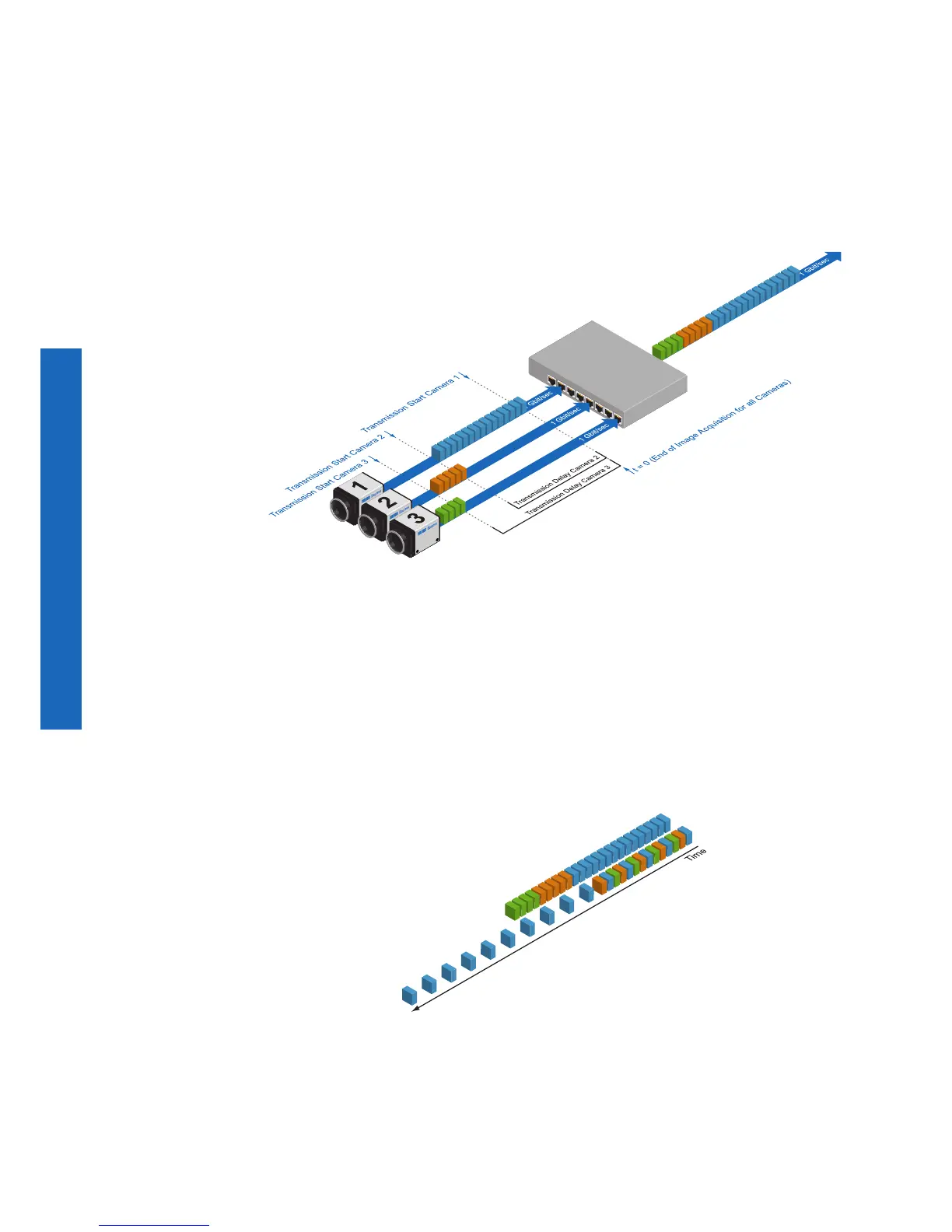
The following gure should serve as an example:
For the image processing three cameras with different sensor resolutions are employed –
for example camera 1: TXG13, camera 2: TXG06, camera 3: TXG03.
Due to process-related circumstances, the image acquisitions of all cameras end at the
same time. Now the cameras are not trying to transmit their images simultaniously, but –
according to the specied transmission delays – subsequently. Thereby the rst camera
starts the transmission immediately – with a transmission delay "0".
TimeSavinginMulti-CameraOperation5.4.1
As previously stated, the transmission delay feature was especially designed for multi-
camera operation with employment of different camera models. Just here an signicant
acceleration of the image transmission can be achieved:
For the above mentioned example, the employment of the transmission delay feature re-
sults in a time saving – compared to the approach of using the inter paket gap – of approx.
45% (applied to the transmission of all three images).
Figure67►
Principle of the trans-
mission delay.
Figure68►
Comparison of trans-
mission delay and inter
packet gap, employed
for a multi-camera sys-
tem with different cam-
era models.


 To Next Page