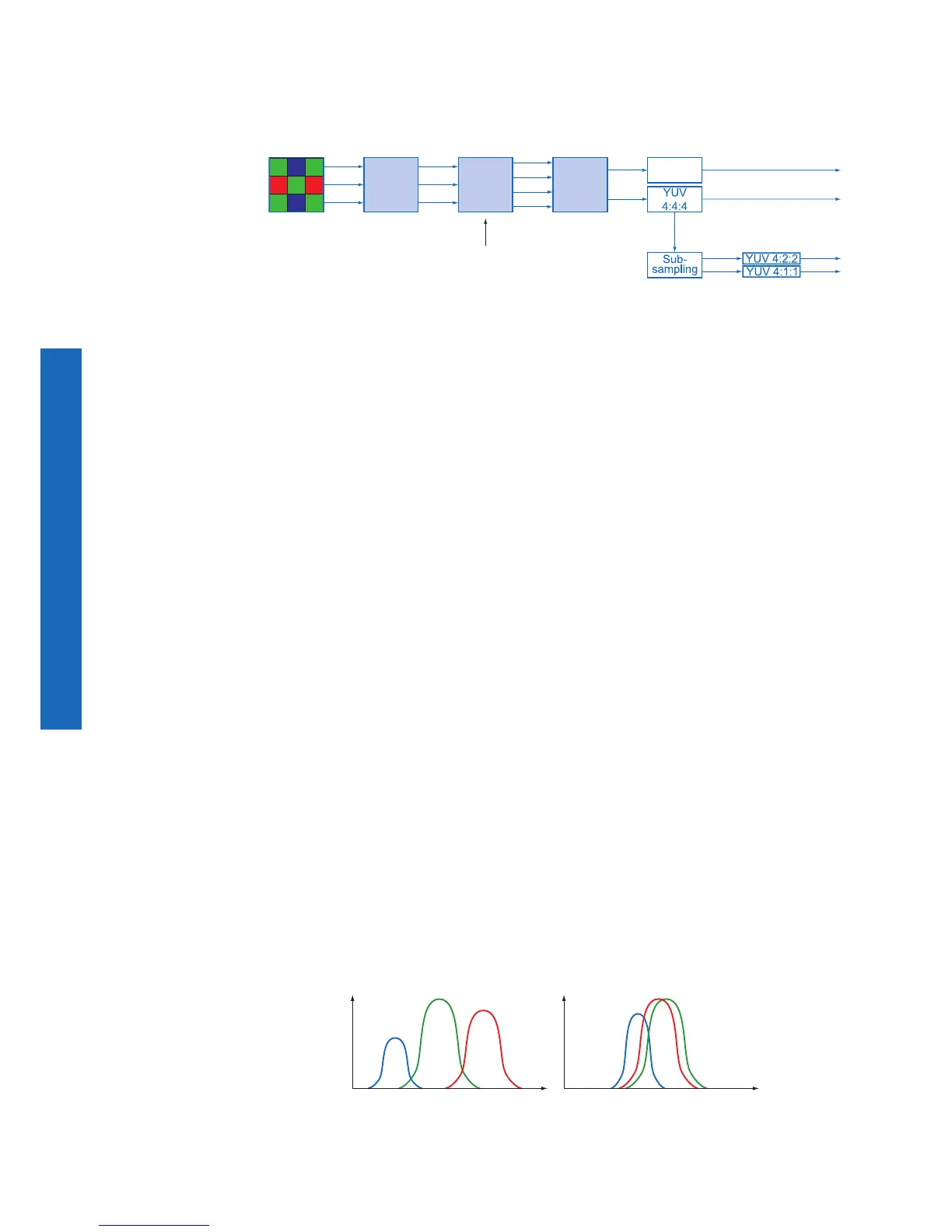
The color signals r (red), g (green) and b (blue) of the sensor are amplied in total and
digitized within the camera module.
Within the Bayer processor, the raw signals r', g' and b' are amplied by using of indepen-
dent factors for each color channel. Then the missing color values are interpolated, which
results in new color values (r'', g'', b''). The luminance signal Y is also generated.
The next step is the color transformation. Here the previously generated color signals r'',
g'' and b'' are converted to the chroma signals U and V, which conform to the standard.
Afterwards theses signals are transformed into the desired output format. Thereby the
following steps are processed simultaneously:
Transformation to color space RGB ▪ or YUV
▪ External color adjustment
Color ▪ adjustment as physical balance of the spectral sensitivities
In order to reduce the data rate of YUV signals, a subsampling of the chroma signals can
be carried out. Here the following items can be customized to the desired output format:
Order of data output ▪
Subsampling of the chroma components to ▪ YUV 4:2:2 or YUV 4:1:1
Limitation of the data rate to 8 bits ▪
4.3 Color Adjustment–WhiteBalance
This feature is available on all color cameras of the Baumer TXG series and takes
place within the Bayer processor.
White balance means independent adjustment of the three color channels, red,
green and blue by employing of a correction factor for each channel.
User-specic4.3.1 Color Adjustment
The user-specic color adjustment in Baumer color cameras facilitates adjustment of the
correction factors for each color gain. This way, the user is able to adjust the amplica-
tion of each color channel exactly to his needs. The correction factors for the color gains
range from 1 to 4.


 To Next Page