Commissioning
EL377392 Version: 2.5
Bit Name Description
SW.5 Limit 2 1
bin
See Limit [}96]
SW.4 1
bin
SW.3 Limit 1 1
bin
See Limit [}96]
SW.2 1
bin
SW.1 Overrange 1
bin
Analog input signal lies above the upper permissible threshold for this
terminal
SW.0 Underrange 1
bin
Analog input signal lies under the lower permissible threshold for this
terminal
Control word
The EL3773 has no control word
Synchronization, trigger and conversion time
The EL3773 generally operates in oversampling mode. It can be operated with and without Distributed
Clocks activated.
Distributed Clocks activated
• the EtherCAT system-wide synchronized Distributed Clocks also encompass this EL3773
• the terminal then operates synchronously with all other DC devices
• the sampling clock is derived from the local DC in the EtherCAT slave controller (SYNC0:
Oversampling, SYNC1: Provision of the data)
Advantages
• several EL3773 record the measured values of all their channels synchronously
• accurate time stamp of the individual samples
The following limit values are to be observed
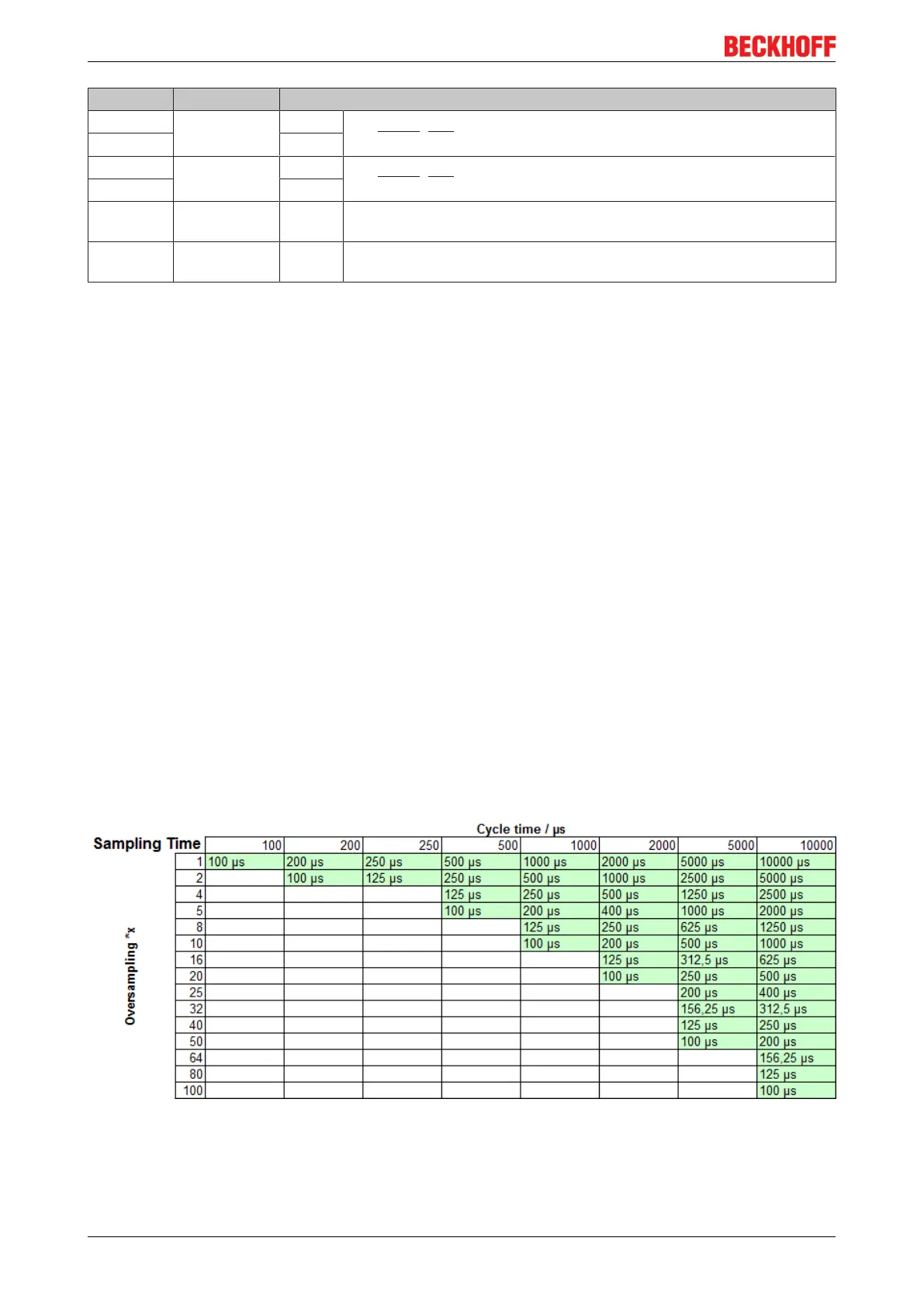
• minimum sampling time 100 µs (10,000 kSps)
• only non-periodic values are permissible for the sampling rate
• the PDO StartTimeNextlatch can only be used/activated with cycle times > 100 µs
Table of sampling times
Fig.106: Samplingtime
The minimum EtherCAT cycle time for the EL3773 is 100 µs. In order to activate Distributed Clocks, "DC" is
to be selected in the Predefined PDO list, so that amongst others the time stamp PDO is selected




 To Next Page