Page 23
9487 Dielman Rock Island Ind Dr, St. Louis, MO 63132 www.becs.com
Installation and Technical Manual Rev: H10
E – 2: Single Point Calibration
To enter the calibration menu, press and hold the Cal
key for three seconds. If the Operator and Rep
access codes have been set, the unit will prompt you
for your access code, otherwise the display clears
followed by Cal pH and the current pH reading. For
help entering your access code, see
D - 1.1:
Entering the Program Menu
.
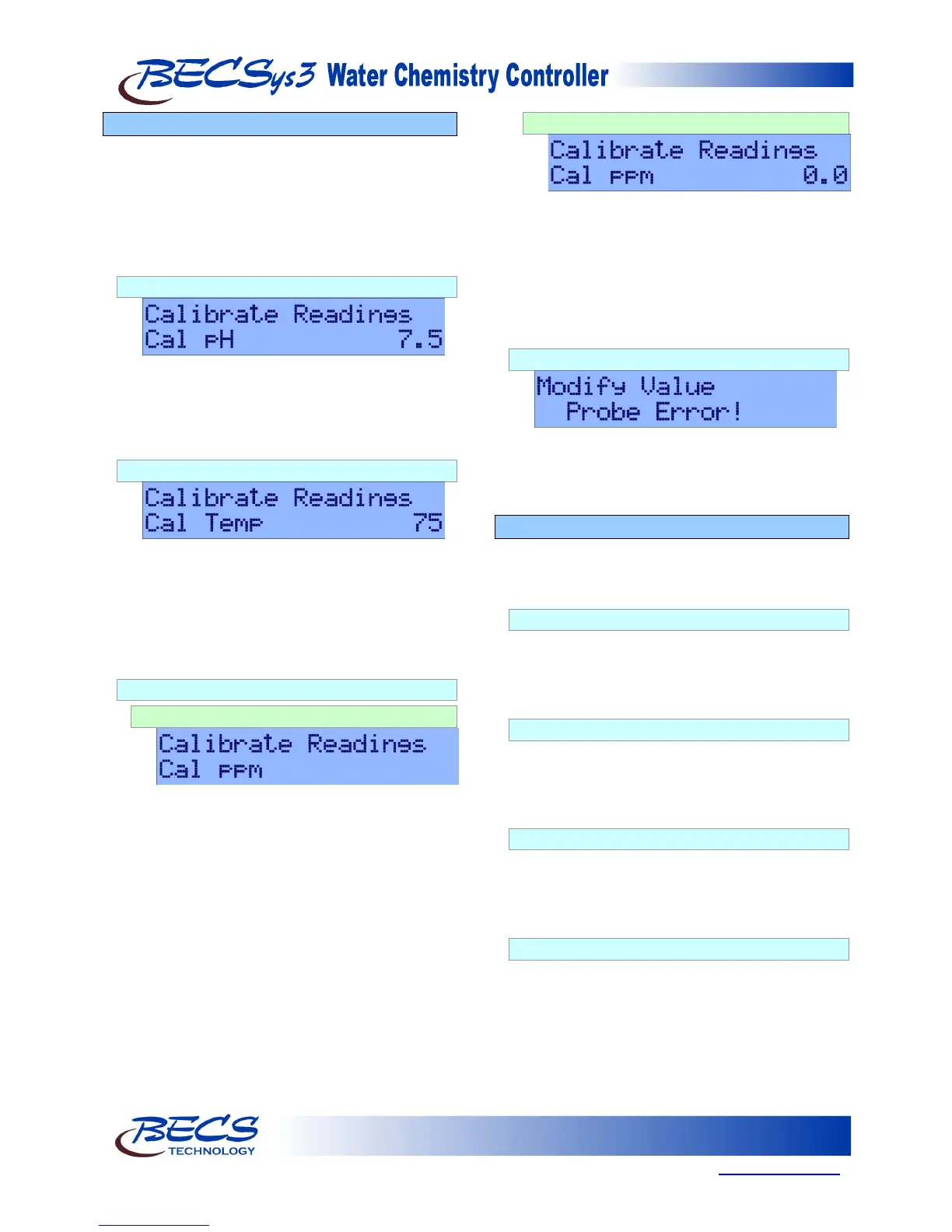
E – 2.1: Single Point Calibration - pH
The display should now read Cal pH followed by
the current pH reading. To calibrate the pH, press
the Enter key. Use the Arrow keys to adjust the
displayed value to match your test kit reading, and
then press the Enter key to save it.
E – 2.2: Single Point Calibration - Temp
This is only shown if the controller is configured to monitor
temperature. Pressing the Down arrow key, the
display will show Cal Temp followed by the
current Temp reading. To calibrate the
temperature, press the Enter key. Use the Arrow
keys to adjust the displayed value to the measured
value then press the Enter key to save it.
E – 2.3: Single Point Calibration – ppm
E – 2.3.1: Calculated ppm
This is only shown if the controller is configured to use
calculated ppm. Pressing the Down arrow key, the
display will show Cal ppm and the ppm LED's
will be flashing. To calibrate the ppm, press the
Enter key. Use the Arrow keys to adjust the
LED bar graph to match your test kit reading,
and then press the Enter key to save the value.
E – 2.3.2: ppm Probe
This is only shown if the controller is configured to use a
ppm probe. Pressing the Down arrow key, the
display will show Cal ppm followed by the
current ppm reading. To calibrate the ppm,
press the Enter key. Use the Arrow keys to
adjust the displayed value to match your test kit
reading, and then press the Enter key to save the
value.
E – 2.4: Probe Error
Probe error indicates the value attempting to be
calibrated is out of range. See the troubleshooting
section at the end of this manual for more
information.
E – 3: Alarms
During normal operation, the following alarms may
be displayed. Some alarms will not be shown
depending on the system's configuration.
E – 3.1: pH High/Low alarms
This is displayed when the pH input has risen
above/fallen below the pH high/low alarm point.
These alarms will also trigger the Cl/Br Lockout
alarm.
E – 3.2: ORP High/Low alarms
These alarms are displayed if the controller is configured to
control off the ORP input. This is displayed when the
ORP input has risen above/fallen below the ORP
high/low alarm point.
E – 3.3: ppm High/Low alarms
These alarms are displayed if the controller is configured to
control off the ppm input. This is displayed when the
ppm input has risen above/fallen below the ppm
high/low alarm point.
E – 3.4: Temperature High/Low alarms
These alarms are displayed when the controller is configured
to monitor temperature. This is displayed when the
Temperature input has risen above/fallen below
the Temperature high/low alarm point.


 To Next Page