Page 5
9487 Dielman Rock Island Ind Dr, St. Louis, MO 63132 www.becs.com
Installation and Technical Manual Rev: H10
A – 5: Free Chlorine Sensor
The BECSys3 can be ordered to accept two different
Free Chlorine Sensors: the CCS140 or the ECL6.
A – 5.1: CCS140
The CCS140 Free Chlorine Sensor can be
connected to the BECSys3 using the appropriate
option board. The CCS140 Free Chlorine Sensor
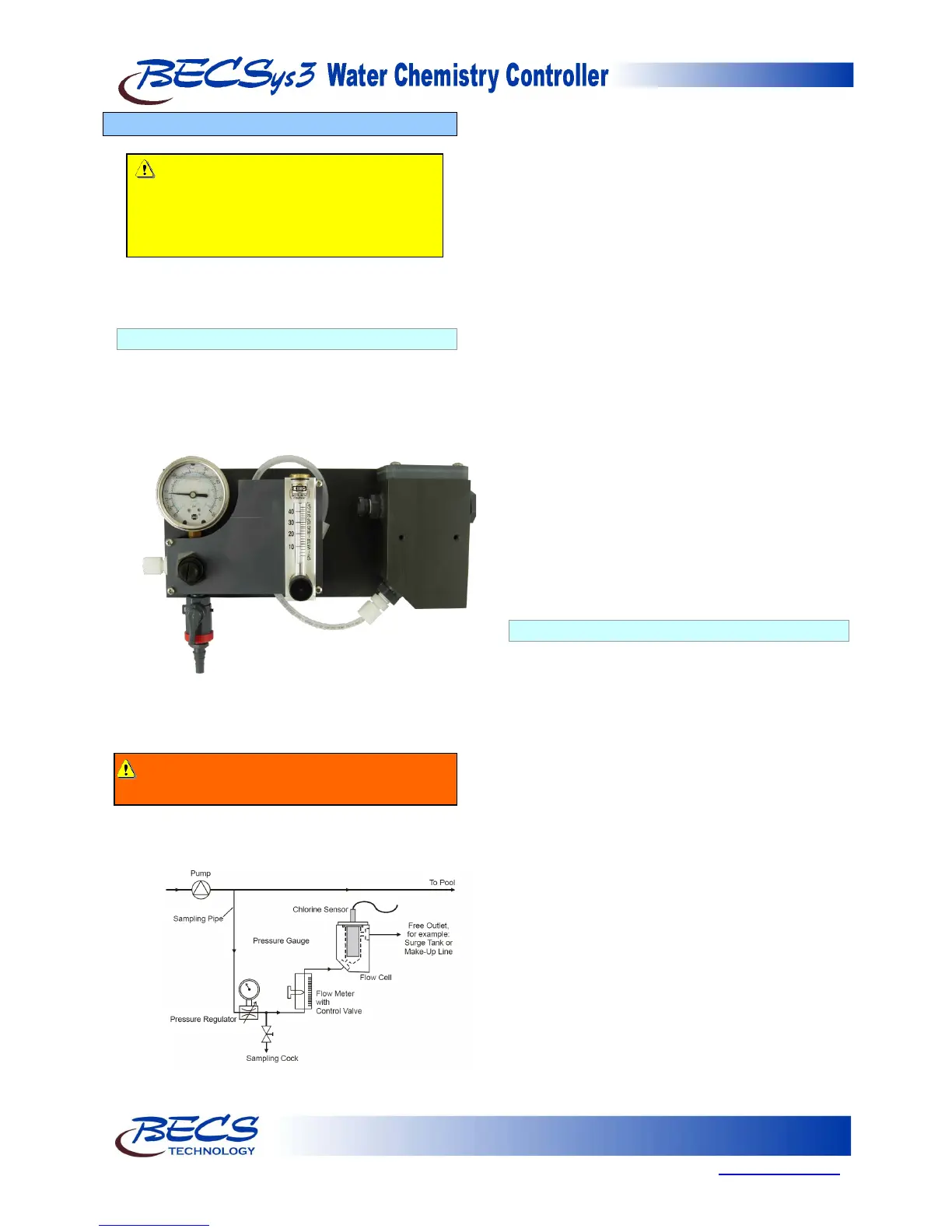
is mounted in a flow cell which includes a flow and
psi restrictor assembly as shown below:
The CCS140 Free Chlorine Sensor requires a
constant flow rate and a constant pressure. This
helps ensure that the ppm level will remain stable.
Here is the recommended method for plumbing
the free chlorine sensor flow cell:
Admission pressure must be above the regulated
pressure (15 psi is the limit on the sensor). Run
the sample stream through a flow restrictor valve
(to maintain flow rate, minimum flow rate
requirement is 8 gph). Take the stream through
the flow cell. Discharge the sample stream to a
free outlet (for example into a surge tank).
The CCS140 Free Chlorine Sensor is supplied with
a yellow protective cap. This cap has an inner
sponge that is used to keep the sensor membrane
hydrated. This cap should be saved for long-term
storage.
The sensor can remain in the flow cell for short-
term interruptions in measurement. To prevent
membrane dehydration, the flow cell must not
drain off. If this is not ensured, then remove the
sensor from the flow cell and slide the yellow
protective cap, moistened at the inner sponge,
onto the measuring end of the sensor.
The voltage applied by the controller to the
CCS140 Free Chlorine Sensor polarizes the surface
of the gold cathode. The polarization period (30
minutes) must elapse before calibration is
performed based on the results acquired through
the use of a DPD test kit.
See Section H - 2.3 for filling the electrolyte.
A – 5.2: ECL6
The ECL6 Free Chlorine Sensor can be connected
to the BECSys3 using the appropriate option
board.
Caution: Amperometric chlorine sensors
require the use of a temperature sensor and
a properly calibrated pH sensor. Refer to
the instruction pamphlet included with the
sensor at the time of installation.
Warning: Negative pressure will damage the
sensor membrane.


 To Next Page