21
The size of the required storage space depends on the
building‘s heating load, but should be chosen large enough
to store 1.5 times the annual fuel quantity.
If the unusable room volume is taken into account,
the following rule of thumb results:
6.2 SIZE OF THE PELLET STORAGE ROOM
PLANING FOLDER PELLET BOILER
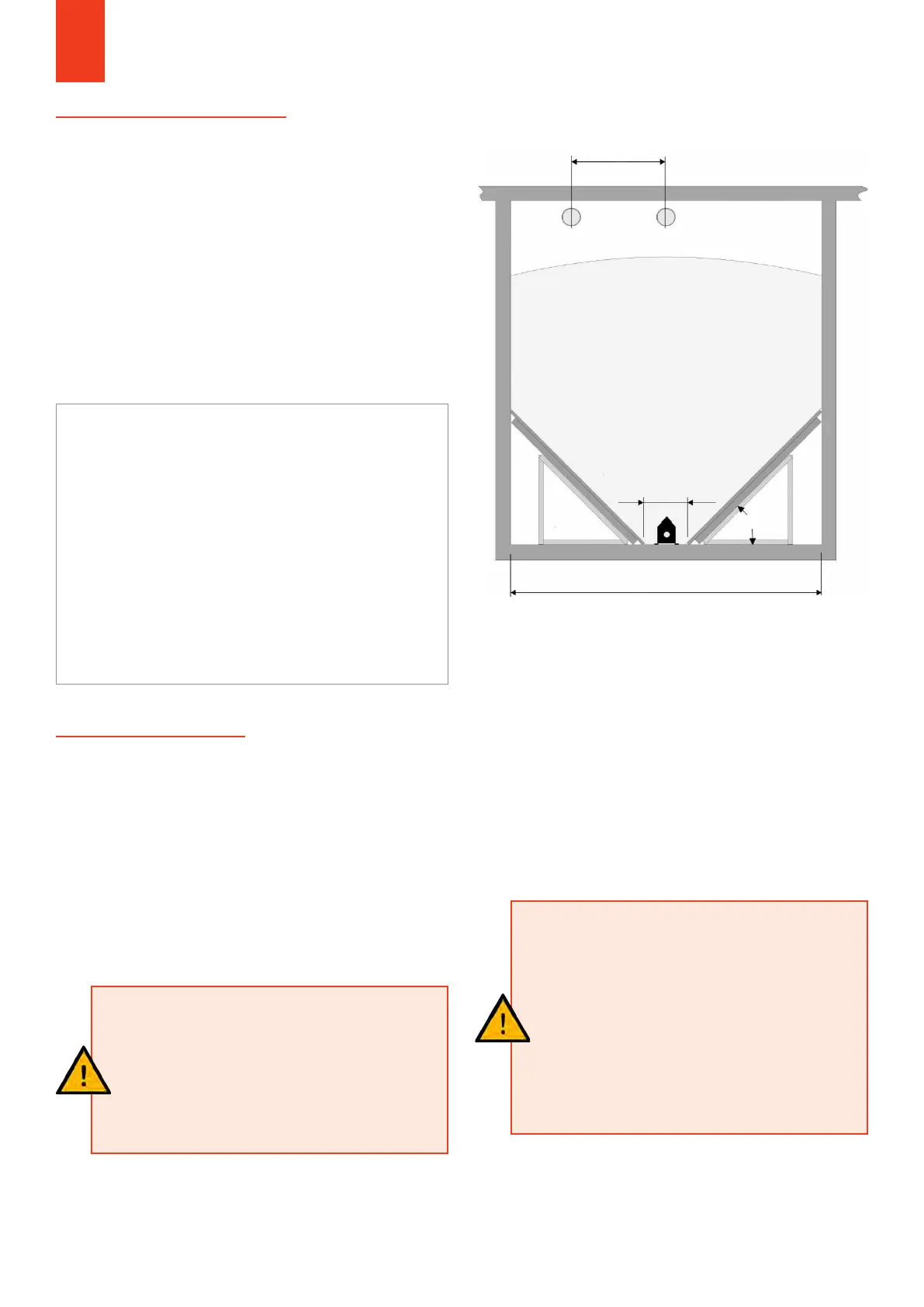
All dimensions in mm!
Filling nozzle
Screw discharge
Empty space
300
min. 500
e.g. 2000
45°
Airspace
Usable Volume
= approx. ⁄ of the room volume
(Storage room cannot be filled all the
way to the top)
Per 1 kW heating load
Usable storage space
1 m pellet quantity
Energy content
=
=
=
=
0,4-0,9 m storage room -
depending on insulation status of
the house (incl. empty space)
2/3 storage room (incl. empty space)
650 kg
ca. 5 kWh/kg
15 kW heating load
x 0,9 m/kW
Usable volume
Storage room size
Amount of energy
stored
=
=
=
=
13,5 m storage space volume
(incl. empty space)
13,5 m x 2/3 = 9 m
13,5 m : 2,4 m (room height)
= 5,6 m storage space (however
it should not be less than 2.0x3.0
meters)
5850 kg x 5 kWh/kg = 29250 kWh
(corresponds to a heating oil
quantity of approx. 3000 litres)
EXAMPLE: Single-family house with a heating load
of 15 kW = 5,800 kg pellets annual requirement
The walls of the storage room must meet the static
requirements of the weight load of the pellets (density
650 kg/m³). The following wall thicknesses have proven
themselves in practice (wall length maximum 5.0 metres,
height 2.5 metres):
• Medium-heavy vertically perforated brick 11.5 cm,
plastered on both sides
• Concrete 10 cm
• Brick 12 cm, plastered on both sides
• Wooden stud walls made of 8 cm frame legs, spacing 50
cm, planked on both sides with 20 mm OSB boards.
The weight of the pellets does not only act vertically downwards
(on the bottom of the store) but also horizontally on the side
walls due to internal friction. A maximum overpressure of 0.03
bar must be taken into account for the blowing-in process.
MOISTURE PROTECTION
Pellets are strongly hygroscopic. If they come into contact
with water or damp surfaces, e.g. walls, the pellets swell up to
4 times their volume, disintegrate and are thus unusable, or,
in the case of a full storage room, can lead to damage to the
interior and exterior walls!
6.3 STATIC REQUIREMENTS FOR THE PELLET STORE
IMPORTANT:
It is essential to ensure that the pellet store is
dust-tight. Aerated concrete blocks (Ytong)
are not recommended. If the outer walls
are made of aerated concrete, they must be
covered with OSB boards. Furthermore, the
structural connection to the ceiling, floor and
walls must be ensured.
ATTENTION:
• The pellet store must remain dry all year
round.
• If there is a risk of temporarily damp walls
(e.g. old buildings), it is recommended
that a ventilated facing shell be attached
to the walls. Alternatively, storage in
containers such as a bag silo is an option.
• Outdoor bag silos and discharge units
must be protected from rainwater, splash
water and direct sunlight (e.g. carport,
wooden sheds...).


 To Next Page