Operations Guide
This section contains information about configuring and using your DataMan reader.
Trigger Modes
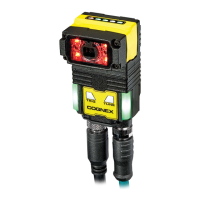
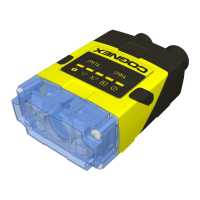
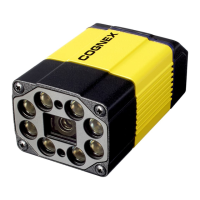
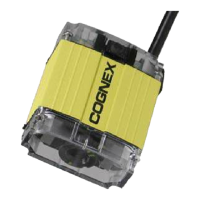
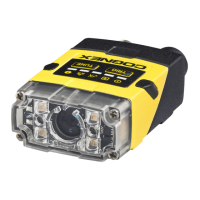
The fixed-mount DataMan readers provide the following trigger modes:
Self-Trigger
DataMan fixed-mount readers support self-triggered operation. In self-trigger mode, the reader automatically detects and
decodes codes in its field of view. The high-speed image acquisition and processing capabilities of the DataMan allow it
to detect and decode codes.
Self-trigger mode has the following characteristics:
l Ease of setup. No external trigger is required.
l Flexible timing. Parts can arrive at irregular intervals.
l Maximum throughput.
Manual
Manual triggering starts acquiring and attempting to decode images when you send an external trigger. The reader
continues to acquire and attempt to decode images until you stop the external triggering. 2-D DPM codes are
automatically learned.
Manual trigger mode is typically used during debugging or system design.
Burst
Burst triggering acquires a pre-defined number of images when an external trigger is signaled, then attempts to decode
the acquired images. You can control the interval between the acquired images. The number of images acquired per
burst depends on the size of the region of interest that you specify.
Continuous
Continuous triggering begins acquiring images based on a single external trigger and continues to acquire and decode
images at a user-specified interval until a symbol is found, or until multiple images containing as many codes as
specified in multicode mode are located. The external trigger can be configured as a latch (acquisition continues while
the line is held high) or acquisition can be started on the first pulse, stopped on the second pulse. If you scan items on a
conveyor, make sure that each item reaches trigger OFF before the next item generates trigger ON.
Single
Single triggering acquires a single image and attempts to decode any symbol it contains, or more than one symbol in
cases where multicode is enabled. The reader relies on an external trigger source.
Presentation
Presentation triggering repeatedly scans for a symbol and decodes it whenever one is detected. The reader relies on an
internal timing mechanism to acquire images.
157
Operations Guide




 To Next Page