7. Configuration of IP-Terminals GE 800
40 1.1/1209
with NAT
” on page 59).
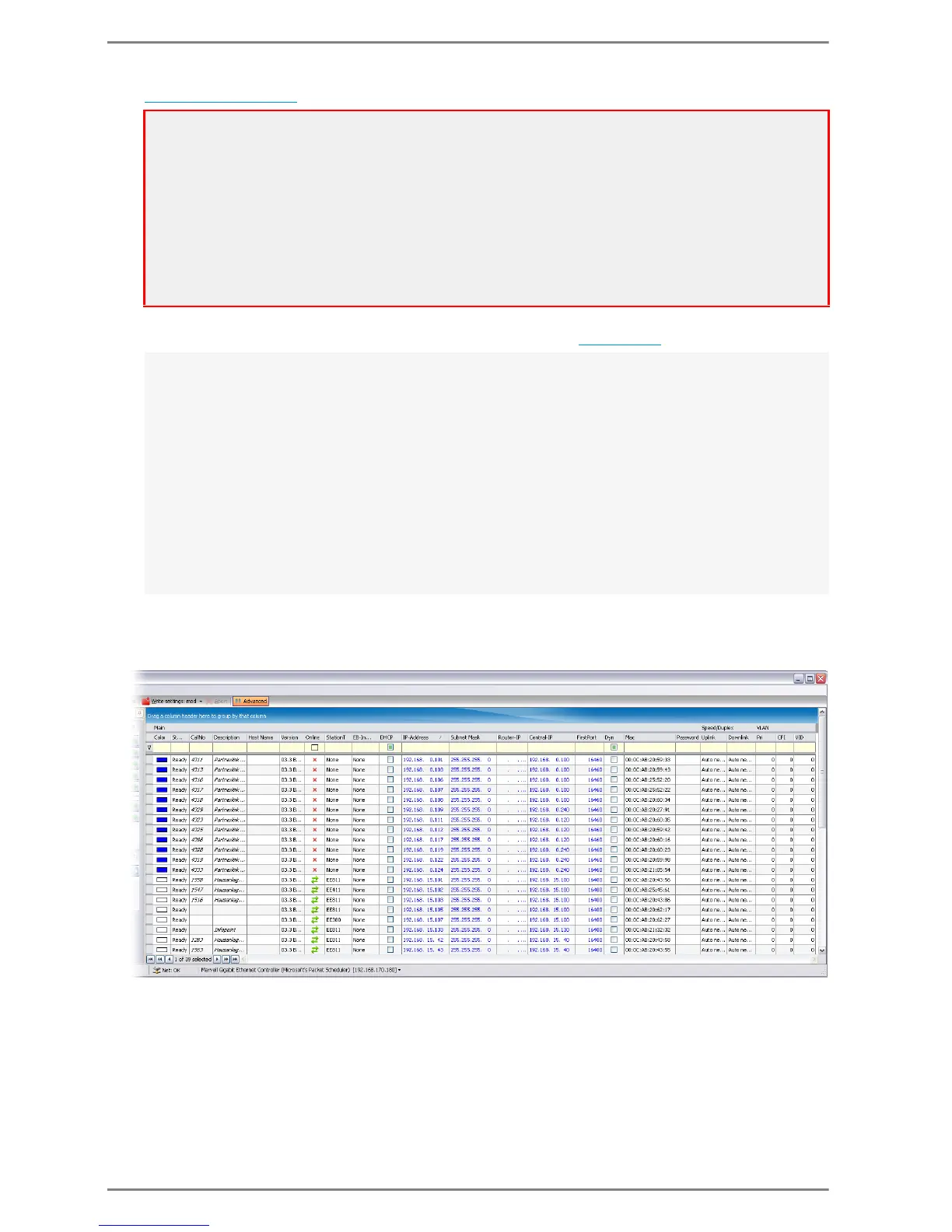
Via the checkbox Dyn, the dynamic registration via the MAC-address can be activated.
Attention: This feature additionaly has to be activated in CCT see page 44
.
In the column Mac the MAC-address of the IP-subscriber is indicated.
Click on the button Advanced, to display further columns:
In the column Color a color coding can be advised to subscribers.*
In the column CallNo the call number of the IP-station / IP-box can be changed.
*
In the column Description a text for identification of the IP-station / IP-box can be entered.*
Attention:
Single Port Protocol is only supported by IP-terminals with firmware versions as of:
ET 901: 02.4 Build 03 / 03.1 Build 03
DSP900 (for ET 908): 03.1 Build 04
G8-IP: 02.5 Build 03 / 03.0 Build 02
When changing the port number of IP-terminals with older firmware versions, the start port number will be
changed – the following ports are changed as well (e.g. first Port No. = 16400 → following ports = 16401,
16402, 16403 and 16404).
General note:
The port 16399 is used by the program “IPStationConfig” for configuration of the devices.
Short Description – Dynamic Registration:
By means of this feature, the registration of an IP-terminal on an Intercom Server even via a non-static Internet
access (e.g. ADSL) is possible (note: for the Intercom Server always a static public IP-address is required).
The registration of the IP-terminals on the Intercom Server is done with the current IP-address & port num-
ber. The allocation subscriber – device will no longer be done via the IP-address & port number, but exclu-
sively via the MAC-address of the IP-device. Thus, several IP-terminals configured for dynamic registration,
can be registered on the Intercom Server with the same port number and the same IP-address.
Consider: Static and dynamic devices NEVER may have the same port number & IP-address!
Note MAC-Address:
The dynamic registration of an IP-terminal described above is enabled by transferring the MAC-address of
the Intercom device, in the data payload of the IP-packet.
If the MAC-address can be set manually (like for the “Intercom Client”), then these IP-terminals may never
have the same MAC-address.


 To Next Page