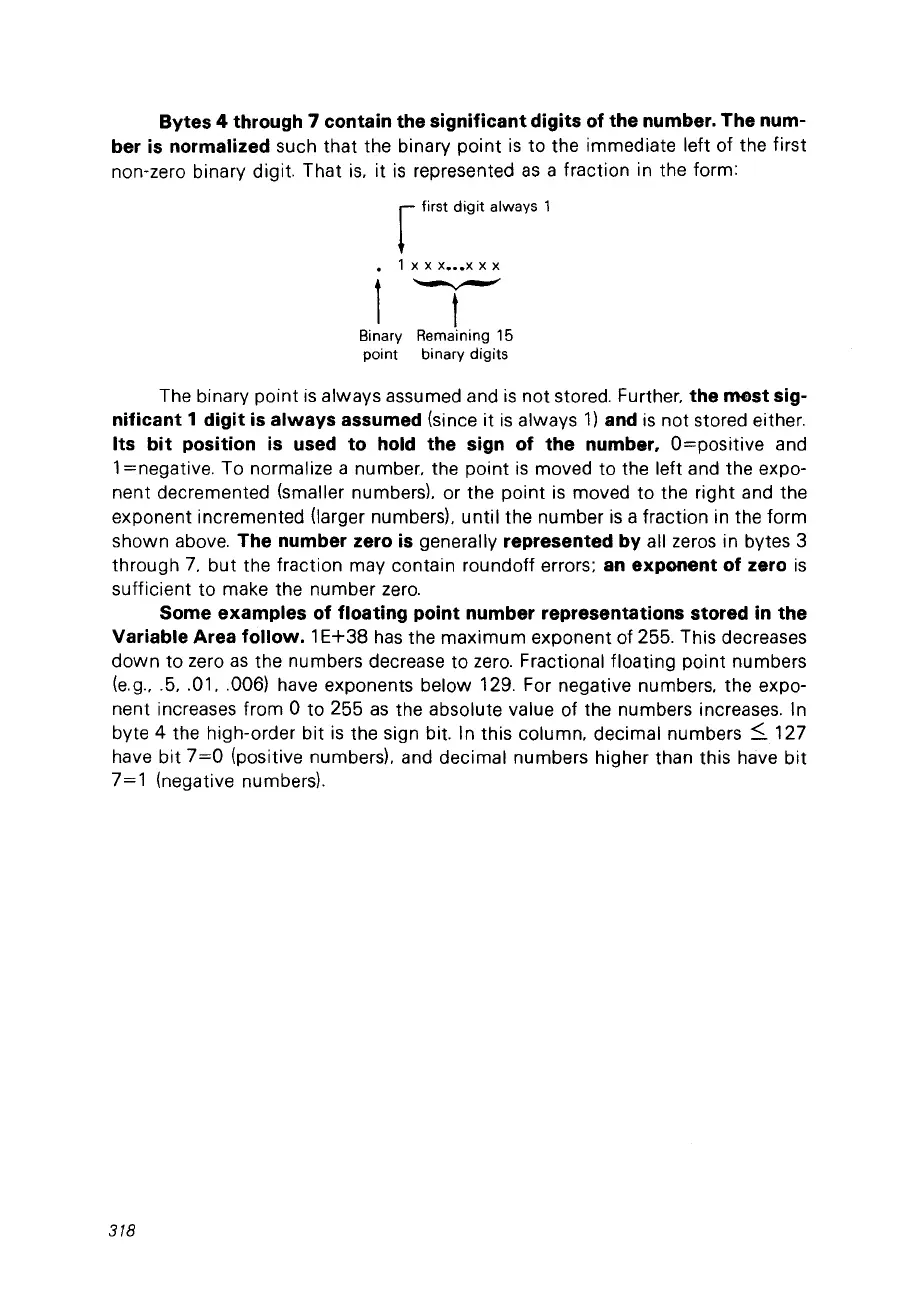
Bytes 4 through 7 contain the significant digits of the number. The num-
ber
is
normalized such that the binary
point
is
to the immediate left of the first
non-zero binary digit. That
is.
it
is
represented
as
a fraction in the form:
rfirst
digit
always 1
1 x x x•••x x x
l T
Binary Remaining 15
point binary digits
The binary
point
is
always assumed and
is
not
stored. Further. the mest sig-
nificant 1 digit
is
always assumed (since
it
is
always
1)
and
is
not
stored either.
Its bit position
is
used to hold the sign of the number, O=positive and
1=negative. To normalize a number. the point
is
moved to the left and the expo-
nent decremented (smaller numbersl. or the
point
is
moved to the right and the
exponent incremented (Iarger numbersl. until the number
is
a fraction in the form
shawn above.
The number zero
is
generally represented by ail zeros in bytes 3
through
7,
but
the fraction may contain roundoff errors;
an
exponent of zero
is
sufficient ta make the number
zero.
Some examples of floating point number representations stored
in
the
Variable Area follow.
1
E+38
has
the maximum exponent of 255. This decreases
down
ta zero
as
the numbers decrease to
zero.
Fractional floating point numbers
(e.g
...
5
..
01, .006) have exponents below 129. For negative numbers. the expo-
nent increases from 0 ta 255
as
the absolute value of the numbers increases. In
byte 4 the high-order
bit
is
the sign bit. In this column. decimal numbers < 127
have
bit
7=0
(positive numbersl. and decimal numbers higher than this have
bit
7=1 (negative numbers).
318



 To Next Page