Byte: 3 4
Number
32767 127
255 (256-127+255 = 32767)
32766
127 254
14000 54 176
256 1
0
255
0
255
1
0
1
-1
255 255 (FFFF16)+ 1 = 1
-2
255 254
-32766
128 2
-32767
1281
1
String
Variable
Format
Byte:
2
3 4
5 6
7
1st
2nd
Char
char
char
+128
count
High
or 128
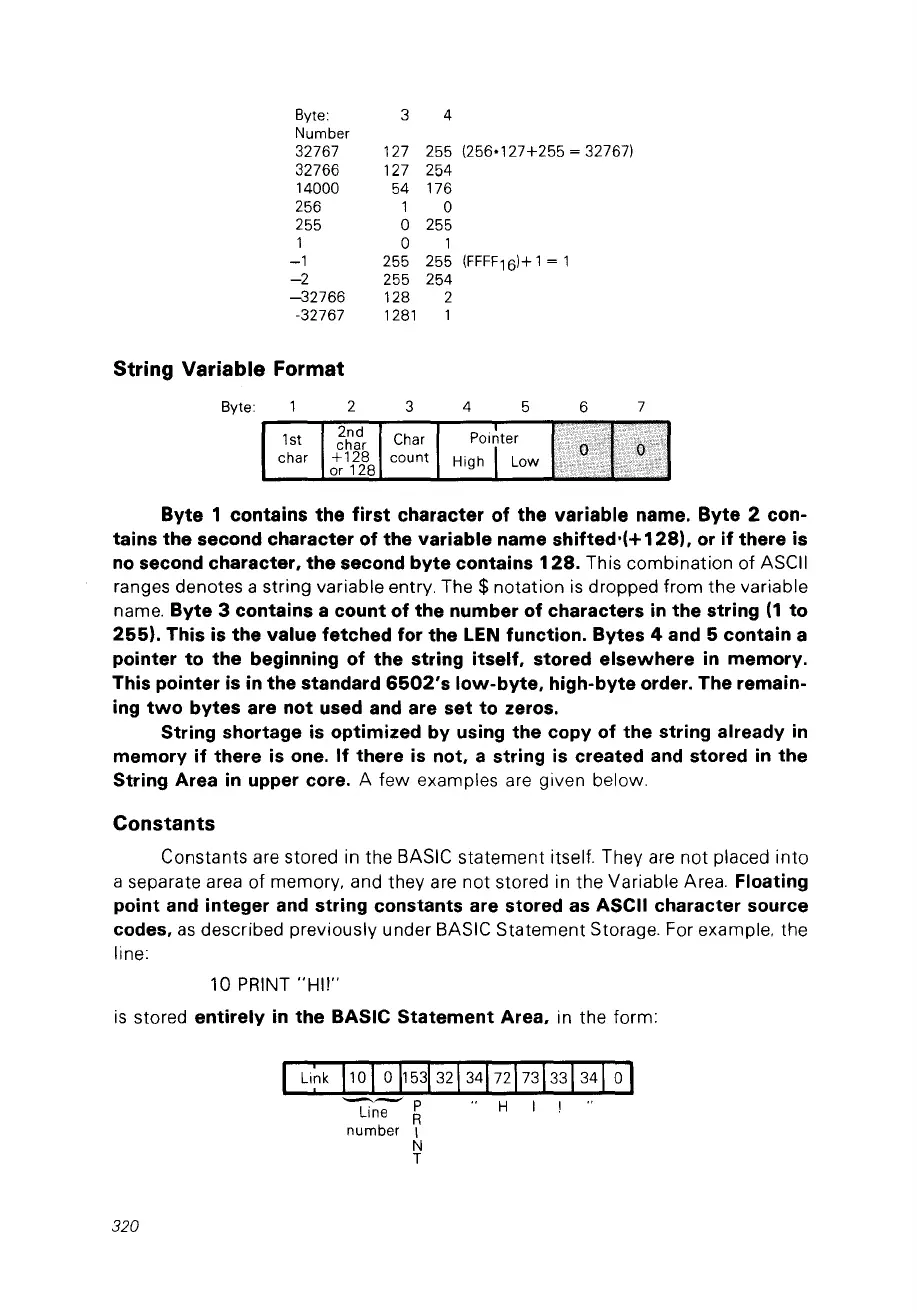
Byte 1 contains the first character of the variable name. Byte 2 con-
tains the second character of the variable name
shifted'(+128),
or
if
there is
no
second character, the second byte contains
128.
This combination of ASCII
ranges denotes a string variable entry. The
$ notation
is
dropped from the variable
name.
Byte 3 contains a count of the number of characters
in
the string
(1
to
255).
This is the value fetched for the
LEN
function. Bytes 4 and 5 contain a
pointer to the beginning of the string itself, stored elsewhere
in
memory.
This pointer is
in
the standard
6502's
low-byte,
high-byte order. The remain-
ing
two
bytes are not used and are set to zeros.
String shortage
is
optimized by using the copy of the string already
in
memory
if
there
is
one.
If
there
is
not, a string
is
created
and
stored
in
the
String Area
in
upper core. A few examples are given below.
Constants
Constants are stored in the BASIC statement itself. They are not placed
into
a separate area of memory. and they are not stored in the Variable Area. Floating
point and integer
and
string constants are stored as ASCII character source
codes,
as
described previously under BASIC Statement Storage. For example. the
line:
10 PRINT
"HI!"
is
stored entirely
in
the BASIC
Statement
Area, in the form:
320



 To Next Page