Only one line number
is
needed for multiple statements placed
on
one
line.
ln immediate mode.
Vou
must
put
multiple
statements on one line. If vou at-
tempted
to
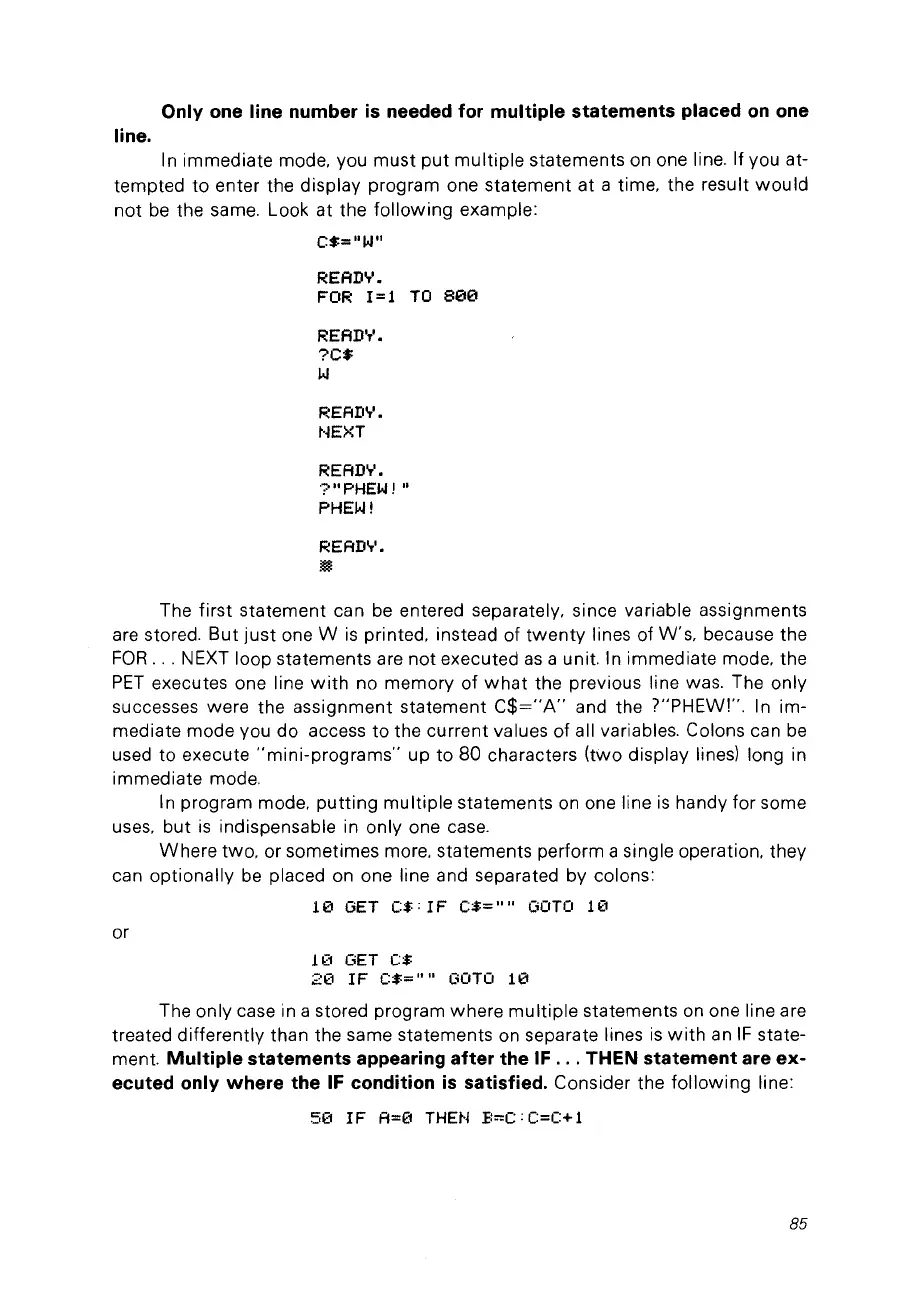
enter the display program one statement at a time, the result
would
not
be
the
sa
me.
Look at the
following
example:
C$="W"
READ'T'.
FOR
1=1
TO
800
READ'T'.
?C$
W
READ'T'.
HEXT
READY.
?"PHEWJ"
PHEWI
READ'T'.
~
The first statement can
be
entered separately. since variable assignments
are stored.
But
just
one W
is
printed, instead of
twenty
lines of W·s. because the
FOR. , . NEXT loop statements are
not
executed
as
a unit. In immediate mode. the
PET
executes one line
with
no memory of
what
the previous line was, The only
successes were the assignment statement
C$="A"
and the ?"PHEW''', ln im-
mediate mode vou do access
to
the current values of ail variables. Colons can
be
used to execute
"mini-programs"
up
to
80 characters
(two
display lines) long in
immediate mode,
ln program mode,
putting
multiple statements
on
one line
is
handy for some
uses.
but
is
indispensable in only one case.
Where
two. or sometimes more. statements perform a single operation. they
can optionally
be
placed on one line and separated by colons:
10
GET
(:$;
1F
(:$=""
GOTO
11'::1
or
11'::1
GET
(:$
20
IF
(:$=""
GOTO
10
The only case in a stored program where
multiple
statements on one line are
treated differently than the same statements on separate lines
is
with
an
IF
state-
ment.
Multiple statements appearing
after
the
IF
...
TH
EN
statement are
ex-
ecuted only where the
IF
condition
is
satisfied. Consider the
following
line:
50
IF
A=0
THEN
B=(:;(:=C+l
85



 To Next Page