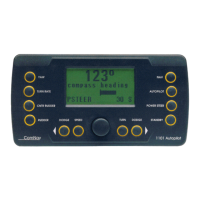
ComNav 1101 Autopilot2 - 2 HOW AUTOPILOTS WORK
The actual heading is fed electronically from the Compass to the Pro-
cessor, which is the heart of the Autopilot. The Processor contains
the microprocessors, electronic hardware and sophisticated control
software necessary to steer the boat.
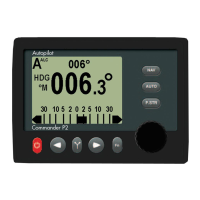
The Control Head, normally located in the wheelhouse, is the inter-
face between the user (that’s you) and the Autopilot. The Control
Head displays information about what the Autopilot is doing. It has
various controls (buttons or knobs) which allow the user to give com-
mands to the Autopilot.
The final part of the picture is the steering system.
In order for the
Autopilot to steer the boat, there must be some sort of steering actua-
tor capable of moving the rudder independently of the ship’s wheel.
This might be a hydraulic steering ram which acts on the tiller or an
electric motor connected to the steering cables. Electronic signals
from the Processor signal the Steering Actuator to move the rudder.
Your Autopilot also will have a Rudder Feedback, a device which tells
the Processor what position the rudder is in at any given time.
Basic Operation
Say, for example, the Autopilot was steering your boat northwest and
you wished to change direction to northeast. To initiate the turn you
would turn the knob on the Control Head to set the desired heading to
45
0
(i.e. northeast). The Processor would compare this to the boat’s
actual heading of 315
0
(northwest), as indicated by the Compass, and
calculate a difference of 90
0
. This in turn would cause the Processor
to send a signal to the steering system to move the Rudder to star-
board so that the boat turns to the right. The Processor verifies that
the Rudder has moved by reading its position from the Rudder Feed-
back.
As the boat turns, the difference between the desired heading and the
actual heading gets smaller and the Processor starts to ‘back off” the
rudder so that the boat does not overshoot the desired heading. Even-
tually, the actual heading will match the desired heading. The Proces-
sor will keep steering the boat on a heading of 45
0
, plus or minus 1/2
0
,
until new instructions are received from the Control Head.
Figure 2 shows a vessel turning in AUTOPILOT mode.
Your ComNav Autopilot maintains a desired heading when it is in
AUTOPILOT mode. When the user first selects AUTOPILOT mode, the
Autopilot will use the current actual heading as the desired heading.
This important feature prevents the Autopilot from executing an unex-
pected turn when you first select AUTOPILOT mode.


 To Next Page